- A 25-year-old housewife complains of head-
aches of 4 months’ duration. She is obese and
has bilateral papilledema, and her vision is de-
teriorating. Her opening cerebrospinal fluid
(CSF) pressure is elevated; other CSF findings
are normal. Computed tomography (CT) and
magnetic resonance imaging (MM) scans are
normal. These signs are due to impairment of
CSF egress. Obstruction at which of the fol-
lowing loci is most likely?
(A) Arachnoid villi
(B) Cerebral aqueduct
(C) Foramen of Luschka
(D) Foramen of Magendie
(E) Foramen of Monro
1-A. This condition, called pseudotumor cerebri (benign intracranial hypertension), is seen pri-
marily in young obese women. Impaired absorptive function of the arachnoid villi is thought to
be the cause.
- All of the following statements concerning
the arachnoid granulations are correct EX-
CEPT
(A) they are found along the superior sagittal
sinus
(B) they project into the dural venous sinuses
(C) they play a role in the absorption of cere-
brospinal fluid (CSF)
(D) they produce CSF
(E) they consist of arachnoid villi
2-D. Arachnoid granulations are tufts of pia-arachnoid tissue that extends into the venous la-
 cunae or directly into the venous dural sinuses. Microscopically, they are arachnoid villi and are
 prominent along the superior sagittal sinus. They play a major role in the absorption of cere-
 brospinal fluid (CSF).
- All of the following statements concerning
the dura mater are correct EXCEPT
(A) it forms the periosteum of the vertebral
canal
(B) it forms the walls of the venous sinuses
(C) it forms the roof of the pituitary fossa
(D) it is innervated by two cranial nerves
(E) it is continuous with the sclera of the eye-
ball
3-A. The dura mater forms the walls of the venous sinuses and the diaphragma sellae, which
form the roof of the hypophyseal fossa. The dura of the anterior and middle cranial fossae is in-
nervated by the ophthalmic and maxillary divisions of the trigeminal nerve (CN V). The in-
fratentorial dura of the posterior cranial fossa is innervated by the vagal nerve (CN X) and the
meningeal branches of the upper cervical spinal nerves. The spinal dura consists of one layer, the
meningeal dura; it does not form the periosteum of the vertebrae. The dura is continuous with
the sclera; it forms the outer connective tissue layer of the optic nerve (CN II).
- All of the following statements concerning
the cranial epidural space are correct EXCEPT
(A) it contains a branch of the facial artery
(B) it contains meningeal veins
(C) it usually is associated with arterial hem-
orrhage
(D) it is bounded by two layers of dura
(E) it is normally a potential space
4-A. The cranial epidural space is actually a potential intradural space that is created only after
trauma and hemorrhage. Epidural hematomas are arterial hemorrhages. The cranial epidural
space lies between the periosteal and meningeal dural layers. Meningeal arteries and veins are
found in this space.
- All of the following statements concerning
the subarachnoid space are correct EXCEPT
(A) it communicates via the foramina of
Luschka with the fourth ventricle
(B) it is found between the arachnoid and the
pia mater
(C) it extends, in the adult, from the conus
medullaris to S2
(D) it is lined with ependymal cells
(E) it communicates via the median foramen
of Magendie with the fourth ventricle
5-D. The subarachnoid space is found between the arachnoid and the pia. It extends in the adult
from the conus medullaris to S2. The subarachnoid space is lined with leptomeningeal (mesothe-
lial) cells. The subarachnoid space communicates via the foramina of Luschka and the median
foramen of Magendie with the fourth ventricle. Ependymal cells line the ventricles.
- All of the following statements concerning
meningiomas are correct EXCEPT
(A) they are derived from arachnoid cells
(B) they are characterized by cellular whorls
and psammoma bodies
(C) they are more frequent in males
(D) they are benign, slow-growing, well-
circumscribed tumors
(E) they comprise approximately 20% of pri-
mary intracranial tumors
6-C. Meningiomas occur more frequently in women (60%) than in men.
- Cerebrospinal fluid (CSF) enters the sub-
arachnoid space via which of the following
structures?
(A) Arachnoid villi
(B) Cerebral aqueduct
(C) Intraventricular foramina of Monro
(D) Lateral foramina of Luschka
(E) Third ventricle
7-D. Cerebrospinal fluid (CSF) enters the subarachnoid space via the outlet foramina of the
 fourth ventricle (foramina of Luschka and foramen of Magendie).
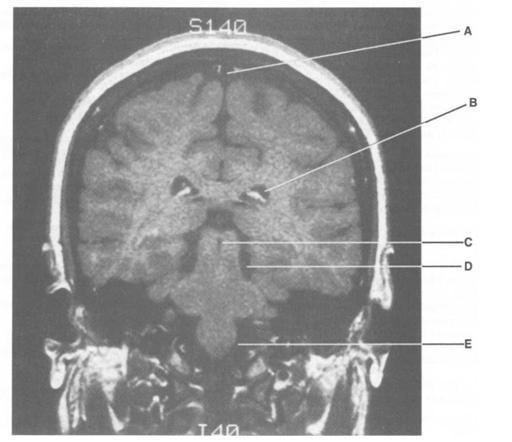
MAtch each letter with the appropriate T1-weighted MRI below
- Olive
- It contains the trochlear nerve (CN IV)
- Its stenosis results in hydrocephalus
- Contains a calcified glomus
- Receives cerebrospinal fluid (CSF) from
the arachnoid villi
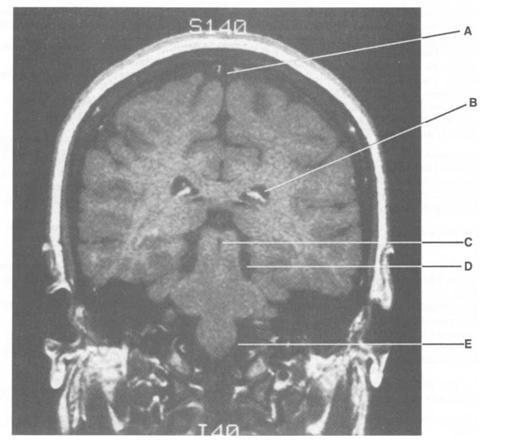
8-E. The olive is a prominent surface structure of the medulla.
9-D. The ambient cistern contains the trochlear nerve (CN IV).
10-C. Stenosis of the cerebral aqueduct prevents cerebrospinal fluid (CSF) from entering the
fourth ventricle; this results in a noncommunicating hydrocephalus.
11-B. The trigone of the lateral ventricle contains a large tuft of choroid plexus called the glo-
mus. It is usually calcified and highly visible in computed tomography (CT) images.
12-A. The superior sagittal sinus receives cerebrospinal fluid (CSF) via the arachnoid villi.
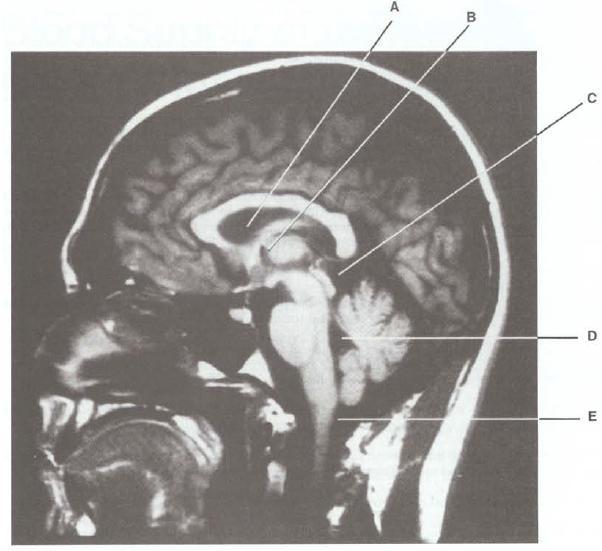
Match with T-1 MRI
- Superior cistern
- Blockage results in hydrocephalus
- Lateral ventricle
- Contains the two foramina of Luschka
- Receives cerebrospinal fluid (CSF) via the
foramen of Magendie
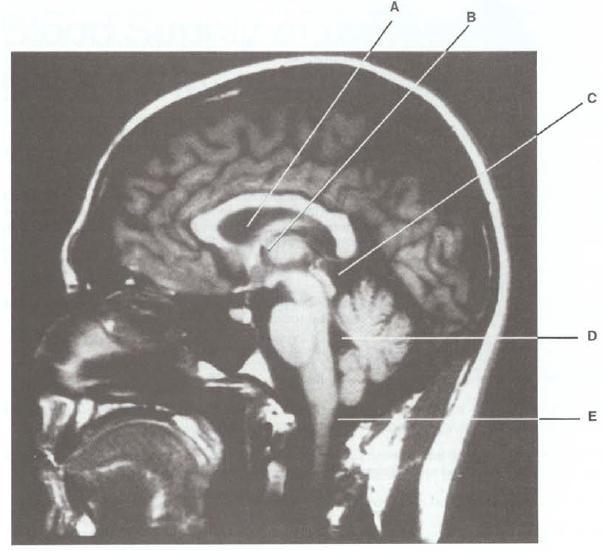
13-C. The superior (quadrigeminal) cistern overlies the dorsal aspect of the midbrain.
14-B. Blockage of the interventricular foramen of Monro (e.g., due to a colloid cyst of the third
ventricle) results in hydrocephalus involving the lateral ventricle.
15-A. The lateral ventricle is seen between the corpus callosum and the fornix.
16-D. The fourth ventricle contains the two foramina of Luschka that drain into the two cere-
bellopontine angle cisterns.
17-E. The cerebellomedullary cistern receives cerebrospinal fluid (CSF) via the foramen of Ma-
gendie.

-
CHAPTER 514
-
CHAPTER 69
-
CHAPTER 718
-
CHAPTER 826
-
CHAPTER 17
-
CHAPTER 29
-
CHAPTER 39
-
CHAPTER 410
-
CHAPTER 917
-
CHAPTER 1326
-
CHAPTER 1012
-
CHAPTER 1111
-
CHAPTER 1221
-
CHAPTER 1743
-
CHAPTER 1824
-
CHAPTER 1927
-
CHAPTER 2020
-
neuroanatomy 3rd Comprehensive Examination 1 - 5050
-
CHAPTER 1417
-
Chapter 1518
-
CHAPTER 1621
-
neuroanatomy 3rd Comprehensive Examination 51 - 9747
-
neuroanatomy 3rd Comprehensive Examination 98 - 12023
-
neuroanatomy 3rd Comprehensive Examination 121 - 14424
-
neuroanatomy 3rd Comprehensive Examination 145 - 18945
-
CHAPTER 2122
-
CHAPTER 2227
-
CHAPTER 2326
-
CHAPTER 248



