- The ability to recognize an unseen familiar object placed in the hand depends on the in- tegrity of which pathway? (A) Spinospinal tract (B) Dorsal column (C) Dorsal spinocerebellar tract (D) Spino-olivary tract (E) Spinothalamic tract
1- B. The ability to recognize the form and texture of an unseen familiar object is called stereognosis. This is an important function of the dorsal column-medial lemniscus system.
- All of the following statements concerning the corticospinal tracts are correct EXCEPT (A) they arise from lamina V of the cerebral cortex (B) they arise from upper motor neurons (UMNs) (C) they descend through the anterior limb of the internal capsule (D) they undergo a 90% decussation in the caudal medulla (E) they descend through the base of the pons
2- C. The corticospinal tracts arise from upper motor neurons (UMNs) found in lamina V of the cerebral cortex. They descend through the posterior limb of the internal capsule, the middle third of the crus cerebri (basis pedunculi) of the midbrain, and the base of the pons and constitute the medullary pyramids. Ninety percent of the corticospinal fibers decussate in the caudal medulla as the pyramidal decussation.
- Destruction of the ventral horn results in all of the following deficits EXCEPT (A) loss of muscle stretch reflexes (MSRs) (B) loss of muscle bulk (C) flaccid paralysis (D) Babinski sign (E) loss of superficial abdominal reflexes
3- D. Destruction of ventral horn motor neurons results in a lower motor neuron (LMN) lesion and is characterized by flaccid paralysis, muscle atrophy (loss of muscle bulk), and areflexia (loss of muscle stretch and superficial abdominal reflexes). The Babinski sign is not seen in LMN disease.
- All of the following tracts decussate in the ventral white commissure EXCEPT the (A) lateral spinothalamic tract (B) ventral spinocerebellar tract (C) ventral corticospinal tract (D) dorsal spinocerebellar tract (E) ventral spinothalamic tract
4- D. The dorsal spinocerebellar tract is an uncrossed tract.
- The corticospinal tracts receive contribu- tions from all of the following areas EXCEPT the (A) prefrontal cortex (B) premotor cortex (C) motor cortex (D) somatesthetic cortex (E) paracentral lobule
5- A. The corticospinal (pyramidal) tracts receive contributions from the premotor (area 6), motor (area 4), and the sensory or somatesthetic (areas 3, 1, and 2) cortices. They receive approximately one-third of their axons from each of these cortical areas. The paracentral lobule represents a continuation of the motor and somatesthetic cortices onto the medial aspect of the hemisphere. The prefrontal cortex lies rostral to the premotor cortex.
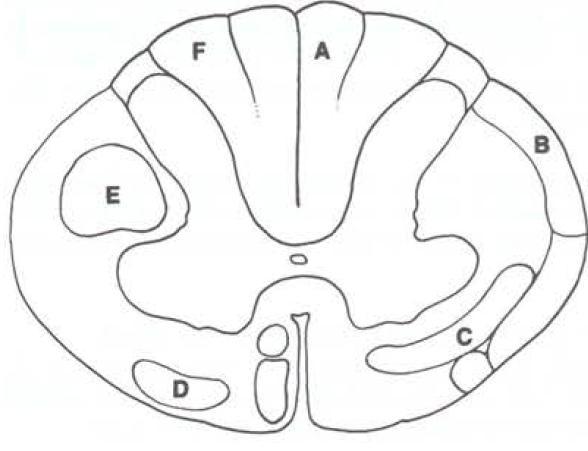
- Contains axons from the giant cells of Deiters (A) Cuneocerebellar tract (B) Cuneate fasciculus (C) Dorsal spinocerebellar tract (D) Lateral corticospinal tract (E) Lateral spinothalamic tract (F) Lissauer tract (G) Vestibulospinal tract
6- G. The vestibulospinal tract arises from the giant cells of Deiters found in the ipsilateral lateral vestibular nucleus of the pons. The vestibulospinal tract facilitates extensor muscle tone.
- Is the upper extremity equivalent of a tract (A) Cuneocerebellar tract (B) Cuneate fasciculus (C) Dorsal spinocerebellar tract (D) Lateral corticospinal tract (E) Lateral spinothalamic tract (F) Lissauer tract (G) Vestibulospinal tract that arises from the cells of Clarke column
7- A. The cuneocerebellar tract is the upper extremity equivalent of the dorsal spinocerebellar tract, which arises from the cells of the Clarke column. The cuneocerebellar tract arises from cells of the accessory cuneate nucleus, a homolog of the nucleus of Clarke.
- Conveys nociceptive input from the contralateral side of the body (A) Cuneocerebellar tract (B) Cuneate fasciculus (C) Dorsal spinocerebellar tract (D) Lateral corticospinal tract (E) Lateral spinothalamic tract (F) Lissauer tract (G) Vestibulospinal tract
8- E. The lateral spinothalamic tract conveys nociceptive input from the contralateral side of the body.
- Contains axons from the giant cells of Betz (A) Cuneocerebellar tract (B) Cuneate fasciculus (C) Dorsal spinocerebellar tract (D) Lateral corticospinal tract (E) Lateral spinothalamic tract (F) Lissauer tract (G) Vestibulospinal tract
9- D. The lateral corticospinal tract contains axons from the giant cells of Betz. The giant pyramidal cells of Betz are found in the precentral gyrus and in the anterior paracentral lobule.
- Contains ipsilateral pain fibers that have their second-order neurons in the dorsal horn (A) Cuneocerebellar tract (B) Cuneate fasciculus (C) Dorsal spinocerebellar tract (D) Lateral corticospinal tract (E) Lateral spinothalamic tract (F) Lissauer tract (G) Vestibulospinal tract
10- F. The dorsolateral tract of Lissauer contains ipsilateral pain fibers that have their second- order neurons in the dorsal horn.
- Projects to the cerebellum via the inferior cerebellar peduncle
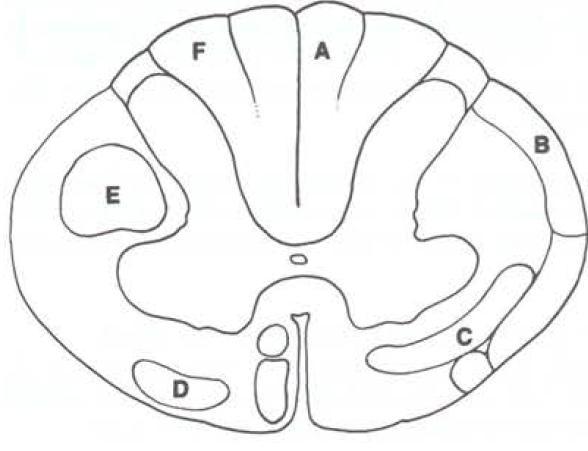
11- B. The dorsal spinocerebellar tract projects unconscious proprioceptive information [muscle spindles and Golgi tendon organs (GTOs)] to the cerebellum via the inferior cerebellar peduncle.
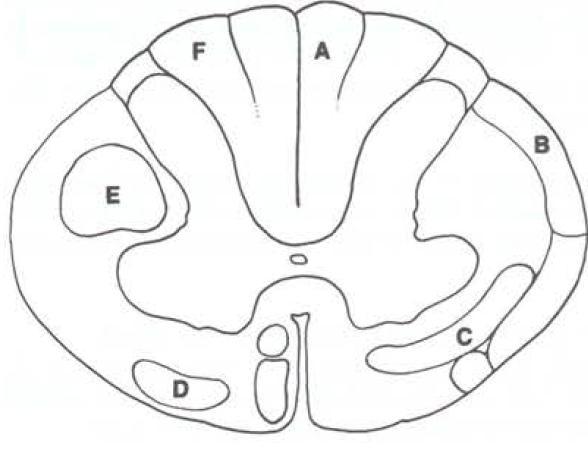
- Mediates pain and temperature sensation
12- C. The lateral spinothalamic tract lies between the ventral spinocerebellar tract and the ventral horn. It mediates pain and temperature sensation.
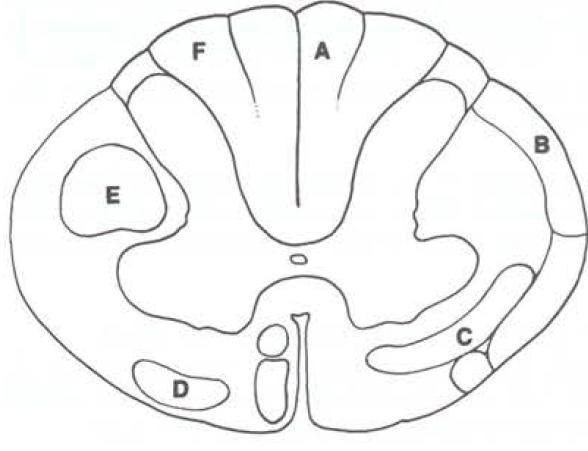
- Cells of origin are found in the precentral gyrus
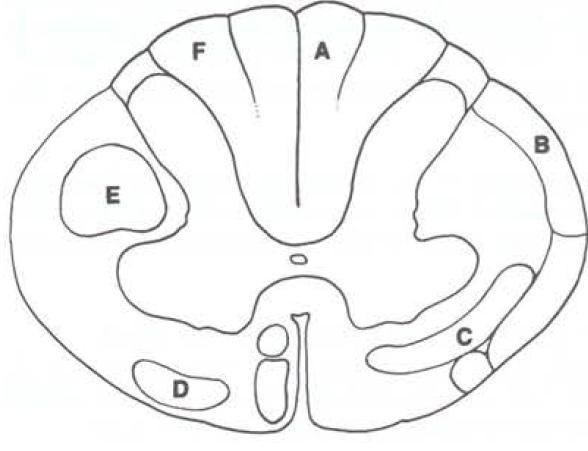
13- E. The lateral corticospinal tract has its cells of origin in the premotor, motor, and sensory cortices. The precentral gyrus and the anterior paracentral lobule are motor cortices and contain the motor homunculus. It gives rise to one-third of the fibers of the corticospinal (pyramidal) tract.
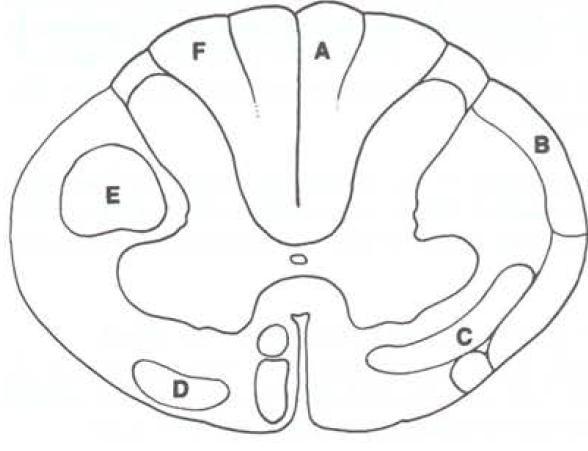
- Mediates two-point tactile discrimination from the hand
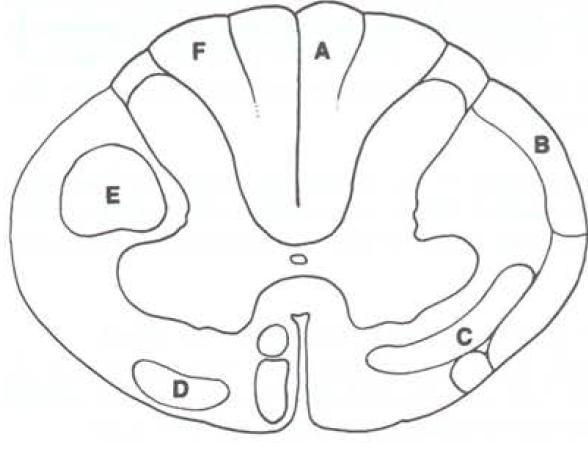
14- F. The fasciculus cuneatus mediates two-point tactile discrimination from the hand.
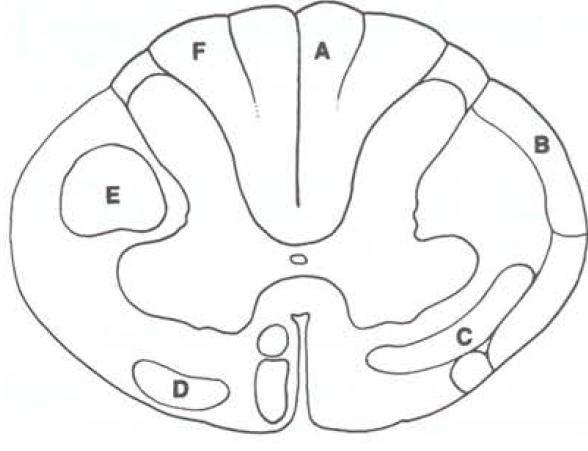
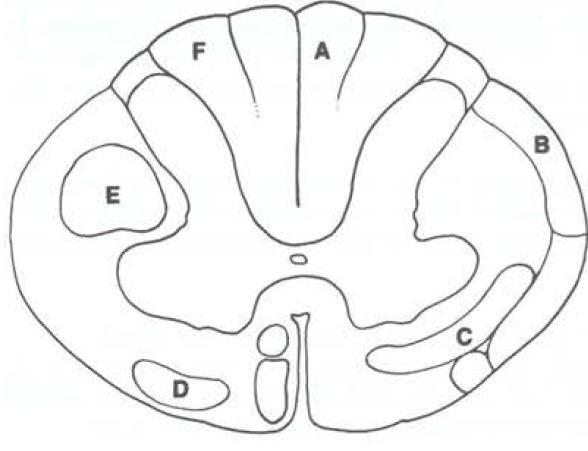
- Myelination is not fully achieved until the end of the second year
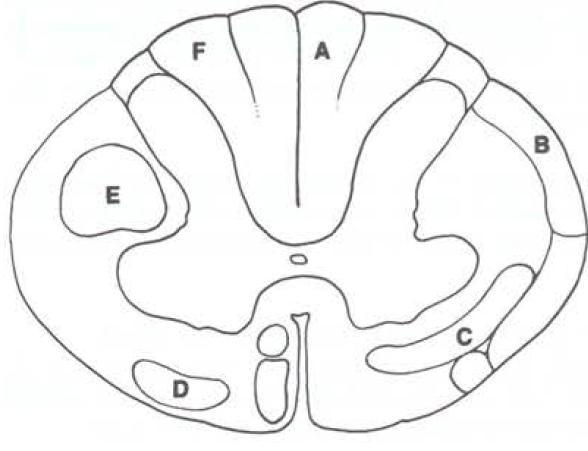
15- E. The corticospinal (pyramidal) tracts are not fully myelinated until the end of the second year. For this reason, the Babinski sign may be elicited in young children.
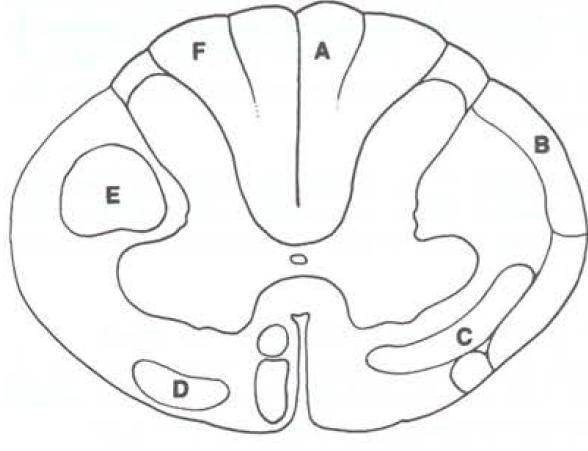
- Transection results in spasticity
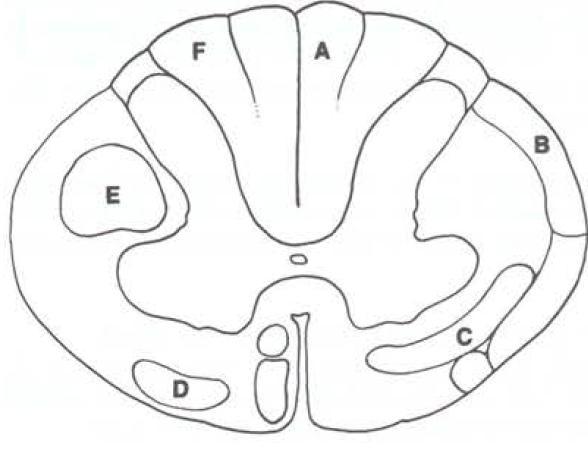
16- E. Transection of the lateral corticospinal tract results in spastic paresis [exaggerated muscle stretch reflexes (MSRs) and clonus].
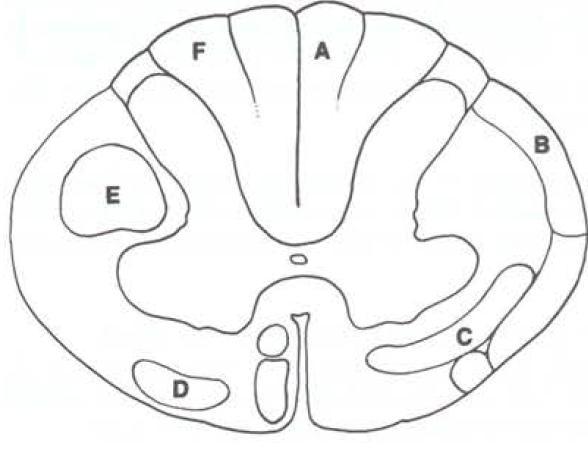
- Plays a role in regulating extensor tone
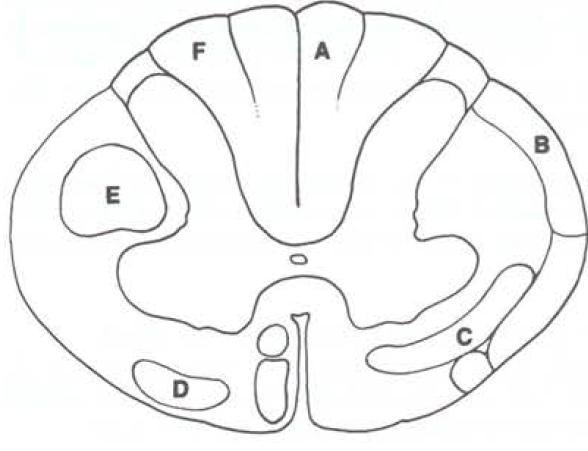
17- D. The vestibulospinal (lateral) tract, found ventral to the ventral horn, plays a role in regulating extensor tone.
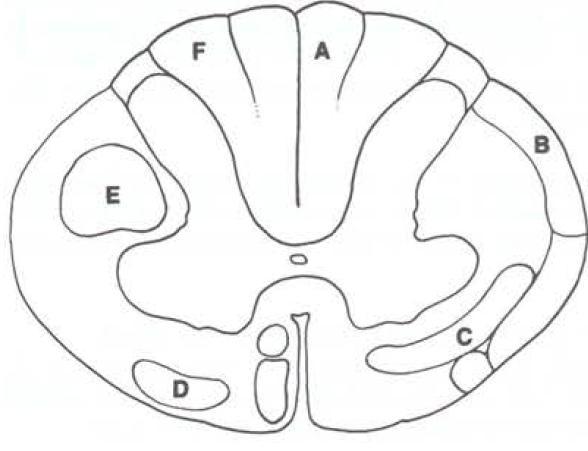
- Transmits vibration sensation from the ankle
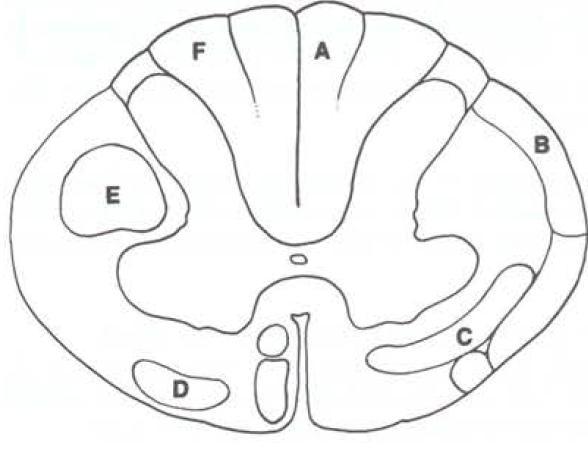
18- A. The fasciculus gracilis transmits vibratory sensation (pallesthesia) from the lower extremities.

-
CHAPTER 514
-
CHAPTER 69
-
CHAPTER 718
-
CHAPTER 826
-
CHAPTER 17
-
CHAPTER 29
-
CHAPTER 39
-
CHAPTER 410
-
CHAPTER 917
-
CHAPTER 1326
-
CHAPTER 1012
-
CHAPTER 1111
-
CHAPTER 1221
-
CHAPTER 1743
-
CHAPTER 1824
-
CHAPTER 1927
-
CHAPTER 2020
-
neuroanatomy 3rd Comprehensive Examination 1 - 5050
-
CHAPTER 1417
-
Chapter 1518
-
CHAPTER 1621
-
neuroanatomy 3rd Comprehensive Examination 51 - 9747
-
neuroanatomy 3rd Comprehensive Examination 98 - 12023
-
neuroanatomy 3rd Comprehensive Examination 121 - 14424
-
neuroanatomy 3rd Comprehensive Examination 145 - 18945
-
CHAPTER 2122
-
CHAPTER 2227
-
CHAPTER 2326
-
CHAPTER 248



