- The neural retina is derived from the
(A) alar plate
(B) choroid
(C) neural crest
(D) neural tube
(E) telencephalic vesicle wall
l-D. The retina is derived from the neural tube, which gives rise to the entire central nervous
system (CNS).
- At birth, the conus medullaris is found at
which vertebral level?
(A) VT12
(B) VL1
(C) VL3
(D) VS1
(E) VS4
2-C. At birth, the conus medullaris extends to VL3, and in the adult it extends to the VL1-VL2
interspace. At 8 weeks, the spinal cord extends the entire length of the vertebral canal.
- Caudal herniation of the cerebellar tonsils
and medulla through the foramen magnum is
called
(A) Dandy-Walker syndrome
(B) Down syndrome
(C) Arnold-Chiari syndrome
(D) cranium bifidum
(E) myeloschisis
3-C. Arnold-Chiari syndrome is a cerebellomedullary malformation in which the inferior vermis
and medulla herniate through the foramen magnum, resulting in communicating hydro-
cephalus. Arnold-Chiari syndrome is frequently associated with spina bifida.
- A newborn has multiple congenital defects
due to dysgenesis of the neural crest. Which of
the following cells would most likely be spared?
(A) Dorsal root ganglion cells
(B) Geniculate ganglion cells
(C) Melanocytes
(D) Motoneurons
(E) Parafollicular cells
4-D. Motoneurons develop from the neural tube, more specifically, from the basal plate. The
other options are derivatives of the neural crest.
- The diencephalon gives rise to all of the fol-
lowing structures EXCEPT the
(A) mamillary bodies
(B) pineal body
(C) subthalamic nucleus
(D) adenohypophysis
(E) neurohypophysis
5-D. The adenohypophysis (pars distalis, pars tuberalis, and pars intermedia) develops from
Rathke pouch, an ectodermal diverticulum of the stomodeum. The neurohypophysis develops
from the infundibulum of the hypothalamus.
- All of the following statements concerning
myelination are correct EXCEPT
(A) it is accomplished by neural crest cells
(B) it is accomplished by Schwann cells in the
peripheral nervous system (PNS)
(C) it is accomplished by oligodendrocytes in
the central nervous system (CNS)
(D) it commences in the fourth fetal month
(E) it is completed by birth
6-E. Myelination is not complete at birth. The corticospinal tracts are not completely myelinated
until the end of the second postnatal year.
- All of the following statements concerning
spina bifida are correct EXCEPT
(A) spina bifida results from failure of verte-
bral arches to fuse
(B) spina bifida is frequently associated with
Arnold-Chiari malformation
(C) spina bifida usually occurs in the cervi-
cothoracic region
(D) spina bifida occulta is the least severe
variation
(E) spina bifida with myeloschisis is the most
severe variation
7-C. Spina bifida usually occurs in the lumbosacral region.
- The neural crest gives rise to all of the fol-
lowing cells EXCEPT
(A) odontoblasts
(B) oligodendrocytes
(C) cells of enteric ganglia
(D) Schwann cells
(E) chromaffin cells
8-B. The neural crest gives rise to dorsal root ganglion cells, the cells of autonomic and enteric
ganglia, Schwann cells, satellite cells, and chromaffin cells of the suprarenal medulla. The neural
crest also gives rise to pigment cells (melanocytes), odontoblasts, meninges, and mesenchyme of
the branchial arches. Oligodendrocytes arise from the glioblasts of the neural tube.
Match the statements in items 9-13 with the appropriate lettered structure shown in the appropriate figure.
- Is derived from the telencephalon
- Gives rise to the choroid plexus
- Is derived from the alar plate
- Gives rise to motor neurons that innervate the tongue
- Gives rise to the solitary nucleus
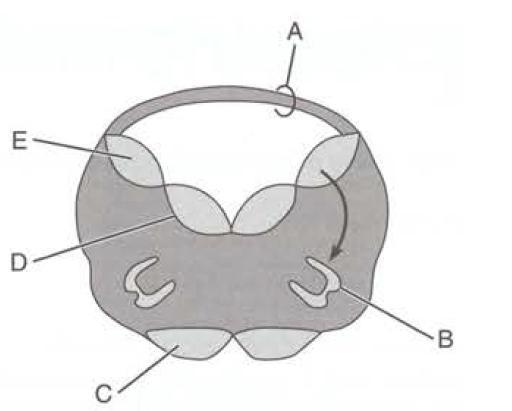
9-C. The corticospinal tract (pyramid) has its origin in the neocortex of the telencephalon.
10-A. The tela choroidea gives rise to the choroid plexus.
11-B. The inferior olivary nucleus is derived from the alar plate of the developing medulla.
12-D. The basal plate gives rise to the hypoglossal nucleus.
13-E. The alar plate gives rise to the solitary nucleus.
Match the statements in items 14-18 with the appropriate lettered structure shown in the figure.
- Innervates the lateral rectus muscle
- Gives rise to a parasympathetic nucleus
- Gives rise to the cerebellum
- Is derived from the alar plate
- Gives rise to motor neurons that migrate into the lateral pontine tegmentum
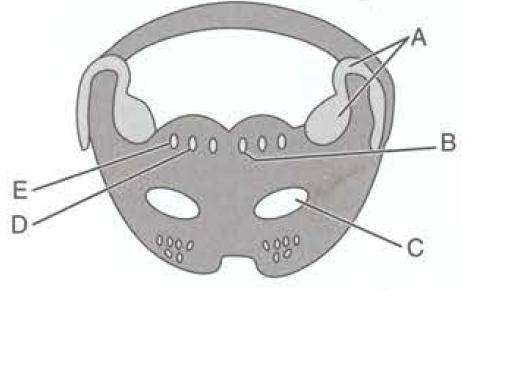
14-B. The general somatic efferent (GSE) column innervates the lateral rectus muscle.
15-E. The general visceral efferent column (GVE) gives rise to the superior salivatory nucleus of CN VII. This parasympathetic nucleus innervates the lacrimal, the sublingual, and the submandibular glands and also the palatine and nasal glands.
16-A. The cerebellum is derived from the alar plate. The alar plate gives rise to the rhombic lip, which becomes the cerebellum.
17-C. The pontine nuclei are derived from the alar plate.
18-D. The special visceral efferent (SVE) column gives rise to motor neurons that migrate into the lateral pontine tegmentum and become the facial nucleus, CN VII.

-
CHAPTER 514
-
CHAPTER 69
-
CHAPTER 718
-
CHAPTER 826
-
CHAPTER 17
-
CHAPTER 29
-
CHAPTER 39
-
CHAPTER 410
-
CHAPTER 917
-
CHAPTER 1326
-
CHAPTER 1012
-
CHAPTER 1111
-
CHAPTER 1221
-
CHAPTER 1743
-
CHAPTER 1824
-
CHAPTER 1927
-
CHAPTER 2020
-
neuroanatomy 3rd Comprehensive Examination 1 - 5050
-
CHAPTER 1417
-
Chapter 1518
-
CHAPTER 1621
-
neuroanatomy 3rd Comprehensive Examination 51 - 9747
-
neuroanatomy 3rd Comprehensive Examination 98 - 12023
-
neuroanatomy 3rd Comprehensive Examination 121 - 14424
-
neuroanatomy 3rd Comprehensive Examination 145 - 18945
-
CHAPTER 2122
-
CHAPTER 2227
-
CHAPTER 2326
-
CHAPTER 248



