- A 50-year-old hypertensive woman com-
plains of numbness and weakness in her left
leg and foot. Occlusion of which of the follow-
ing vessels may account for this complaint?
(A) Anterior choroidal artery
(B) Anterior cerebral artery
(C) Interior carotid artery
(D) Middle cerebral artery
(E) Posterior artery
l-B. The anterior cerebral artery perfuses the paracentral lobule, which represents the motor
and sensory strips of the leg and foot areas.
- A 15-year-old boy is hit on the temple with
a baseball and becomes unconscious. After
about 10 minutes, he regains consciousness,
but he soon becomes lethargic, and over the
next 2 hours, he becomes stuporous. His pupils
are unequal. Intracranial hemorrhage is sus-
pected. Which of the following vessels is most
likely to be the source of the hemorrhage?
(A) Anterior cerebral artery
(B) Anterior communicating artery
(C) Basilar artery
(D) Middle cerebral artery
(E) Middle meningeal artery
2-E. Laceration of the middle meningeal artery gives rise to an epidural hematoma. Classic
signs of an epidural hematoma are skull trauma, usually with fracture, and sequential progres-
sion from unconsciousness to lucidity to progressive coma to death due to transtentorial hernia-
tion with ipsilateral third palsy.
- The optic chiasm is supplied by all of the fol-
lowing arteries EXCEPT the
(A) internal carotid artery
(B) anterior communicating artery
(C) anterior choroidal artery
(D) posterior communicating artery
(E) anterior cerebral artery
3-C. The anterior choroidal artery lies outside of the circle of Willis and does not supply the op-
tic chiasm.
- All of the following statements concerning
the internal carotid artery are correct EX-
CEPT
(A) it enters the skull via the sphenoid bone
(B) it lies within the cavernous sinus
(C) it gives off direct branches to the internal
capsule
(D) it gives rise to the anterior choroidal
artery
(E) it gives rise to the posterior communicat-
ing artery
4-A. The internal carotid artery enters the skull via the carotid canal of the temporal bone.
- The cavernous sinus and its lateral wall
contain all of the following structures EXCEPT
the
(A) carotid siphon
(B) oculomotor, abducent, and trochlear nerves
(C) ophthalmic and maxillary nerves
(D) optic nerve
(E) postganglionic sympathetic fibers
5-D. The cavernous sinus and its lateral wall contain the carotid siphon; the oculomotor (CN
III), abducent (CN VI), and trochlear nerves (CN IV); a sympathetic plexus; and the ophthalmic
and maxillary divisions of the trigeminal nerve (CN V). The optic nerve (CN II) and ophthalmic
artery reach the orbit via the optic canal.
- All of the following statements concerning
the middle meningeal artery are correct EX-
CEPT
(A) it is usually a branch of the maxillary
artery
(B) it enters the cranium through the fora-
men spinosum
(C) laceration results in epidural hemorrhage
(D) it supplies most of the dura of the calvar-
ium
(E) it supplies the dura of the posterior cranial fossa
6-E. The middle meningeal artery usually is a branch of the maxillary artery, which enters the
cranium via the foramen spinosum and supplies most of the dura of the calvarium. Laceration
of this artery leads to epidural hemorrhage (hematoma). The artery and its accompanying dural
veins lie between the periosteal and meningeal layers of the dura. The dura of the posterior fossa
is supplied by branches of the ascending pharyngeal, vertebral, and occipital arteries (posterior
meningeal arteries).
Questions 7-11
The response options for items 7—11 are the
same. You will be required to select one answer
for each item in the set.
(A) Posterior cerebral artery
(B) Superior cerebellar artery
(C) Anterior inferior cerebellar artery
(D) Posterior inferior cerebellar artery
(E) Anterior spinal artery
Match each of the following descriptions with
the most appropriate artery.
- Usually gives rise to the artery that supplies the inner ear
- Supplies the facial nucleus and the spinal
trigeminal nucleus and tract - Is the terminal branch of the basilar artery
- Supplies the deep cerebellar nuclei
- Supplies the nucleus ambiguus
7-C. The anterior inferior cerebellar artery usually gives rise to the labyrinthine artery, which
supplies the structures of the inner ear (i.e., the cochlea and vestibular apparatus).
8-C. The facial nucleus and the spinal trigeminal nucleus and tract are supplied by the anterior
inferior cerebellar artery.
9-A. The posterior cerebral artery is the terminal branch of the basilar artery.
10-B. The superior cerebellar artery supplies the superior surface of the cerebellum and the
cerebellar nuclei (dentate nucleus).
11-D. The posterior inferior cerebellar artery supplies the dorsolateral medullary field, includ-
ing the nucleus ambiguus.
Questions 12-16
Match the statements in items 12—16 with the
appropriate lettered artery shown in the figure
- An aneurysm of this artery may cause a
third nerve palsy - Irrigates the posterior limb of the internal
capsule - Occlusion of this artery results in a fluent
receptive aphasia - An aneurysm of this artery may result in
Horner syndrome - Occlusion of this artery results in infarc-
tion of the paracentral lobule with Babinski
sign
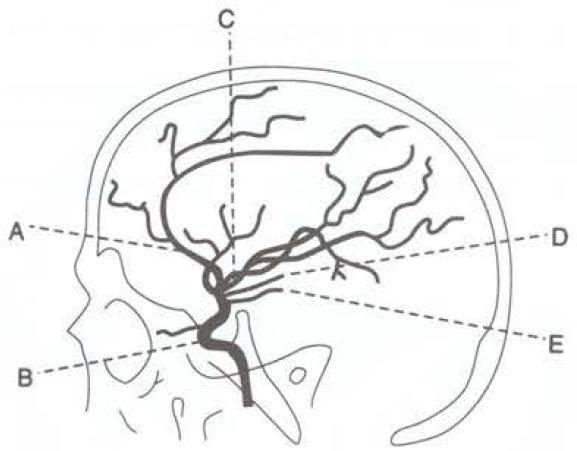
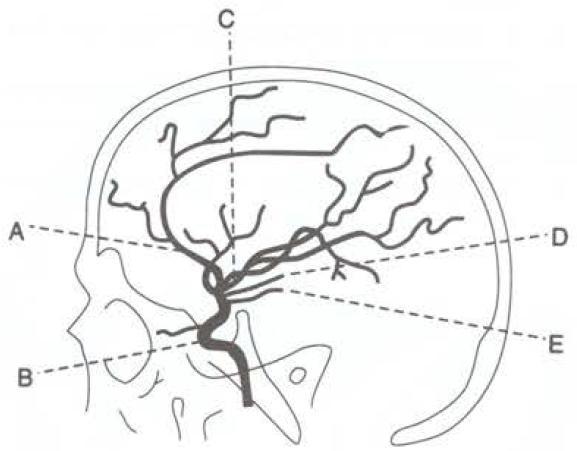
12-E. An aneurysm of the posterior communicating artery may cause a third nerve palsy.
13-D. The anterior choroidal artery irrigates the posterior limb of the internal capsule.
14-C. Occlusion of the proximal stem of the left middle cerebral artery results in Wernicke apha-
sia, a fluent receptive aphasia.
15-B. An aneurysm of the internal carotid artery within the cavernous sinus can interrupt post-
ganglionic sympathetic fibers, resulting in Horner syndrome.
16-A. The anterior cerebral artery perfuses the mesial aspect of the hemisphere from the frontal
pole to the parieto-occipital sulcus, including the paracentral lobule. The paracentral lobule gives
rise to corticospinal fibers to the contralateral foot and leg. Destruction of these fibers results in
the Babinski sign.
Questions 17-23
Match the statements in items 17—23 with the
appropriate lettered artery shown in the figure.
- Thrombosis may result in an abducent palsy
- Drains the deep cerebral veins
- Marks the site of the foramen of Monro
- Receives the arachnoid granulations
- Receives blood from the ophthalmic veins
- Laceration results in subdural hemorrhage
- Receives blood from the straight, sagittal,
superior, and transverse sinuses
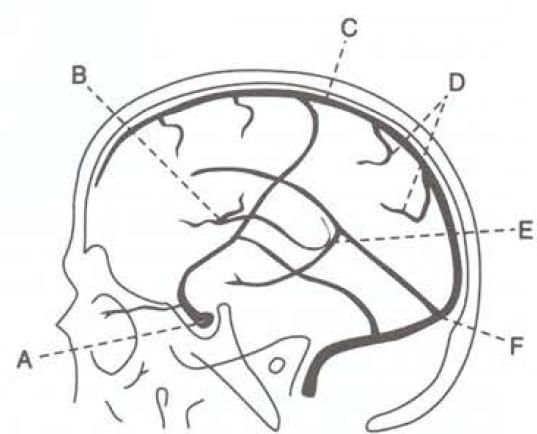
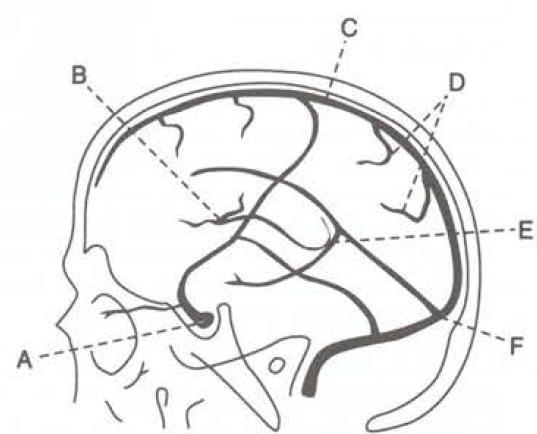
17-A. Cavernous sinus thrombosis may result in cranial nerve palsies, including CN III, CN IV,
CN VI, CN V-l, and CN V-2.
18-E. The great cerebral vein of Galen drains the deep cerebral veins that drain the thalamus
and basal ganglia. The vein of Galen empties into the straight sinus.
19-B. The venous angle marks the site of the interventricular foramen of Monro; it is the point
where the septal and thalamostriate veins meet.
20-C. The superior sagittal sinus receives cerebrospinal fluid (CSF) via the arachnoid granula-
tions.
21-A. The inferior and superior ophthalmic veins drain into the cavernous sinus.
22-D. Laceration of the superior cerebral veins (bridging veins) results in subdural hemorrhage
(hematoma).
23-F. The confluence of the sinuses (torcular Herophili) receives blood from the straight, sagit-
tal, superior, and transverse sinuses.

-
CHAPTER 514
-
CHAPTER 69
-
CHAPTER 718
-
CHAPTER 826
-
CHAPTER 17
-
CHAPTER 29
-
CHAPTER 39
-
CHAPTER 410
-
CHAPTER 917
-
CHAPTER 1326
-
CHAPTER 1012
-
CHAPTER 1111
-
CHAPTER 1221
-
CHAPTER 1743
-
CHAPTER 1824
-
CHAPTER 1927
-
CHAPTER 2020
-
neuroanatomy 3rd Comprehensive Examination 1 - 5050
-
CHAPTER 1417
-
Chapter 1518
-
CHAPTER 1621
-
neuroanatomy 3rd Comprehensive Examination 51 - 9747
-
neuroanatomy 3rd Comprehensive Examination 98 - 12023
-
neuroanatomy 3rd Comprehensive Examination 121 - 14424
-
neuroanatomy 3rd Comprehensive Examination 145 - 18945
-
CHAPTER 2122
-
CHAPTER 2227
-
CHAPTER 2326
-
CHAPTER 248



