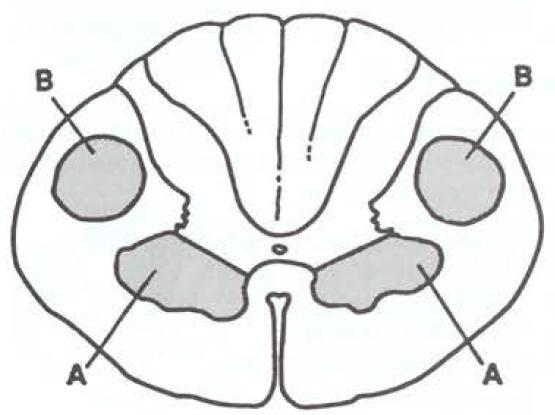
Neuropathologic examination of the spinal
cord reveals two lesions labeled A and B. Lesion A is restricted to five segments.
- The result of lesion A is best described as
(A) bilateral arm dystaxia with dysdiado-chokinesia
(B) spastic paresis of the legs
(C) flaccid paralysis of the upper extremities
(D) loss of pain and temperature sensation
below the lesion
(E) urinary and fecal incontinence
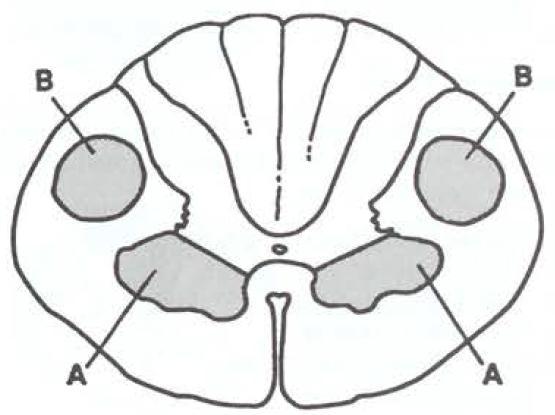
1- C. Lesion A involves degeneration of the ventral horns bilaterally at midcervical levels, re-
sulting in flaccid paralysis in the upper extremities.
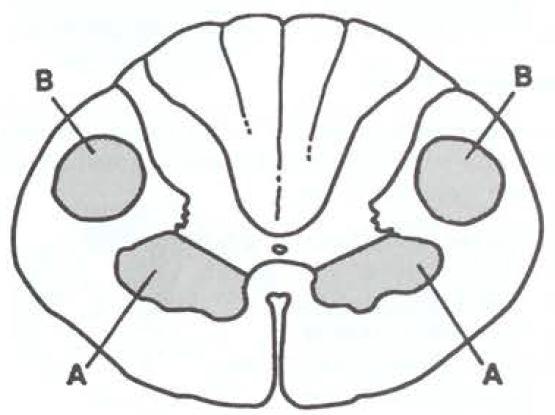
- The result of lesion B is best described as
(A) dyssynergia of movements affecting both
arms and legs
(B) flaccid paralysis of the upper extremities
(C) impaired two-point tactile discrimination
in both arms
(D) spastic paresis affecting primarily the
muscles distal to the knee joint
(E) bilateral appallesthesia
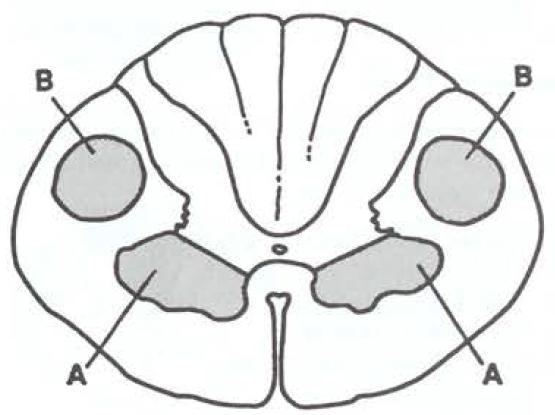
2- D. Lesion B involves degeneration of the lateral corticospinal tracts bilaterally, resulting in
spastic paresis of the lower extremities and primarily affecting the muscles distal to the knee.
Spastic paresis of the upper extremities is masked by flaccid paralysis resulting from lesion A.
Apallesthesia is the inability to perceive a vibrating tuning fork.
- Lesions A and B result from
(A) an intramedullary tumor
(B) an extramedullary tumor
(C) thrombosis of a spinal artery
(D) multiple sclerosis
(E) amyotrophic lateral sclerosis (ALS)
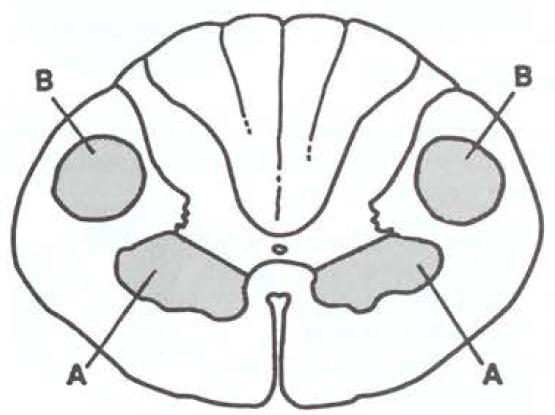
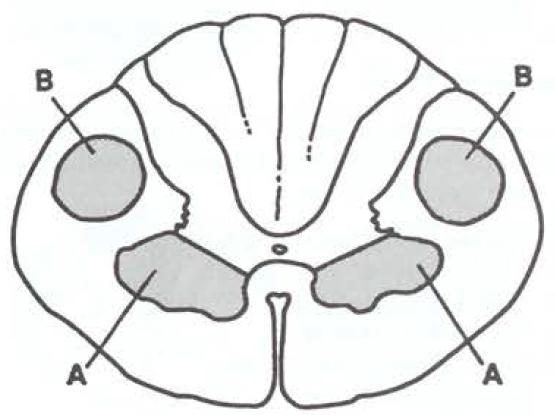
3- E. Lesions A and B are the result of amyotrophic lateral sclerosis (ALS), a pure motor disease
- Neurologic examination reveals an extensor
plantar reflex on the left side, hyperreflexia on
the left side, a loss of pain and temperature
sensation on the right side, and ptosis and mio-
sis on the left side. A lesion that causes this
constellation of deficits would most likely be
found in the
(A) paracentral lobule, left side
(B) crus cerebri, right side
(C) dorsolateral medulla, left side
(D) cervical spinal cord
(E) lumbar spinal cord
4- D. A lesion of the cervical spinal cord could result in ipsilateral Horner syndrome, ipsilateral
spastic paresis, and contralateral loss of pain and temperature sensation. Horner syndrome is
always manifested on the ipsilateral side. This lesion represents a classic Brown-Sequard syn-
drome.
- A 50-year-old woman complains of clumsi-
ness in her hands while working in the
kitchen; she recently burnt her hands on the
stove without experiencing any pain. Neuro-
logic examination reveals bilateral weakness
of the shoulder girdles, arms, and hands, as
well as a loss of pain and temperature sensa-
tion covering the shoulder and upper extrem-
ity in a cape-like distribution. Severe atrophy
is present in the intrinsic muscles of the hands.
The most likely diagnosis is
(A) amyotrophic lateral sclerosis (ALS)
(B) subacute combined degeneration
(C) Werdnig-Hoffmann disease
(D) syringomyelia
(E) tabes dorsalis
5- D. Syringomyelia is a cavitation of the spinal cord most commonly seen in the cervicothoracic
segments. This condition results in bilateral loss of pain and temperature sensation in a cape-
like distribution as well as wasting of the intrinsic muscles of the hands. Amyotrophic lateral
sclerosis (ALS) is a pure motor syndrome, subacute combined degeneration includes both sen-
sory and motor deficits, Werdnig-Hoffmann disease is a pure motor disease, and tabes dorsalis
is a pure sensory syndrome (neurosyphilis).
- A 50-year-old man has a 2-year history of
progressive muscle weakness in all extremi-
ties, with severe muscle atrophy and reduced
muscle stretch reflexes (MSRs) in both legs. In
his arms, the muscle atrophy is less pro-
nounced and the MSRs are exaggerated. Post-
mortem examination would most likely show
which of the following areas of neuronal de-
generation?
(A) Loss of Purkinje cells
(B) Loss of neurons from the globus pallidus
(C) Loss of neurons from the paracentral lob-
ule and from the anterior horns of the
spinal cord
(D) Demyelination of axons in the posterior
and lateral columns
(E) Demyelination of axons in the posterior
limb of the internal capsule
6- C. Amyotrophic lateral sclerosis (ALS) affects both the upper and lower motor neurons. It is
also referred to as motor systems disease. A loss of Purkinje cells as seen in cerebellar cortical
atrophy (cerebello-olivary atrophy) results in cerebellar signs. Cell loss in the globus pallidus and putamen is seen in Wilson disease (hepatolenticular degeneration). Demyelination of axons in
the posterior and lateral columns is seen in subacute combined degeneration. Demyelination of
axons in the posterior limb of the internal capsule results in contralateral spastic hemiparesis.
- All of the following statements concerning
syringomyelia are correct EXCEPT
(A) it is a central cavitation of the spinal cord
(B) it usually is found at lumbosacral levels
(C) it usually includes a lower motor neuron
(LMN) lesion
(D) it usually results in a bilateral loss of pain
and temperature sensation
(E) it may result in Horner syndrome
7- B. Syringomyelia is a central cavitation of the cervical spinal cord and is of unknown etiology.
Expansion of the syrinx typically affects the ventral white commissure, interrupting the decus-
sating fibers of the spinothalamic tracts and resulting in a bilateral loss of pain and temperature sensation at the level of involvement. Lateral extension involves one or both of the ventral horns and results in a lower motor neuron (LMN) lesion with muscle wasting and flaccid paralysis. Caudal extension to (C8) T1-T2 may involve the lateral horn (ciliospinal center of Budge) and produce Horner syndrome.
- Hemisection of the spinal cord at Tl on the
left side results in all of the following signs or
symptoms EXCEPT
(A) plantar response flexor on the left side
(B) loss of vibration sensation in the left leg
(C) leg dystaxia on the right side
(D) exaggerated knee jerk reflex on the left
side
(E) normal pain and temperature sensation
on the left side
8- A. Hemisection of the spinal cord is known as Brown-Sequard syndrome. Transection of the
left lateral corticospinal tract would result in an extensor plantar response on the left side
(Babinski sign). Leg dystaxia on the right side results from interruption of the crossed ventral
spinocerebellar tract.
- Lower motor neuron (LMN) lesions result in
all of the following deficits or signs EXCEPT
(A) loss of muscle stretch reflexes (MSRs)
(B) loss of superficial reflexes
(C) fasciculations
(D) muscle wasting
(E) plantar reflex extensor
9- E. Lower motor neuron (LMN) lesions result from destruction of ventral horn (or cranial
nerve) motor neurons or transection of their axons. LMN lesions interrupt the final common
pathway to skeletal muscles; they result in flaccid paralysis and atrophy (muscle wasting) and a
loss of all reflex action (areflexia). Fasciculations (visible muscle twitching) and fibrillations [seen on an electromyogram (EMG)] are signs of LMN disease. The Babinski sign, an extensor plantar reflex, is not seen in LMN lesions.
- All of the following statements concerning
upper motor neuron (UMN) lesions are correct
EXCEPT
(A) they are found above the pyramidal de-
cussation
(B) they result in the presence of the Babin-
ski sign
(C) they result in the absence of the knee jerk
reflex
(D) they are commonly caused by cerebrovas-
cular accidents
(E) they frequently involve the internal cap-
sule
10- C. Upper motor neuron (UMN) lesions result from destruction of cortical neurons (or their
axons) that give rise to the corticospinal and corticobulbar tracts. UMNs are found in the cere-
bral cortex and in the brainstem. UMN lesions result in spastic paralysis (hyperreflexia, hyper-
tonia, clasp-knife phenomenon, clonus, muscle weakness, and the Babinski sign). UMN lesions
are commonly caused by cerebrovascular accidents and frequently damage the internal capsule
- All of the following statements concerning
Horner syndrome are correct EXCEPT
(A) it is seen in spinal cord lesions above Tl
(B) it is ipsilateral to the lesion
(C) it results from interruption of descending
autonomic pathways
(D) it results in mydriasis and mild ptosis
(E) it results in facial hemianhidrosis
11- D. Interruption of descending autonomic pathways found in the lateral funiculi of the spinal
cord results in Horner syndrome. Horner syndrome is ipsilateral to the lesion and consists of miosis, ptosis, facial hemianhidrosis, and apparent enophthalmos.
- All of the following statements concerning
intervertebral disk herniation are correct EXCEPT
(A) it results from prolapse of the nucleus pul-
posus through a defective annulus fibro-
sus into the vertebral canal
(B) it may involve the cauda equina
(C) it usually involves a single nerve root
(D) it most frequently appears in the L4-L5
interspace
(E) it usually results in urinary incontinence
12- E. Intervertebral disk herniation results from the prolapse of the nucleus pulposus through
a defective annulus fibrosus into the vertebral canal. In 90% of cases, it appears at the L4-L5 or
the L5—Si interspace. In 10% of cases, it appears at the cervical region, usually at the C5-C6 or
C6-C7 interspace. Intervertebral disk herniation may involve the cauda equina; usually it in-
volves a single nerve root. Urinary incontinence is not seen with unilateral root lesions.
- A pure lower motor neuron disease
(A) Amyotrophic lateral sclerosis (ALS)
(B) Cauda equina syndrome
(C) Cervical spondylosis
(D) Friedreich ataxia
(E) Guillain-Barre syndrome
(F) Multiple sclerosis
(G) Subacute combined degeneration
(H) Tabes dorsalis
(I) Werdnig-Hoffmann disease
13-I. Werdnig-Hoffmann disease is a heredofamilial degenerative disease of infants that affects
only lower motor neurons (LMNs).
- Elevated cerebrospinal fluid (CSF) protein
with a normal CSF cell count
(A) Amyotrophic lateral sclerosis (ALS)
(B) Cauda equina syndrome
(C) Cervical spondylosis
(D) Friedreich ataxia
(E) Guillain-Barre syndrome
(F) Multiple sclerosis
(G) Subacute combined degeneration
(H) Tabes dorsalis
(I) Werdnig-Hoffmann disease
14- E. Guillain-Barre syndrome is characterized by an elevated cerebrospinal fluid (CSF) pro-
tein with normal CSF cell count (albuminocytologic dissociation).
- Characterized by asymmetric lesions found in the white matter of cervical segments
(A) Amyotrophic lateral sclerosis (ALS)
(B) Cauda equina syndrome
(C) Cervical spondylosis
(D) Friedreich ataxia
(E) Guillain-Barre syndrome
(F) Multiple sclerosis
(G) Subacute combined degeneration
(H) Tabes dorsalis
(I) Werdnig-Hoffmann disease
15- F. Multiple sclerosis is characterized by asymmetric lesions frequently found in the white
matter of cervical segments.
- May result from intervertebral disk herniation
(A) Amyotrophic lateral sclerosis (ALS)
(B) Cauda equina syndrome
(C) Cervical spondylosis
(D) Friedreich ataxia
(E) Guillain-Barre syndrome
(F) Multiple sclerosis
(G) Subacute combined degeneration
(H) Tabes dorsalis
(I) Werdnig-Hoffmann disease
16- B. The cauda equina syndrome frequently results from intervertebral disk herniation; se-
vere spontaneous radicular pain is common.
- Symptoms include a painful stiff neck,
arm pain and weakness, spastic leg weakness
with dystaxia; sensory disorders are frequent
(A) Amyotrophic lateral sclerosis (ALS)
(B) Cauda equina syndrome
(C) Cervical spondylosis
(D) Friedreich ataxia
(E) Guillain-Barre syndrome
(F) Multiple sclerosis
(G) Subacute combined degeneration
(H) Tabes dorsalis
(I) Werdnig-Hoffmann disease
17 -C. Cervical spondylosis is the most commonly observed myelopathy. Its symptoms include a
painful stiff neck, arm pain and weakness, and spastic leg weakness with dystaxia; sensory dis-
orders are frequent.
- Associated with a loss of Purkinje cells
(A) Amyotrophic lateral sclerosis (ALS)
(B) Cauda equina syndrome
(C) Cervical spondylosis
(D) Friedreich ataxia
(E) Guillain-Barre syndrome
(F) Multiple sclerosis
(G) Subacute combined degeneration
(H) Tabes dorsalis
(I) Werdnig-Hoffmann disease
18- D. Friedreich ataxia is the most common hereditary ataxia with autosomal recessive inher-
itance. Dorsal columns, spinocerebellar tracts, and the corticospinal tracts show demyelination.
Friedreich ataxia results in a loss of Purkinje cells in the cerebellar cortex and a loss of neurons
in the dentate nucleus.
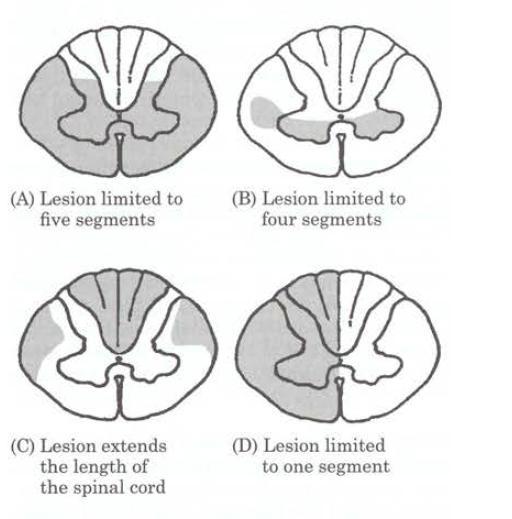
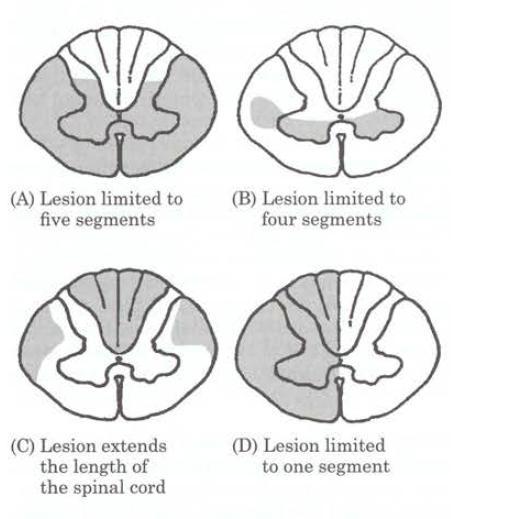
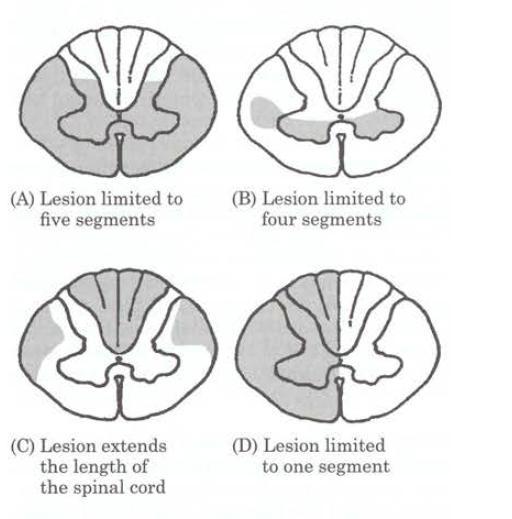
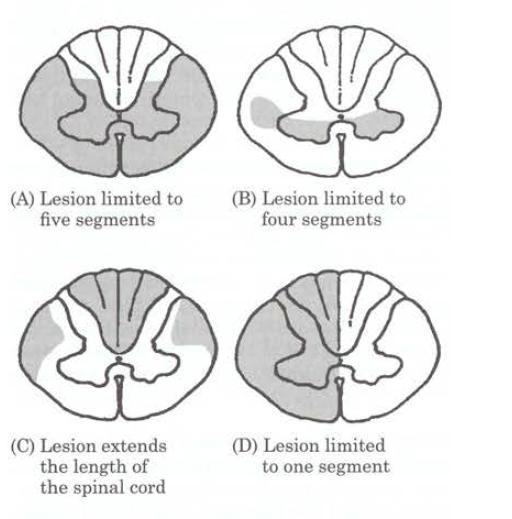
Questions 19-26
Match the statement in items 19—26 with the
lesion shown in the figure below that corre-
sponds best to it.
- Neurologic manifestation of vitamin B12
deficiency
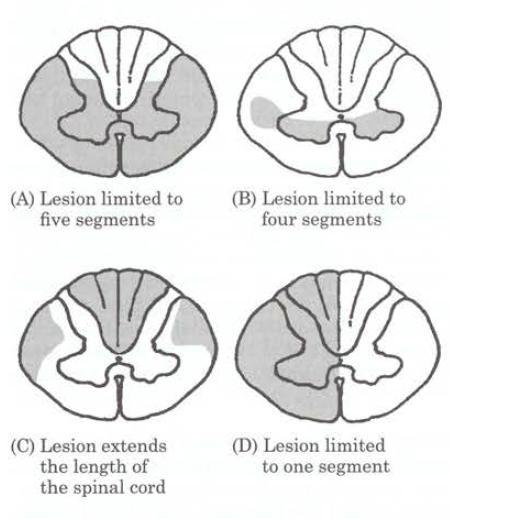
19- C. A neurologic manifestation of vitamin B12 deficiency is subacute combined degeneration.
There is no involvement of LMNs.
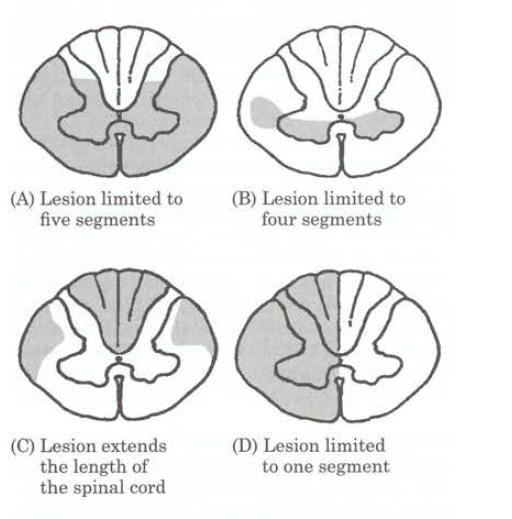
- Lesion due to vascular occlusion
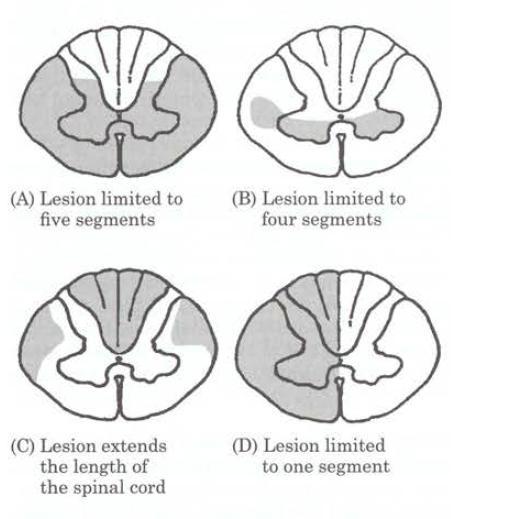
20- A. Lesion A shows the territory of infarction resulting from occlusion of the ventral (anterior)
spinal artery.
- Loss of vibration sensation on the right
side; loss of pain and temperature sensation on
the left side
21- D. A spinal cord hemisection (Brown-Sequard syndrome) on the right side results in a loss
of vibration sensation on the right side and a loss of pain and temperature sensation on the left
side (dissociated sensory loss).
- Bilateral loss of pain and temperature sen-
sation in the legs
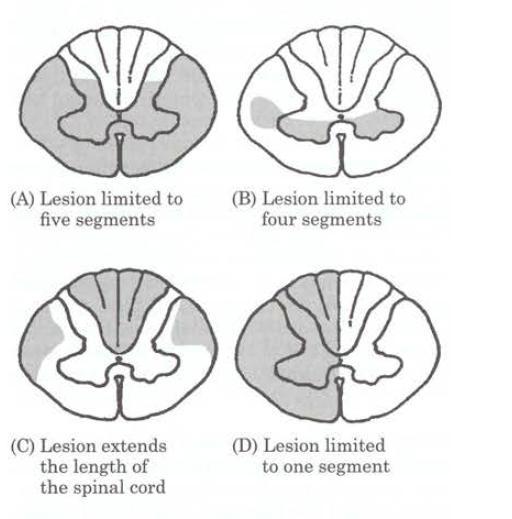
22- A. Total occlusion of the ventral spinal artery, involving five cervical segments, results in in-
farction of the ventral two-thirds of the spinal cord and interrupts both lateral spinothalamic
tracts. The patient would have a loss of pain and temperature sensation caudal to the lesion.
- Bilateral loss of pain and temperature sen-
sation in the hands; muscle atrophy in both
hands; spastic paresis on the right side only
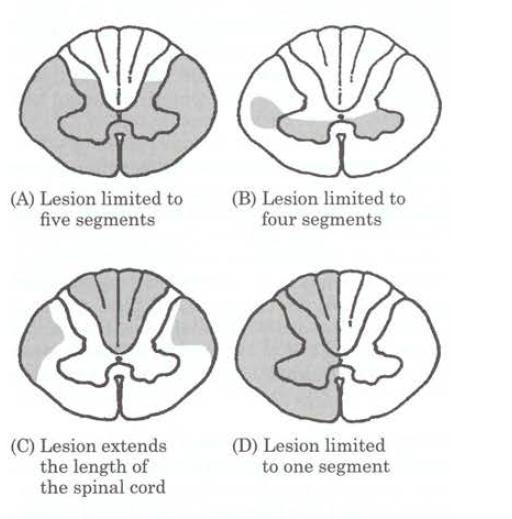
23- B. Lesion B shows a cervical syringomyelic lesion involving the ventral white commissure,
both ventral horns, and the right corticospinal tract. The patient would have a bilateral loss of
pain and temperature sensation in the hands, muscle wasting in both hands, and a spastic pare-
sis on the right side.
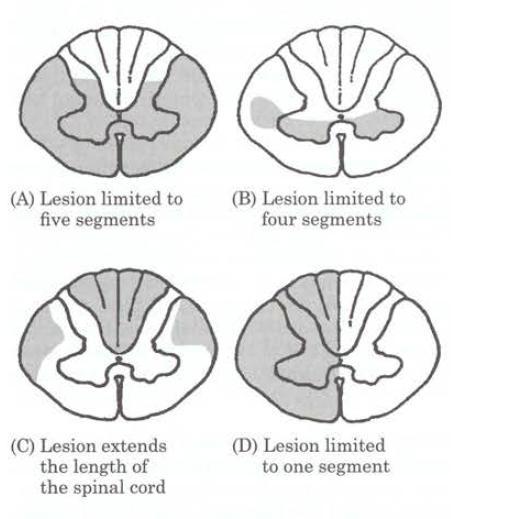
- Urinary incontinence and quadriplegic
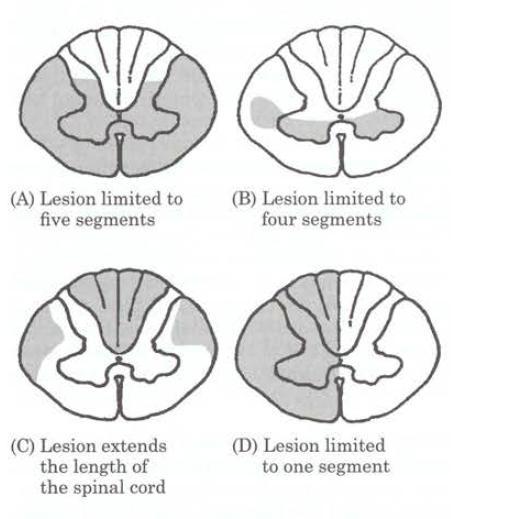
24- A. In lesion A, both lateral and ventral funiculi have been infarcted by arterial occlusion. Bi-
lateral destruction of the lateral corticospinal tracts at upper cervical levels results in quadri-
plegia (spastic paresis in upper and lower extremities). Bilateral destruction of the ventrolateral
quadrants results in urinary and fecal incontinence.



-
CHAPTER 514
-
CHAPTER 69
-
CHAPTER 718
-
CHAPTER 826
-
CHAPTER 17
-
CHAPTER 29
-
CHAPTER 39
-
CHAPTER 410
-
CHAPTER 917
-
CHAPTER 1326
-
CHAPTER 1012
-
CHAPTER 1111
-
CHAPTER 1221
-
CHAPTER 1743
-
CHAPTER 1824
-
CHAPTER 1927
-
CHAPTER 2020
-
neuroanatomy 3rd Comprehensive Examination 1 - 5050
-
CHAPTER 1417
-
Chapter 1518
-
CHAPTER 1621
-
neuroanatomy 3rd Comprehensive Examination 51 - 9747
-
neuroanatomy 3rd Comprehensive Examination 98 - 12023
-
neuroanatomy 3rd Comprehensive Examination 121 - 14424
-
neuroanatomy 3rd Comprehensive Examination 145 - 18945
-
CHAPTER 2122
-
CHAPTER 2227
-
CHAPTER 2326
-
CHAPTER 248



