- Supplementary motor area
22-B. The supplementary motor cortex (area 6) lies on the medial aspect of the hemisphere, just anterior to the paracentral lobule.
- A lesion resulting in a nonfluent expressive aphasia would most likely be found in the (A) temporal lobe (B) parietal lobe (C) frontal lobe (D) occipital lobe (E) limbic lobe
5-C. A nonfluent, expressive motor aphasia (Broca aphasia) results from a lesion in the posterior inferior frontal gyrus (areas 44 and 45) of the dominant frontal lobe.
- Broca aphasia is frequently associated with (A) auditory hallucinations (B) finger agnosia (C) construction apraxia (D) an upper motor neuron (UMN) lesion (E) visual field deficits
6-D. Broca aphasia is frequently associated with an upper motor neuron (UMN) lesion of the contralateral face and arm and occasionally of the leg. Broca speech area lies just anterior to the motor strip; both Broca speech area and the motor strip are irrigated by the superior division of the middle cerebral artery (prerolandic and rolandic arteries). Broca aphasia is frequently associated with a “sympathetic apraxia,” an apraxia of the nonparalyzed left hand.
- Lesion in this area results in paresthesias and numbness in the contralateral foot
23-D. A lesion in the posterior part of the paracentral lobule would result in loss of joint and position sense (astatognosia) and loss of tactile discrimination (astereognosis) in the contralateral foot.
- Lesion in this area results in contralateral lower homonymous quadrantanopia
24-E. A lesion of the superior bank of the calcarine sulcus (cuneus) would result in a contralateral lower homonymous quadrantanopia. A lesion destroying both cunei would produce a lower homonymous altitudinal hemianopia.
- Lesion in this area results in a contralateral Babinski sign
25-C. A lesion of the anterior part of the paracentral lobule results in a contralateral paresis of the foot muscles and in Babinski sign (i.e., plantar reflex extensor or extensor toe sign).
- Lesion in this area results in loss of initiative and inappropriate social behavior
26-A. Lesions of the prefrontal cortex may result in personality changes, with disorderly and inappropriate conduct and facetiousness and jocularity (witzelsucht). Lesions interrupt fibers that interconnect the dorsomedial nucleus and the prefrontal cortex (e.g., prefrontal lobotomy or leukotomy).
- A 55-year-old right-handed veteran received a small shrapnel wound in the head during the Vietnam War. Within 1 year of receiving his wound, the man complained of seizures and was treated with seizure medication. The medication was not effective, and a section of the anterior corpus callosum was performed successfully. Which of the following neurologic deficits is most likely?
(A) Alexia
(B) The inability, with closed eyes, to identifyverbally an object held in he left hand
(C) Gait dystaxia
(D) Loss of binocular vision
(E) Sympathetic apraxia in the right hand
l-B. Transection of corpus callosum results in the inability, when blindfolded, to identify verbally an object held in the left hand (dysnomia). The left hemisphere is dominant for language and naming objects. Alexia is found in lesions of the inferior parietal lobule. Gait dystaxia may result from normal pressure hydrocephalus, which also involves dementia and incontinence. The man’s visual pathways are not affected. Transection of callosal fibers adjacent to the left premotor cortex produces a right hemiparesis, a motor (Broca) dysphasia, and a sympathetic dyspraxia of the left, nonparalyzed, arm.
A 70-year-old hypertensive man suddenly experiences numbness on the right side of his body. When asked to raise his left hand, he raises his right hand. The lesion is most likely in the (A) right frontal lobe (B) left parietal lobe (C) right parietal lobe (D) left temporal lobe (E) right internal capsule
2-B. The right hemiparesis points to a lesion on the left side involving the corticospinal tract. Left-right confusion is seen in Gerstmann syndrome along with finger agnosia. This syndrome results from destruction of the left angular gyrus.
- A 45-year-old farmer complains of headaches. Neurologic examination reveals pronator drift and mild hemiparesis on the right side. The patient’s eyes and head are turned to the left side, and papilledema is visible on the left side. The lesion is most likely in which of the following cortices? (A) Frontal (B) Insular (C) Occipital (D) Parietal (E) Temporal
3-A. The cortical center for lateral conjugate gaze is located in area 8 of the frontal lobe. Destruction of this area results in turning of the head and eyes toward the side of the lesion. Stimulation of this area results in contralateral turning of the eyes and head; pronator drift and hemiparesis are frontal lobe signs.
- An 80-year-old microbiologist has a cerebral infarction. His speech is limited to expletives, he cannot write but does respond to questions by shaking his head, and he has lower facial weakness on the right Side. The lesion is most likely in the (A) left frontal lobe (B) right frontal lobe (C) left parietal lobe (D) right parietal lobe (E) left temporal lobe
4-A. Lower facial weakness is a localizing neighborhood sign. The Broca speech area is located in the posterior part of the inferior frontal gyrus (Brodmann areas 44 and 45).
- Alexia without agraphia and aphasia would most likely result from occlusion of the (A) left anterior cerebral artery (B) right anterior cerebral artery (C) left middle cerebral artery (D) left posterior cerebral artery (E) right posterior cerebral artery
7-D. Alexia without agraphia and aphasia results from occlusion of the left posterior cerebral artery, which supplies the left visual cortex and callosal fibers (within the splenium) from the right visual association cortex. Interruption of bilateral visual association fibers en route to the left angular gyrus results in alexia. Because the angular gyrus and Wernicke area are spared, the patient will not be agraphic or dysphasic.
- Agraphia and dyscalculia would most likely result from a lesion in the (A) left frontal lobe (B) left parietal lobe (C) right occipital lobe (D) left temporal lobe (E) splenium of corpus callosum
8-B. Lesions of the angular gyrus of the dominant hemisphere may result in Gerstmann syndrome, which consists of agraphia, dyscalculia, finger agnosia, and left—right confusion.
- A patient is asked to bisect a horizontal line through the middle, to draw the face of a clock, and to copy a cross. The patient bisected the horizontal line to the left of the midline, placed all of the numerals of the clock on the right side, and did not complete the cross on the left side. The most likely lesion site for this deficit would be in the (A) left frontal lobe (B) right parietal lobe (C) left parietal lobe (D) right temporal lobe (E) left occipital lobe
9-B. The inability to draw a clock face or bisect a line through the middle is called construction apraxia. Lesions of the right (nondominant) parietal lobe result in construction apraxia, dressing apraxia, anosognosia, and sensory hemineglect.
- A lesion of the dominant inferior parietal lobule could result in all of the following deficits EXCEPT (A) the inability to perform calculations (B) the inability to identify fingers (C) the inability to write from dictation (D) right—left disorientation (E) difficulty in dressing
10-E. Dressing apraxia is a symptom of the nondominant parietal lobe. A lesion of the dominant angular gyrus is known as Gerstmann syndrome, which includes finger agnosia (autotopagnosia or somatotopagnosia), right-left confusion, agraphia, and dyscalculia. Alexia may be associated with Gerstmann syndrome.
- All of the following statements concerning the parietal lobe are correct EXCEPT (A) it contains the primary somatosensory area (B) it contains the angular gyrus (C) it contains the supramarginal gyrus (D) it contains the visual radiation (E) it contains the Wernicke speech area
11-E. Wernicke speech area (included in Brodmann area 22) is found in the posterior part of the superior temporal gyrus of the dominant hemisphere. Wernicke speech area includes the planum temporale, which lies on the lower bank of the lateral sulcus.
- All of the following statements concerning the layers of the neocortex are correct EXCEPT (A) layer I has the highest numerical cell density in the neocortex (B) layer III is the external pyramidal layer (C) layer TV in the occipital lobe receives input from the lateral geniculate body (D) layer V contains the giant cells of Betz (E) layer VI is the major source of corticothalamic fibers
12-A. Layer I is characterized by a paucity of neurons, the horizontal cells of Cajal. (Layer II contains small granular cells.) Layer III contains pyramidal cells that are myelinated within the cortex; they course in the white matter as projection, association, or commissural fibers. Layer IV, the major sensory-receiving station of the neocortex, receives input from the ventral posterolateral and ventral posteromedial nuclei. Layer V, the internal pyramidal layer, gives rise to the corticonuclear and corticospinal fibers and also contains the giant cells of Betz; the largest neurons of the cortex, the Betz cells are located in Brodmann area 4 of the precentral gyrus and inthe paracentral lobule. There are 40,000 Betz cells in a single hemisphere. Finally, layer VI is the major source of corticothalamic fibers.
- Lesions of the frontal lobes may give rise to all of the following EXCEPT (A) ocular signs (B) upper motor neuron (UMN) lesion signs (C) gait apraxia (D) hemianopias (E) sucking, groping, and grasping reflexes
13-D. Frontal lobe lesions may affect the frontal eye field, the motor cortex, and the premotor and prefrontal cortices (gait apraxia). Sucking, groping, and grasping reflexes are seen in frontal lobe lesions. Hemianopias result from lesions of the visual pathway. The visual pathway is not found in the frontal lobe.
- All of the following statements concerning the primary motor cortex are correct EXCEPT (A) it is found in the paracentral lobule (B) it is located in the frontal lobe (C) it contains the giant cells of Betz (D) it corresponds to Brodmann area 4 (E) ablation results in a permanent flaccid paralysis
14-E. The primary motor cortex, the motor strip (area 4), is located in the precentral gyrus and in the anterior part of the paracentral lobule, both of which are found in the frontal lobe. The giant motor cells of Betz are found in layer V of the motor cortex. Ablation of the motor strip initially results in flaccid paralysis, which becomes a spastic contralateral hemiparesis with Babinski sign.
- All of the following statements concerning the paracentral lobule are correct EXCEPT (A) it is found in two lobes of the brain (B) it contains giant cells of Betz (C) it is irrigated by two arteries (D) its infarction results in loss of vibration sense in the contralateral foot (E) its infarction results in a contralateral extensor plantar reflex
15-C. The paracentral lobule is perfused by the anterior cerebral artery; the territory of the anterior cerebral artery extends a centimeter over the crest of the lateral convexity and perfuses the hip area of the motor and sensory strips. The giant cells of Betz are largest in the paracentral lobule.
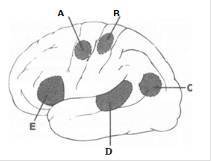
Questions 16-21Match the descriptions in items 16-21 with theappropriate lettered area shown in the figure.
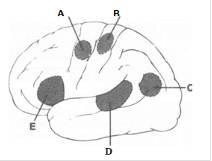
16-E. Broca speech area (areas 44 and 45) is found in the posterior part of the inferior frontal gyrus of the dominant hemisphere, directly anterior to the premotor and motor cortices.
- Wernicke speech area
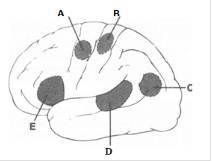
17-D. Wernicke speech area is located in the posterior part of the superior temporal gyrus (part of Brodmann area 22) of the dominant hemisphere. A lesion of this area results in a fluent sensory (receptive) aphasia.
- Lesion in this area results in contralateral astereognosis
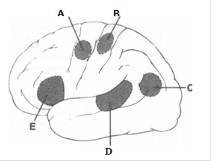
18-B. A lesion of the left postcentral gyrus results in a right astereognosis (tactile agnosia), the inability to identify objects by touch. Lesions of the superior parietal lobule result in contralateral astereognosis and in sensory neglect.
- Infarction in this area results in an upper motor neuron (UMN) lesion
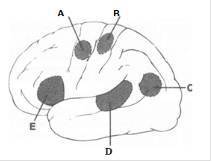
19-A. A lesion in the precentral gyrus is an upper motor neuron (UMN) lesion. The precentral gyrus (motor strip) gives rise to one-third of the pyramidal tract (corticospinal tract) fibers.



-
CHAPTER 514
-
CHAPTER 69
-
CHAPTER 718
-
CHAPTER 826
-
CHAPTER 17
-
CHAPTER 29
-
CHAPTER 39
-
CHAPTER 410
-
CHAPTER 917
-
CHAPTER 1326
-
CHAPTER 1012
-
CHAPTER 1111
-
CHAPTER 1221
-
CHAPTER 1743
-
CHAPTER 1824
-
CHAPTER 1927
-
CHAPTER 2020
-
neuroanatomy 3rd Comprehensive Examination 1 - 5050
-
CHAPTER 1417
-
Chapter 1518
-
CHAPTER 1621
-
neuroanatomy 3rd Comprehensive Examination 51 - 9747
-
neuroanatomy 3rd Comprehensive Examination 98 - 12023
-
neuroanatomy 3rd Comprehensive Examination 121 - 14424
-
neuroanatomy 3rd Comprehensive Examination 145 - 18945
-
CHAPTER 2122
-
CHAPTER 2227
-
CHAPTER 2326
-
CHAPTER 248



