growth function G(x)
loss emergence pattern
growth function as of time x, x is avg acc date to evaluation date
G(x)=1/CDF=pk = cumulative % of loss reported or paid
can be described by Loglogistic and Weibull
Weibull and loglogistic
Weibull: G(x) = 1-exp(-(x/theta)^w)
loglogistic: G(x)=x^w/(theta^w+x^w)
average accident date to evaluation date
AvgAge(t) = t/2 for t< 12 and t-6 for t>12
variance of actual loss emergence
total variance = process variance + parameter variance
process variance
process variance = σ2 * reserves
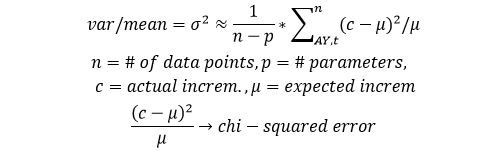
why is σ2 larger for LDF?
LDF requires more parameters
-LDF requires parameters for each AY Ult loss and parameters in G
µ = ULTAY*[G(y)-G(x)]
-CC requires ELR parameter and parameters in G
µ = PremAY*[G(y)-G(x)]
Why is CC perferred in general?
- CC has smaller parameter var since add info and fewer parameters
- process var can be higher or lower than LDF
- CC in general produces lower total var than LDF
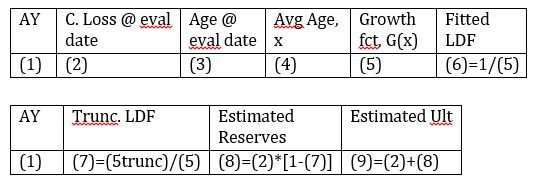
LDF method
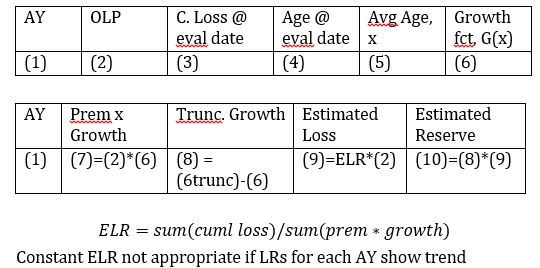
CC Method
CoV and why CC’s is lower
CoV = std dev/estimated reserves
-CoV for CC is reduced from LDF because relying on more info like premium and this allows to make better estimate of reserve
normalized residuals

plot of residuals
- Plot of increment age vs normalized residuals should be randomly scattered around 0 -> if not, growth curve not appropriate
- plot can show CY effect by having string of negative residuals for one CY and positive residuals for another
- positive residuals = underestimates losses
- negative = overestimates losses
variance of prospective loss
uses CC, if have estimate of future prem, can calc estimate of expected loss which would be estimated reserves, process var calc as usual
CY development
rather than calc IBNR for each AY, estimate development for next CY period beyond latest diag -> take difference in growth fct @ 2 evaluation ages and mult by estimated ult loss
benefit of estimated CY development to help validate model
12 month development estimate is testable within short time period compared to estimate of total unpaid loss reserves
within 1 yr, can see whether actual CY development falls within range of estimated CY development (based on expected and std dev of 12 month devel)
if development is within forecast range, indicates model may be reasonable
Discounted reserves
- start with age of AY and age of truncation
- breakdown this diff in 12 month portions
- set up table with age, avg age, etc
- CY reserve = Ult*(growth i - growth i+1)
- then discount
- to do process variance you can do the above but discounting is squared and you need to multiply by sigma^2
CY discount
1/(1+i)^(avg age i - age of AY)
which period doesn’t have discounted reserve
AY age
to calc expected incremental
incremental emergence % = G(y)-G(x)
even with truncation
total variance for CC
total var = process var + parameter var
=σ2R+Var(ELR)*Prem2
3 assumptions of Clark
- incremental losses are i.i.d
- one reserving period doesn’t affect surrounding periods
- assumes emergence pattern is same for all AYs - var/mean scale parameter is fixed and known
- variance estimates are based on approx to rao-cramer lower bound
advantages of using parameterized curves to describe expected loss emergence pattern
- simplifies problem of estimating expected loss emergence because few parameters are needed
- can use data that’s not in triangle with evenly spaced eval dates
- indicated pattern is smooth curve, doesnt follow noise in historical age-to-age factors
why is paramater var greater than process var?
only 6 data points but LDF model uses 5 parameters -> model is over-parameterized and overfits noise in data
there are few data points in loss reserve triangle so most of uncertainty in reserve estimate is from parameter estimate needed to estimate expected reserve, not random events
advantage of tabular form
with tabular form, can use data with irregular evaluation periods




