Components of Reinsurer’s loss reserve
- Case reserves reported by ceding companies
- Reinsurer additional reserves on individual claims
- Actuarial estimate of future development on 1 &2
- Actuarial estimate of pure IBNR
- Discount for future investment income
- Risk load
- adverse deviation loading to keep reserves at conservative level
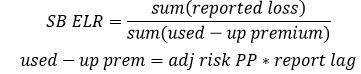
Stanard-Buhlmann (Cape Cod)
earned risk PP
earned risk PP = EP*(1-expenses % for treaty)
modification made to earned risk PP to get adj prem
current rate level
we want all prem to be on same level because
combining all years to calc single ELR
advantage of CC vs BF
ultimate ELR for all years combined is estimated from overall reported claims experience, instead of being selected judgmentally like BF
advantage of CC vs CL
more stable in most recent AYs & when fluctuations in reported losses
disadvantage of CC
IBNR by year is dependent on rate level adj prem which may be difficult to obtain
Simple Credibility IBNR estimate
-gives more weight to SB estimate for immature years and gives more weight to CL for older years where cuml. rate level adjs are less reliable

If more claims emerge than expected, what does it mean?
- purely random?
- does it indicate that beginning IBNR was too small?
- were the lags too short?
- thought 80% done, but only 70% done
Claim report lags to reinsurers are generally longer
- lengthy reporting pipeline = reported to cedant, claim filters through cedant’s report system to reinsurance department, claim travels through intermediary, claim appears in reinsurer’s system
- serious claims tend to be under reserved (modal)
- mass tort claims may have extreme delays in discovery or in reporting to cedant
Persistent upward development of most claims reserves
- economic and social inflation
- tendency of claims adjusters to reserve at modal values
- tendency to under reserve ALAE
Claims reporting patterns differ greatly by reinsurance line, by type of contract, by specific terms, by cedant, and possibly intermediary
- exposures assumed by reinsurers tend to be heterogeneous
- traditional reserving methods require large volumes of homogeneous data
- even when reinsurers have large amounts of similar exposure, low freq and lengthy report lags may cause extreme fluct. in hist data
industry statistics are not very useful
- no breakdown of reinsurers’ exposures into homo. Groups
- severity of development increases with attachment point
- industry data heterogeneity may be caused be aggreg, of cedant LOBs into 1 LOB for reinsurance reporting
- RAA data only distributed once every 2 years
Reports reinsure receives may be lacking important info
- proportional covers require only summary claims info
- often data by CY instead of AY
- info tends to be insufficient even when ind. claims reporting
- reinsurer’s exposure is not completely measured in most recent year
Because of heterogeneity in coverage and reporting requirements, reinsurers often have data coding and IT systems problems
-business grows faster than ability of reinsurer’s data systems to handle and produce reports
US tax reform act of 1986
- requires discounting of loss reserves for income tax purposes
- no longer have implicit risk margin built into loss reserve estimates
Claim development is extremely difficult
- reinsurance contract are unique
- significant fluct. during development because of single large claims
Reinsurance loss reserving problems: 8 problems
- Claim report lags to reinsurers are generally longer
- Persistent upward development of most claims reserves
- Claims reporting patterns differ greatly by reinsurance line, by type of contract, by specific terms, by cedant, and possibly intermediary
- Because of heterogeneity in 3, industry statistics are not very useful
- Reports reinsure receives may be lacking important info
- Because of heterogeneity in coverage and reporting requirements, reinsurers often have data coding and IT systems problems
- Size of adequate loss reserve compared to surplus is greater for reinsurer
- US tax reform act of 1986
ultimate loss ratio for CC

predicted reported loss development using CL

examining difference between actual and predicted loss as percentage of expected loss development -> what does it mean
if loss development is higher than expected and is consistently hgiher than expected for all AYs, this could be pure randomness or report pattern from Gamma is too short
*could continue to watch development over next few quarters
considerations to appropriately partition BoB for loss reserving purposes
goal is to partition into reasonably homogeneous exposure groups with consistent mixes of business
first groups should be split out by LOB since prop, WC, and GL will all have very different development patterns
book should be split out by type of contract and cover
if asbestos is covered
those exposures should be split out




