Dividend discount model: equity value of firm
equity value of firm = present value of future dividends
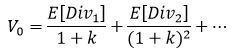
DDM: value of share of stock
discounted present value of expected future dividends
E[Div1] reflects expected dividends to be paid at end of period 1
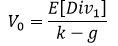
if dividends are expected to grow in perpetuity at constant rate g
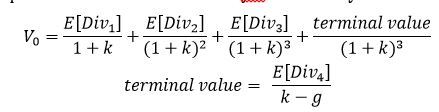
If dividends are projected over finite horizon and then assumed to grow at g beyond that horizon, incorporate terminal value term
example of initial finite horizon of 3 yrs followed by constant rate
3 assumptions needed to implement DDM
- Expected dividends during forecast horizon
- Dividend growth rates beyond forecast horizon
- Appropriate risk-adjusted discount rate
Expected dividends during forecast horizon
- Extremely complex to forecast future dividends
- Involves forecasts of revenues, expenses, investment needs, cash flows, etc
Dividend growth rates beyond forecast horizon: approaches
- Simple approach to estimate growth rates beyond forecast horizon is to use growth rates during forecast to extrapolate future growth rates
- Another approach is to base growth rate on
Dividend payout ratio - portion of earnings paid as dividends
Return on equity - profit per dollar of reinvested earnings
-With this approach, g can be estimated as
G =plowback*ROE
Plowback = portion of earnings retained and reinvested
High growth rate does not necessarily mean that firm value will increase
- Only if everything is held constant
- Growth rates, dividend payout ratios and risk-adj rate are not independent in reality
2 examples of dependence between dividends and growth rate
- High growth rates and high dividends are not sustainable at the same time, high growth rates will be offset by lower dividend amounts
- Firms with high growth rates tend to be riskier which drives risk-adj rate up and present value of dividend amounts down
When valuing risky cash flows, need to reflect risk in value that is being calc: 2 ways
- One way = using risk-adj rate that is higher than risk-free rate which lowers value of cash flows
- Another = adjust cash flows for risk directly and then discount at risk free rate
Private vs equilibrium market valuation
- Private evaluation assumes that individual investors have their own views of risk resulting in same investment having different value to different investors
- Equilibrium market valuation assumes that all investors hold the same portfolio; investments will have same value to all investors
Determining discount rate
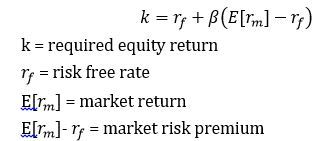
- Most popular model is Capital Asset Pricing Model (CAPM)
- In CAPM, risk is defined in terms of investment’s beta, which is measure of systematic risk that cannot be diversified away
- CAPM can be expressed as
2 methods for determining beta
- Firm beta - run linear regression of company’s returns against market returns using historical stock price data
- Industry beta - use industrywide mean or median value
P&C insurance company example - DDM
- Create table for net income after tax, dividends paid, beginning US GAAP equity, ending equity, ROE
- Net income after tax = net income before tax*(1-corporate tax rate)
- Dividends paid = net income after tax*dividend payout ratio
- Beginning US GAAP Equity = ending equity from previous year
- Ending US GAAP Equity = beginning equity + net income after tax - dividends paid
- ROE = net income after tax / beginning equity
- Determine growth rate
If ROE is trending upward over time, select latest ROE
Growth rate = ROE*(1-dividend payout ratio)
-calc equity value of firm V0
Discounted Cash Flow
free cash flow to firm FCFF
free cash flow to equity FCFE
free cash flow
- free cash flow = all cash that could be paid as dividend
- free cash flow is net of anything that needs to be reinvested in firm for required operations and growth
free cash flow to firm FCFF
- Focuses on free cash flow to entire firm prior to accounting for debt payments or taxes associated with debt payments
- Discounting the FCFF gives total firm value
- Equity value of firm=total firm value-market value of debt
free cash flow to equity FCFE
- Focuses on cash flows to equity holders only
- Subtract debt payments net of their associated tax consequences from free cash flow to firm
- Discounting resulting free cash flows to determine equity value
Important distinction = use different discount rates
FCFF vs FCFE for discount rate
- FCFF uses discount rate that reflects overall risk to both debt holders and equity holders known as WACC
- FCFE uses discount rate that reflects risk to equity holders only
Limitations of DDM
- Actual dividend payments are discretionary and can be difficult to forecast
- Due to increased use of stock buybacks as vehicle for returning funds to shareholders we may need to redefine dividend
Free Cash Flow to Firm: difficult to apply to P&C
- Difficult to apply to P&C
1. Policyholders liabilities vs debt
2. Weighted average cost of capital (WACC) - used to discount cash flows that include both equity and debt sources of capital
3. Adjusted present value (APV) method - uses all equity discount rate to derive value of firm without considering debt holders’ claims, tax consequences of debt, or impact of debt on riskiness of equity holders’ claims
4. Policyholder liabilities make it difficult to precisely define either WACC or all equity discount rate needed for APV
FCFE can be calculated as
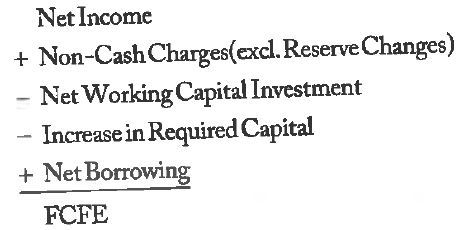
Non-cash charges
expenses that are deducted under GAAP but do not represent actual cash expenditures
Net working capital investment
reflects net short term assets held to maintain operations such as inventory or accounts receivable






