stochastic models for CL
- Mack
- over dispersed poisson
- over dispersed negative binomial
- normal approx to NB
MACK
-only on cumulative loss
Bayesian compared to the Mack, the full distribution can be easily calculated & the prediction error can be calculated
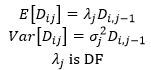
ODP
- increm loss
- since neg increm values are possible with reported data, preferable to use paid loss or claim counts
- not obvious it produces CL
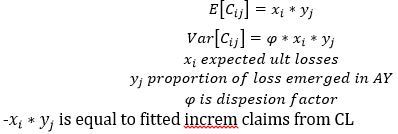
ODNB
- same for increm and cumulative losses
- if link ratio is less than 1 or id column sums of incremental loss are positive, produce negative variance
- expected value for each increm cell is equivalent to CL estimate AKA form of mean is the same as CL
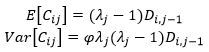
normal approx to NB
- allows for neg increm claims
- more parameters
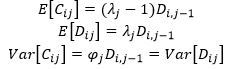
2 areas where expert knowledge is applied
- BF method (row parameters/AY ultimates)
- Insertion of prior knowledge about individual DFs in CL (unlike Bootstrapping)
Bayesian models have 2 important properties
- Can incorporate expert knowledge
- Can be easily implemented
estimate for outstanding losses: CL

estimate for outstanding losses: BF

prediction variance
process variance + estimation variance
prediction error will be [] if less confident in expert opinion
higher
When comparing prediction errors
it’s best to think of the prediction error as a percentage of the prediction, since the reserve estimate itself may vary greatly from model to model
difficulty in calculating the prediction error highlights a few advantages of Bayesian methods
- full predictive distribution can be found using simulation methods
- RMSEP can be obtained directly by calculating the std dev of method
2 cases of intervention in estimation of DFs for CL
- DF changed in some rows due to external information
- DFs = 5yr volume weighted average rather than all of the available data in the triangle
Incorporating Expert opinion about DFs
- means and variance of prior distributions of DFs reflect expert opinion
- lamda has mean and var W
- mean is opinion
- W depends on strength of opinion
if W is large
DF will be pulled closer to CL DF and reserve will closely resemble CL reserve
if W is small
DF will be pulled closer to prior mean and reserve will move away from CL reserve
using BF
- BF assumes expert opinion about level of each row xi from ODP, need to specify prior distribution for xi
- uses Gamma
E[xi] = alpha/beta = M
Var(xi) = alpha/beta^2 = M/beta
-for given choice of M, variance can be altered by changing beta
smaller B implies
we are more unsure about M
Bayesian Model for BF (BAYESIAN MEAN RESERVE) -> E[Cij]

formula for Z
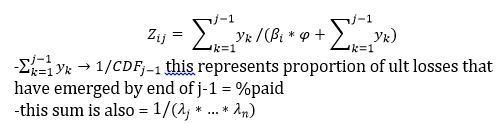
beta can control Z
so large beta aka more conf., more weight to BF
-mean of incremental claims is credibility formula where Z controls trade-off between prior mean (BF) and data (CL)
to modify Bayesian framework ->
insert row parameter for each AY and specify low variances
Estimating column parameters (BF RESERVE)
- To account for all variability, we also need to estimate the column parameters (yj )
- use estimates from traditional CL
- or define prior dist for column parameters and estimate column parameters first
- Once we define improper prior distributions (i.e. large variances) for the column parameters and estimate them, we obtain an over-dispersed negative binomial with mean
E[Cij]=(gamma(i)-1)*sum(Cmj)




