What is the definition of dementia?
a progressive and largely irreversible syndrome that is characterised by a widespread impairment of mental function
sufficiently severe to impair social and occupational functioning
What care needs are implicated in dementia?
dementia is associated with complex needs and high levels of dependency and morbidity
care needs often challenge the skills and capacity of carers and available services
What are the 6 types of neurodegenerative dementia?
Which is the most common and least common?
most common - Alzheimer’s disease
- vascular dementia
- mixed dementia
- lewy body disease
- fronto-temporal dementia
least common - Parkinson’s dementia
In which 3 ways can dementia be classified?
- site in the brain
- age
- pathology
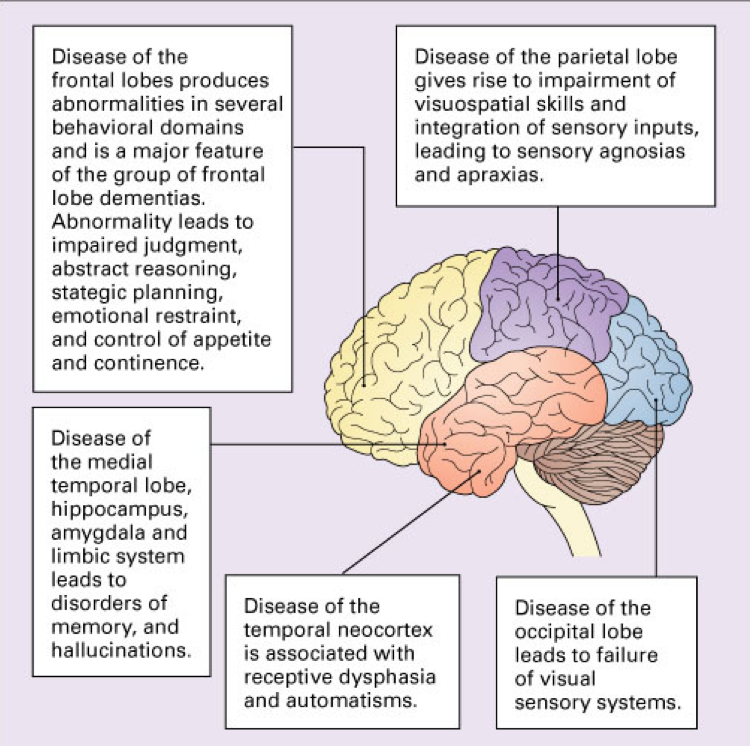
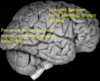
What kind of symptoms are produced from disease of the frontal lobes?
it produces abnormalities in several behavioural domains
abnormality leads to impaired:
- judgement
- abstract reasoning
- strategic planning
- emotional restraint
- control of appetite and continence
What does disease of the medial temporal lobe, hippocampus, amygdala and limbic system lead to?
disorders of memory and hallucinations
What are the symptoms of disorders of the temporal neocortex?
receptive dysphasia and automatisms
What is receptive dysphasia and expressive dysphasia?
receptive dysphasia:
- difficulty in comprehension and understanding
- can speak words fluently, but they do not make sense
expressive dysphasia:
- difficulty putting words together to make meaning
- comprehension is intact
What symptoms arise due to disorders of the occipital lobe?
failure of the visual and sensory systems
What symptoms arise from disease of the parietal lobe?
Why do they occur?
impairment of visuospatial skills and integration of sensory inputs
this leads to sensory agnosias and apraxias
What is meant by an automatism?
an action that is performed unconsciously or involuntarily
What are the 4 categories of classification of dementia based on site?
- anterior
- posterior
- subcortical
- cortical
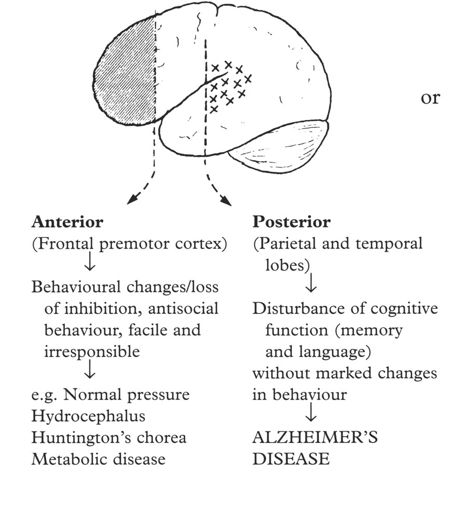
What are the symptoms of a condition affecting the anterior region?
What are examples of conditions which arise?
frontal premotor cortex
- behavioural changes / loss of inhibition
- antisocial behaviour
- facile and irresponsible
seen in normal pressure hydrocephalus, Huntington’s chorea and metabolic disease
What symptoms arise from a problem in the posterior region?
What condition results from this?
parietal and temporal lobes
- disturbance of cognitive function (memory & language) without marked changes in behaviour
seen in Alzheimer’s disease
What are the symptoms of a problem in the subcortial site?
What conditions results from this?
- apathetic
- forgetful and slow with poor ability to use knowledge
- associated with other neurological signs and movement disorders
seen in Parkinson’s disease and AIDS dementia complex
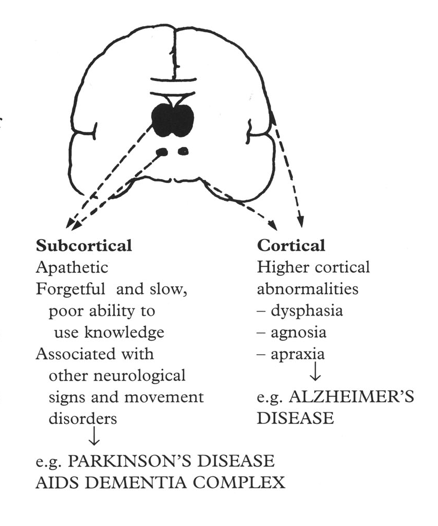
What are the symptoms associated with a problem in the cortical region?
higher cortical abnormalities including:
- dysphasia
- agnosia
- apraxia
this is seen in Alzheimer’s disease
What is meant by agnosia and apraxia?
agnosia:
- inability to interpret sensations and recognise things
apraxia:
- individual has difficulty with the motor planning to perform tasks or movements when asked
What is meant by young onset dementia?
a young onset age is < 65 years
it is not always memory that is affected
this may be genetic or metabolic
What types of dementia are present in people aged above and below 65?
age above 65:
- alzheimer’s
- vascular
- lewy body
age less than 65:
- alzheimer’s
- vascular
- fronto-temporal
What are the three categories in the molecular-genetic classification of neurodegenerative diseases?
tauopathies:
- characterised by neuronal and/or glial inclusions composed of the microtubule-binding protein, tau
synucleinopathies:
- characterised by abnormal accumulation of aggregates of alpha-synuclein protein in neurones, nerve fibres or glial cells
ubiquinopathies:
What are examples of tauopathies?
- FTD and FTDP-17
- progressive supranuclear palsy (PSP)
- corticobasal degeneration
- Alzheimer’s disease
What are examples of synucleinopathies?
- parkinson’s disease
- dementia with lewy bodies
- multiple system atrophy (MSA)
What are examples of ubiquinopathies?
- motor neurone disease (MND) and MND / dementia
- semantic dementia



-
Arthritis58
-
A1 - Pectoral Girdle & Shoulder102
-
A2 - Upper Arm & Elbow94
-
Peripheral Nerve Lesions - Brachial Plexus Injuries34
-
Upper Limb Ultrasound17
-
A3 - Forearm92
-
A4 - Wrist & Hand82
-
L1 - Anatomy of the Vertebral Column94
-
Back Pain51
-
Hip Fracture43
-
L2 - Pelvis & Hip Joint76
-
Gluteal Region & Hip58
-
The Knee Joint72
-
The Thigh & Knee Anatomy68
-
Posterior Thigh & Knee74
-
Leg & Ankle58
-
Vessels of the Lower Limb49
-
The Leg & Ankle Anatomy74
-
The Foot60
-
Lower Limb Radiology36
-
LL Ultrasound and Cases25
-
Lower Limb Muscles100
-
Muscles of the Upper Limb69
-
SDL 1 - FRONT OF NECK67
-
Introduction to the Brain41
-
The Skull22
-
Blood Supply to Brain & Meninges74
-
SDL 2 - Face & Skull89
-
SDL 3 - Brain, Meninges & Blood Supply44
-
Front of Neck Surface Anatomy10
-
Brainstem & Cerebellum65
-
SDL 4 - Brainstem, Cerebellum & Cranial Nerves65
-
Cranial Nerves67
-
Forebrain & Ventricles56
-
Localisation60
-
SDL 5 - FOREBRAIN, VENTRICLES & CSF39
-
Local Anaesthetics43
-
Spinal Cord & Spinal Nerves66
-
Ascending Pathways68
-
Descending Motor Pathways53
-
Transient Ischaemic Attack (TIA)35
-
Stroke37
-
SDL - Vertebral Column & Spinal Cord70
-
SDL 7 - SPINAL CORD & SPINAL NERVES18
-
Parkinson’s Disease58
-
Basal Ganglia55
-
Somatosensory Physiology57
-
Patterns of Sensory Loss40
-
Skin Histology45
-
Epilepsy75
-
Headache - Diagnosis & Management72
-
Radiotherapy & Chemotherapy for CNS Tumours66
-
Dementia84
-
Multiple Sclerosis43
-
Pain 152
-
Clinical Aspects of Pain75
-
General Anaesthesia77
-
The Auditory Pathway48
-
The Visual Pathway55
-
Visual Defects72
-
Cerebellum50
-
The Auditory System78
-
Physiology of Vision54
-
Limbic System49
-
Balance, Posture & Vestibular System0
-
Upper & Lower Motor Neurone Disorders27
-
Gait and Posture41
-
Pharmacology of Movement37
-
Diagnosing Weakness23



