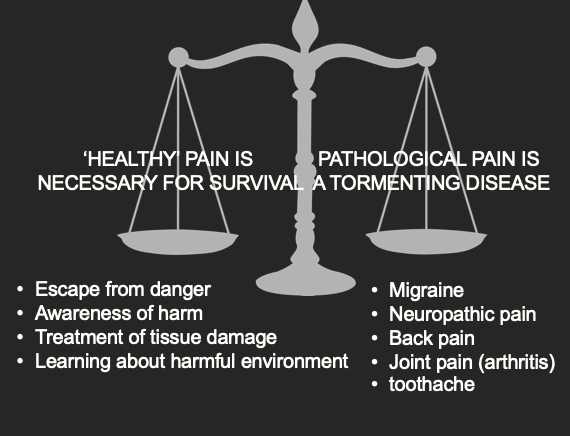
What are examples of healthy pain and pathological pain?
healthy pain:
- escape from danger
- awareness of harm
- treatment of tissue damage
- learning about harmful environment
pathological pain:
- migraine
- neuropathic pain
- back pain
- joint pain (arthritis)
- toothache
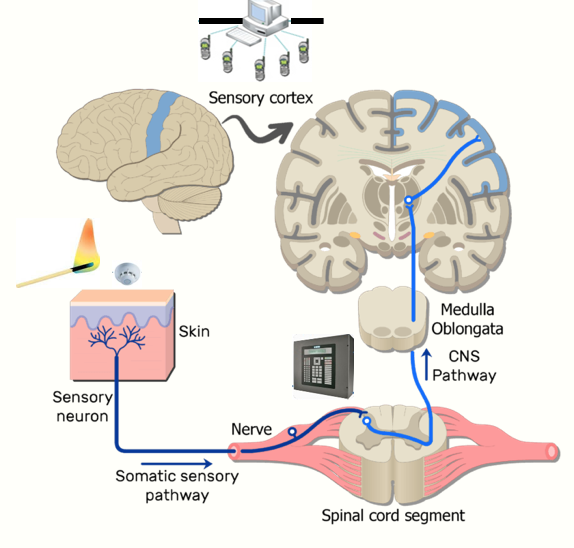
In general, what pathway does pain travel in?
- pain is detected by sensory receptors in the skin
- these travel via the somatic sensory neurones to the spinal cord
- neurones ascend through the medulla oblongata to the sensory cortex
Which part of the brain perceives pain?
the pain signal first goes to the thalamus
the thalamus sends the signal to a few different areas for interpretations
it also sends signals to the limbic system, which is the emotional centre of the brain
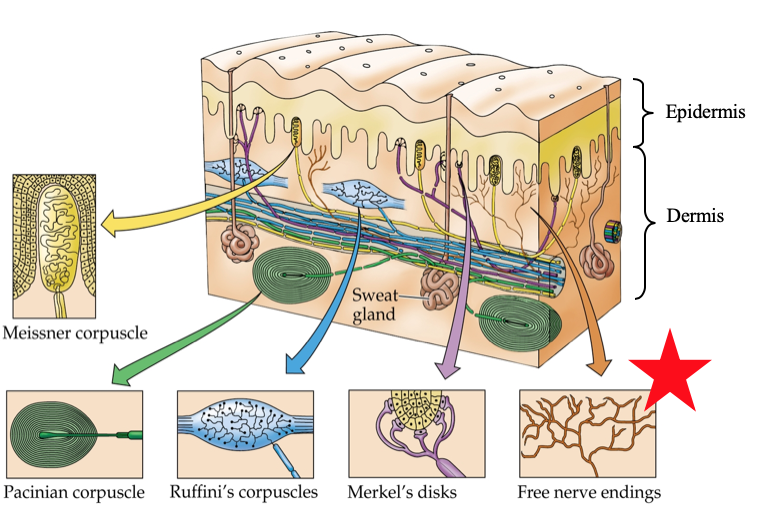
What are the 5 different sensory receptors in the skin?
- Meissner corpuscle
- Pacinian corpuscle
- Ruffini’s corpuscle
- Merkel’s disks
- free nerve endings
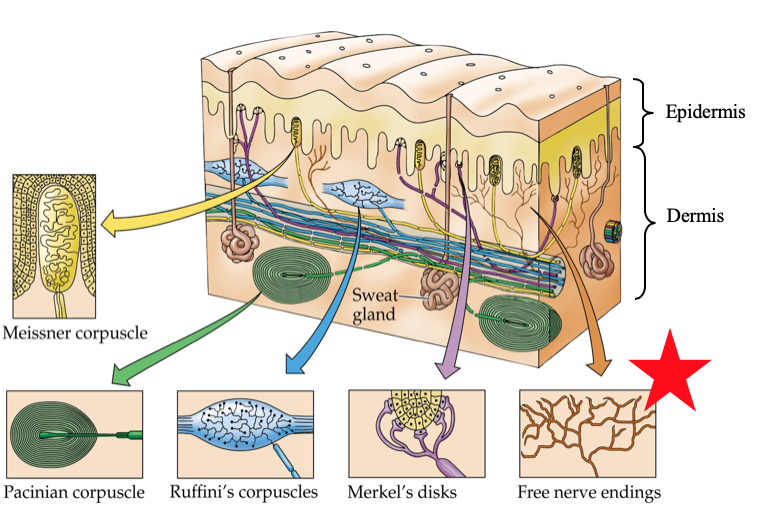
Which sensory receptors are found just beneath the epidermis?
Meissner corpuscles and Merkel’s disks
Meissners corpuscles sit between the dermal pupillae
Merkel’s disks are aligned with the dermal pupillae
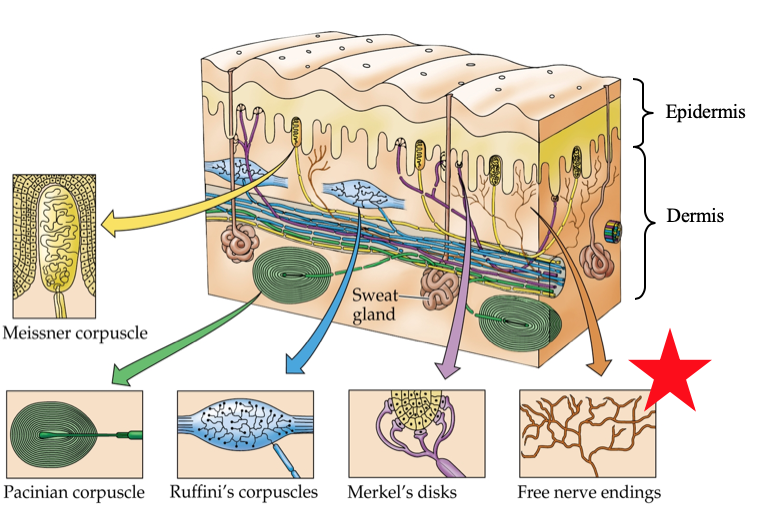
Where are pacinian corpuscles located?
they are large encapsulated endings located in the subcutaneous tissue
Where are Ruffini’s corpuscles located?
they are located deep in the dermis
the long axis of the corpuscle is orientated parallel to the skin
they form 20% of receptors in the skin
How is conduction velocity associated with axon diameter?
conduction velocity is positively correlated with axon diameter
(larger diameter axons have faster conduction velocity)
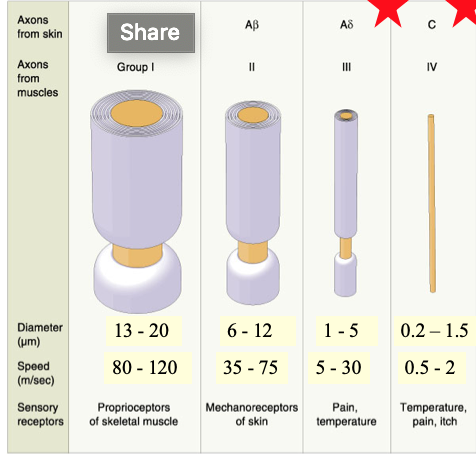
What types of axons of sensory afferents innervating somatosensory receptors have a large diameter?
large diameter, rapidly conducting afferents (I / II) are associated with low threshold mechanoreceptors
e.g. proprioceptors of skeletal muscle, mechnoreceptors of skin
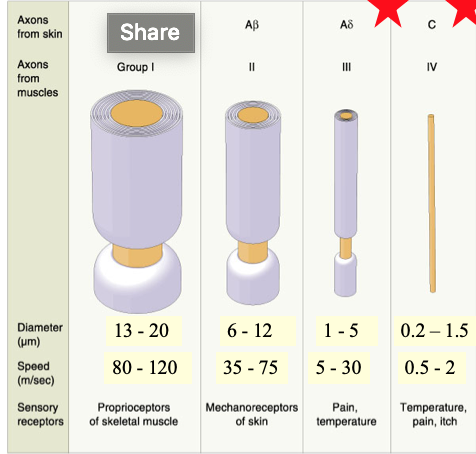
what types of axons of sensory afferents innervating somatosensory receptors have a small diameter?
small diameter, slow conducting afferents (III / IV) are associated with nociceptors and thermoreceptors
both type III and IV fibres are involved in conducting pain sensation
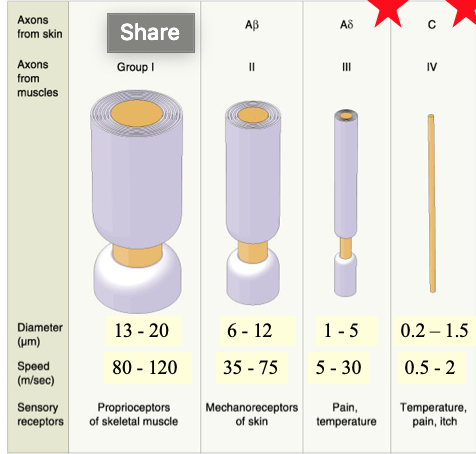
What are the two categories of pain perception?
Which fibres do they travel in?
different fibres convey different aspects of pain sensation
first pain:
- conveyed through fast Ad fibres
second pain:
- conveyed through slow C-fibres
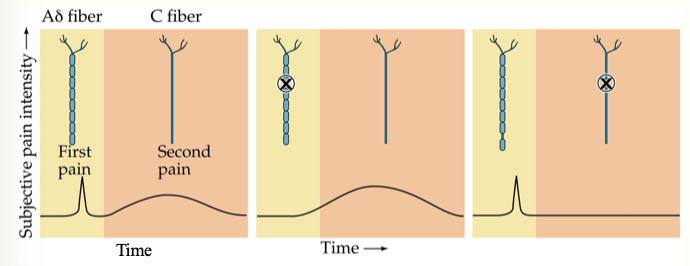
What is the difference in sensation between first and second pain?
a single painful stimulus yields two successive and distinct sensations
first pain:
- brief, pricking and well localised
second pain:
- longer-lasting, burning and less well localised
What are the characteristics of first pain?
What types of receptors produce this kind of pain?
What is the duration like?
conducted via fast Ad fibres
- sharp or prickling
- easily localised
- occurs rapidly
- short duration
mechanical or thermal nociceptors
What are the characteristics of second pain?
What types of receptors detect this pain?
carried by slow C-fibres
- dull ache, burning
- poorly localised
- slow onset
- persistent
sensory receptors are polymodal nociceptors
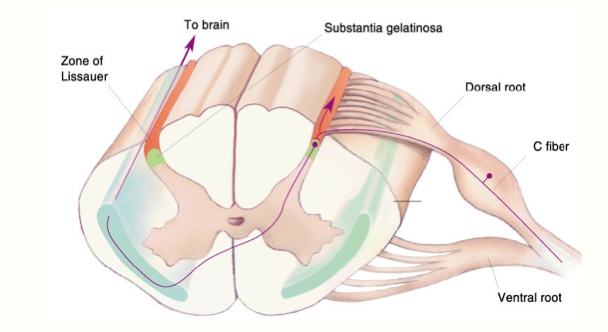
What are the spinal connections of the nociceptive axon terminals?
- afferent terminals enter the dorsal horn and project into the zone of lissauer
- afferent terminals synapse onto neurones of lamina I and lamina II (substantia gelatinosa)
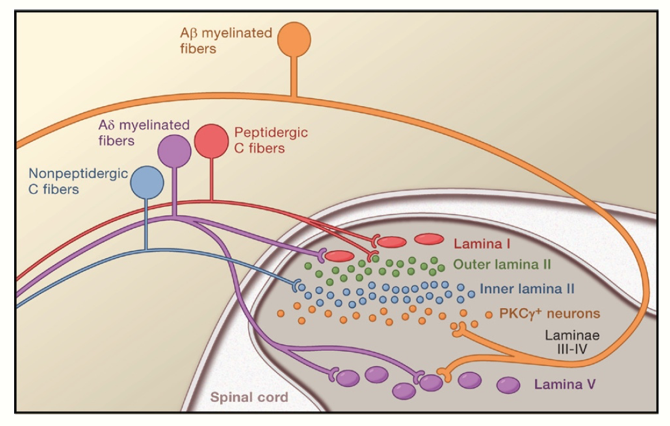
What are the connections between the primary afferent pain fibres and the spinal cord?
AB myelinated fibres:
- synapse with PKCy+ neurones and lamina V
Peptidergic C fibres:
- synapse with lamina I
Ad myelinated fibres:
- synapse with outer lamina II and lamina V
nonpeptidergic C fibres:
- synapse with inner lamina II
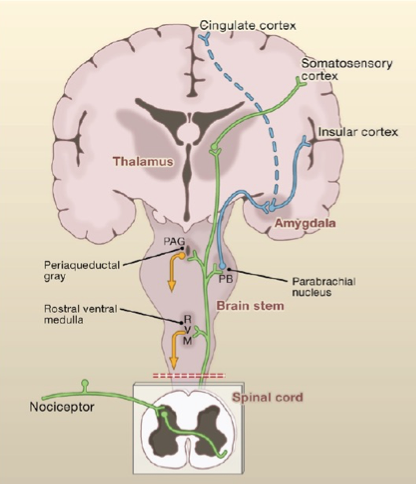
What are the 3 different neurones involved in the spinal pain pathway?
first order neurones:
- pseudounipolar neurones have a cell body in the DRG
second order neurones:
- cell body in Rexed lamina of spinal cord or cranial nerve nuclei in the brainstem
- decussate in anterior white commisure
- ascend cranially in the spinothalamic tract to the VPL of the thalamus
third order neurone:
- cell body in the VPL of the thalamus
- project via posterior limb of internal capsule to terminate in ipsilateral postcentral gyrus
- this is the primary somatosensory cortex
What are the specialised receptors that some first order neurones have?
What type of receptors are these?
nociceptors which are activated through various noxious stimuli
nociceptors exist as the free nerve endings of the primary afferent neurone
as they are free nerve endings, they are unencapsulated receptors
What are the 3 different types of nociceptors?
What type of stimulus do they detect?
mechanical nociceptors:
- detect sharp, prickling pain
thermal / mechano-thermal nociceptors:
- detect sensations which elicit pain which is slow and burning or cold and sharp in nature
polymodal nociceptors:
- detect mechanical, chemical and thermal stimuli
How are signals from mechanical, thermal and mechano-thermal nociceptors transmitted?
they are transmitted to the dorsal horn via Ad fibres
these are myelinated and have a low threshold for firing and fast conduction speed
they are responsible for transmitting the first pain
they permit localisation of pain
Where do Ad fibres terminate?
rexed lamina I
they mainly release the neurotransmitter glutamate
How do polymodal nociceptors transmit their signals to the dorsal horn?
via C-fibres
these are unmyelinated and have a slow conduction speed
they have large receptive fields and poor localisation of pain
Where do C fibres terminate?
in rexed laminae I and II
they release the neurotransmitter substance P
What are the roles of the cingulate cortex and insular cortex in pain perception?
cingulate cortex:
- acute pain perception
- development of chronic pain after peripheral nerve injury
insular cortex:
- part of the limbic system
- subjective feeling of pain and induce learning about the pain in other brain areas



-
Arthritis58
-
A1 - Pectoral Girdle & Shoulder102
-
A2 - Upper Arm & Elbow94
-
Peripheral Nerve Lesions - Brachial Plexus Injuries34
-
Upper Limb Ultrasound17
-
A3 - Forearm92
-
A4 - Wrist & Hand82
-
L1 - Anatomy of the Vertebral Column94
-
Back Pain51
-
Hip Fracture43
-
L2 - Pelvis & Hip Joint76
-
Gluteal Region & Hip58
-
The Knee Joint72
-
The Thigh & Knee Anatomy68
-
Posterior Thigh & Knee74
-
Leg & Ankle58
-
Vessels of the Lower Limb49
-
The Leg & Ankle Anatomy74
-
The Foot60
-
Lower Limb Radiology36
-
LL Ultrasound and Cases25
-
Lower Limb Muscles100
-
Muscles of the Upper Limb69
-
SDL 1 - FRONT OF NECK67
-
Introduction to the Brain41
-
The Skull22
-
Blood Supply to Brain & Meninges74
-
SDL 2 - Face & Skull89
-
SDL 3 - Brain, Meninges & Blood Supply44
-
Front of Neck Surface Anatomy10
-
Brainstem & Cerebellum65
-
SDL 4 - Brainstem, Cerebellum & Cranial Nerves65
-
Cranial Nerves67
-
Forebrain & Ventricles56
-
Localisation60
-
SDL 5 - FOREBRAIN, VENTRICLES & CSF39
-
Local Anaesthetics43
-
Spinal Cord & Spinal Nerves66
-
Ascending Pathways68
-
Descending Motor Pathways53
-
Transient Ischaemic Attack (TIA)35
-
Stroke37
-
SDL - Vertebral Column & Spinal Cord70
-
SDL 7 - SPINAL CORD & SPINAL NERVES18
-
Parkinson’s Disease58
-
Basal Ganglia55
-
Somatosensory Physiology57
-
Patterns of Sensory Loss40
-
Skin Histology45
-
Epilepsy75
-
Headache - Diagnosis & Management72
-
Radiotherapy & Chemotherapy for CNS Tumours66
-
Dementia84
-
Multiple Sclerosis43
-
Pain 152
-
Clinical Aspects of Pain75
-
General Anaesthesia77
-
The Auditory Pathway48
-
The Visual Pathway55
-
Visual Defects72
-
Cerebellum50
-
The Auditory System78
-
Physiology of Vision54
-
Limbic System49
-
Balance, Posture & Vestibular System0
-
Upper & Lower Motor Neurone Disorders27
-
Gait and Posture41
-
Pharmacology of Movement37
-
Diagnosing Weakness23



