Label the following structures surrounding the ear location
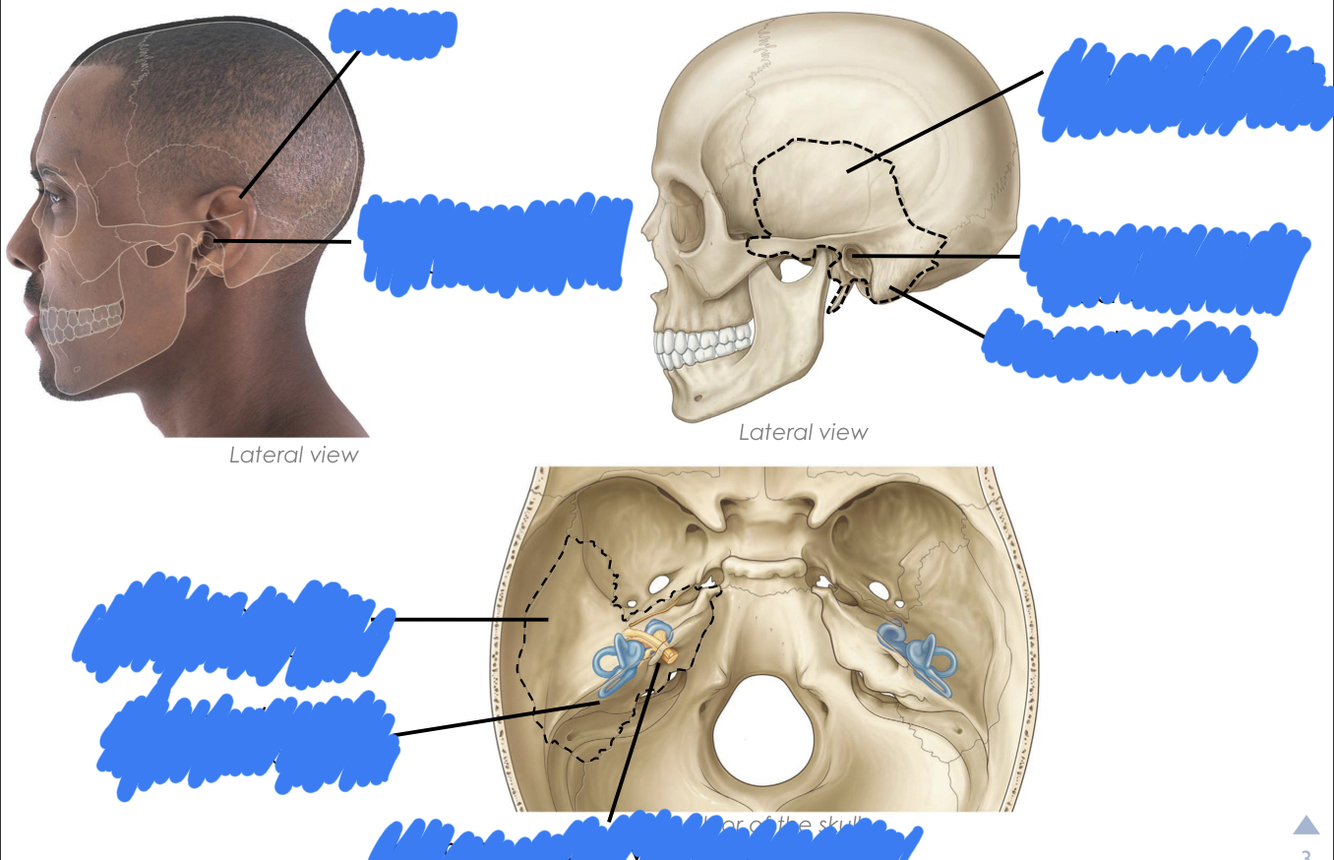
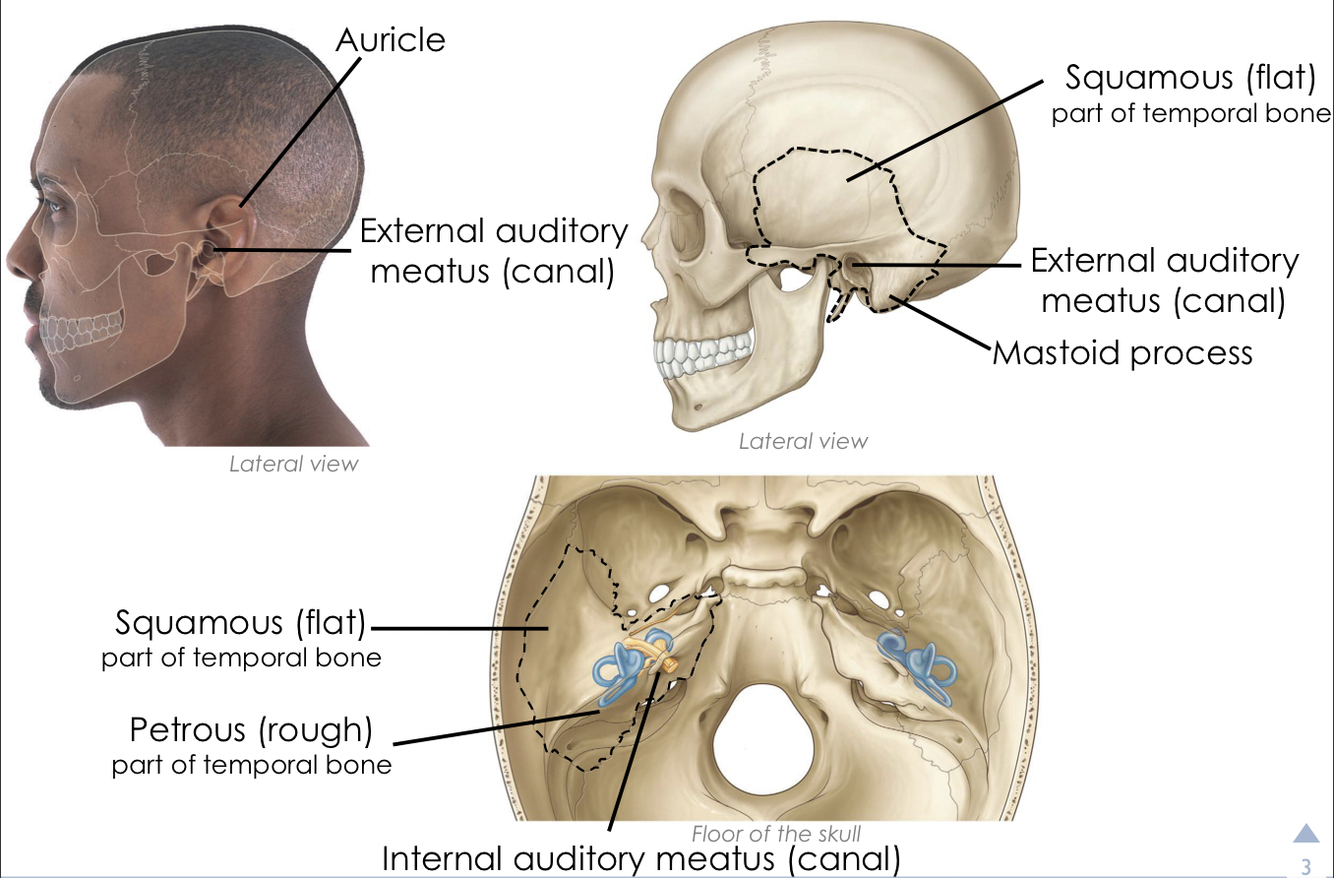
What are the 3 divisions of the ear?
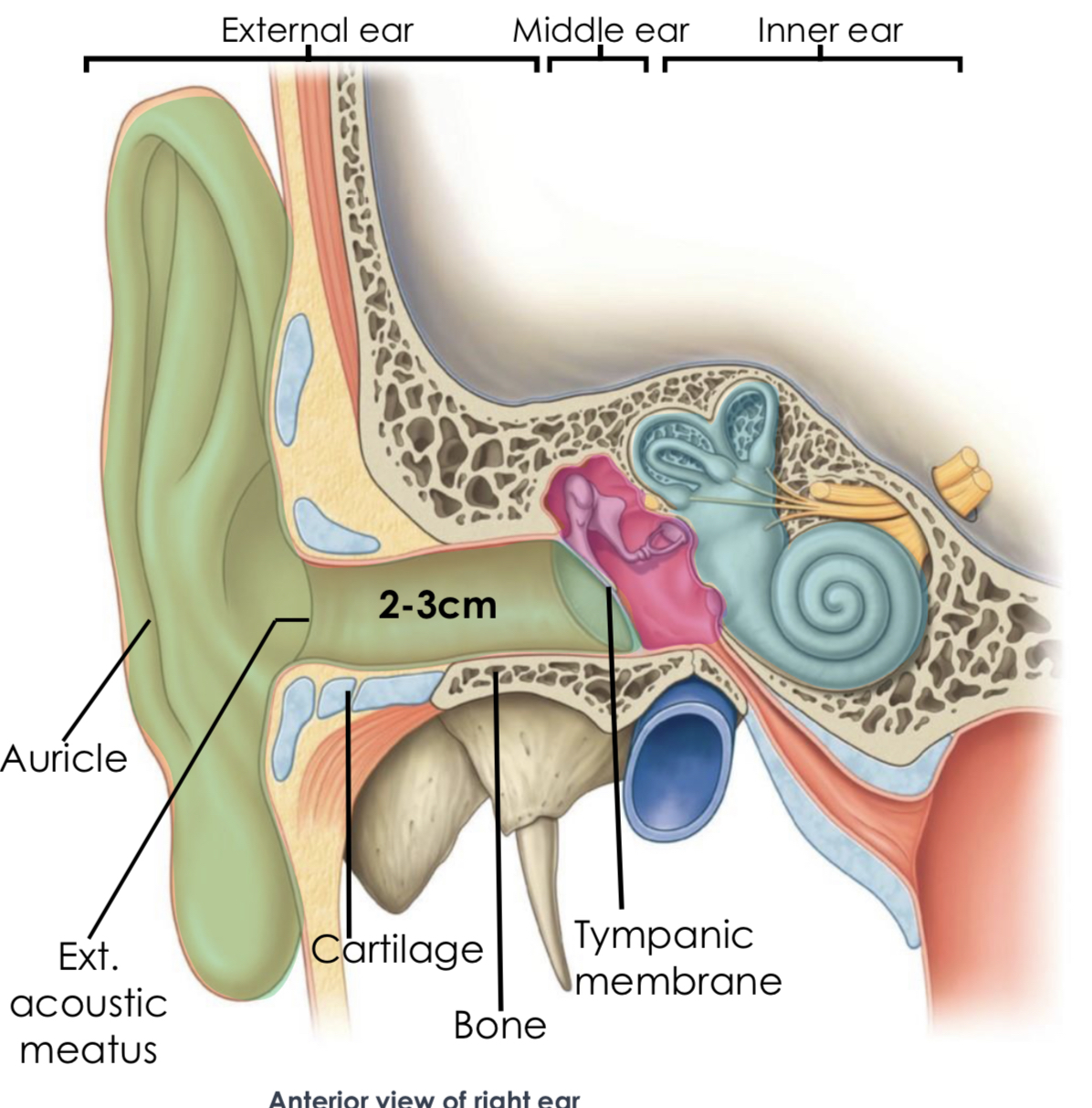
Label the diagram
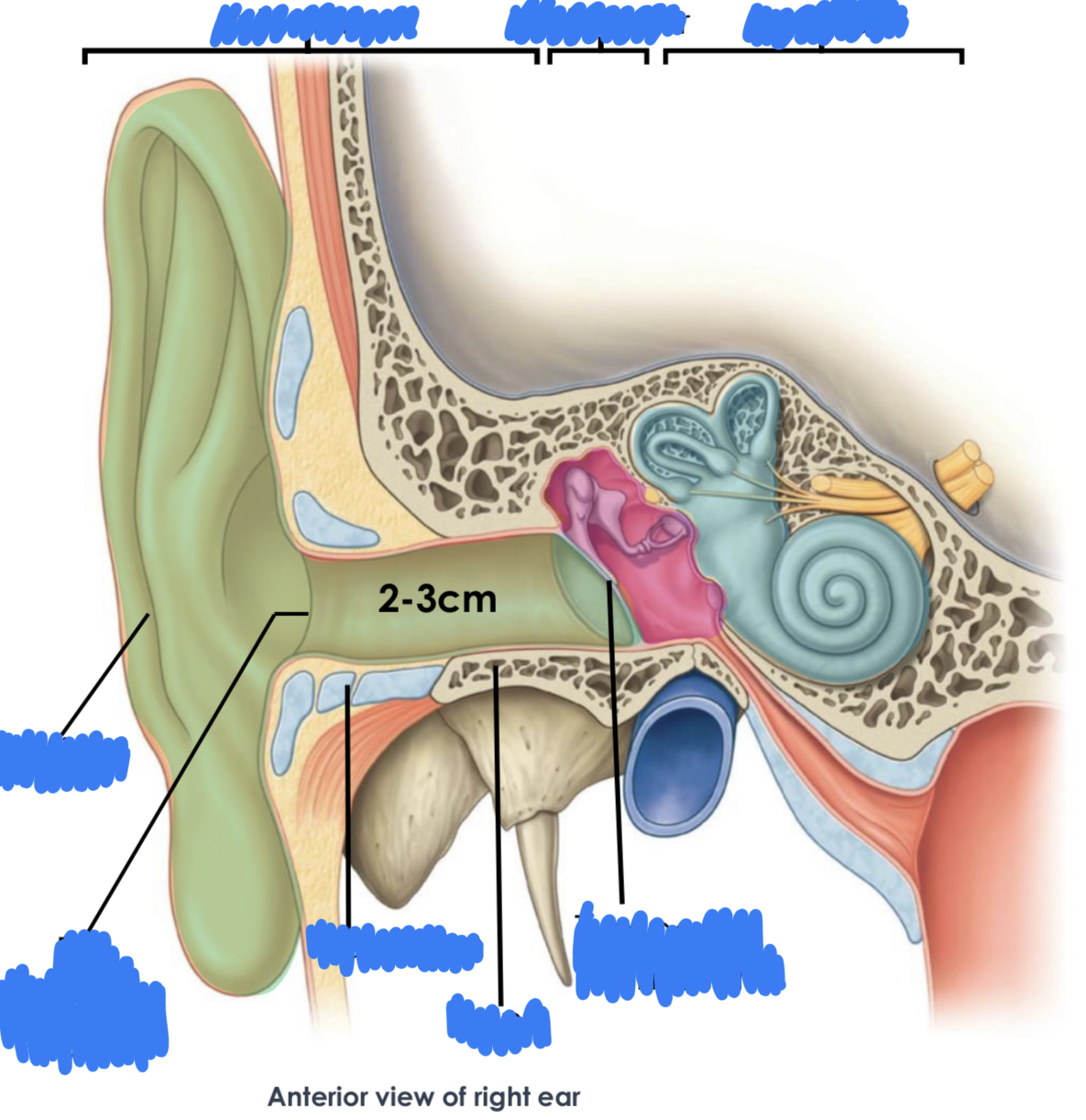
- External ear
- middle ear
- inner ear
What bone forms the bony part of the external ear?
Temporal bone
the mastoid process and styloid process are visible
What is the role of the external ear?
what is its composition like?
The external ear receives sound waves
the lateral 1/3 is cartilaginous and the medial 2/3s are bony
What is the role of the middle ear?
What is its composition like?
It is an air-filled space where sound waves are converted to mechanical energy
it contains ossicles
these are bones that mechanically vibrate
What is the role of the inner ear?
What is its composition like?
It converts mechanical energy to electrical energy
it contains the cochlea
there is a hollow cavity within the temporal bone through which CN III exits
What is the role of the tympanic membrane?
It separates the external ear and middle ear
The external auditory canal transmits sound waves towards the tympanic membrane (eardrum)
it physically moves when sound waves hit it, and transfers these waves to the middle ear
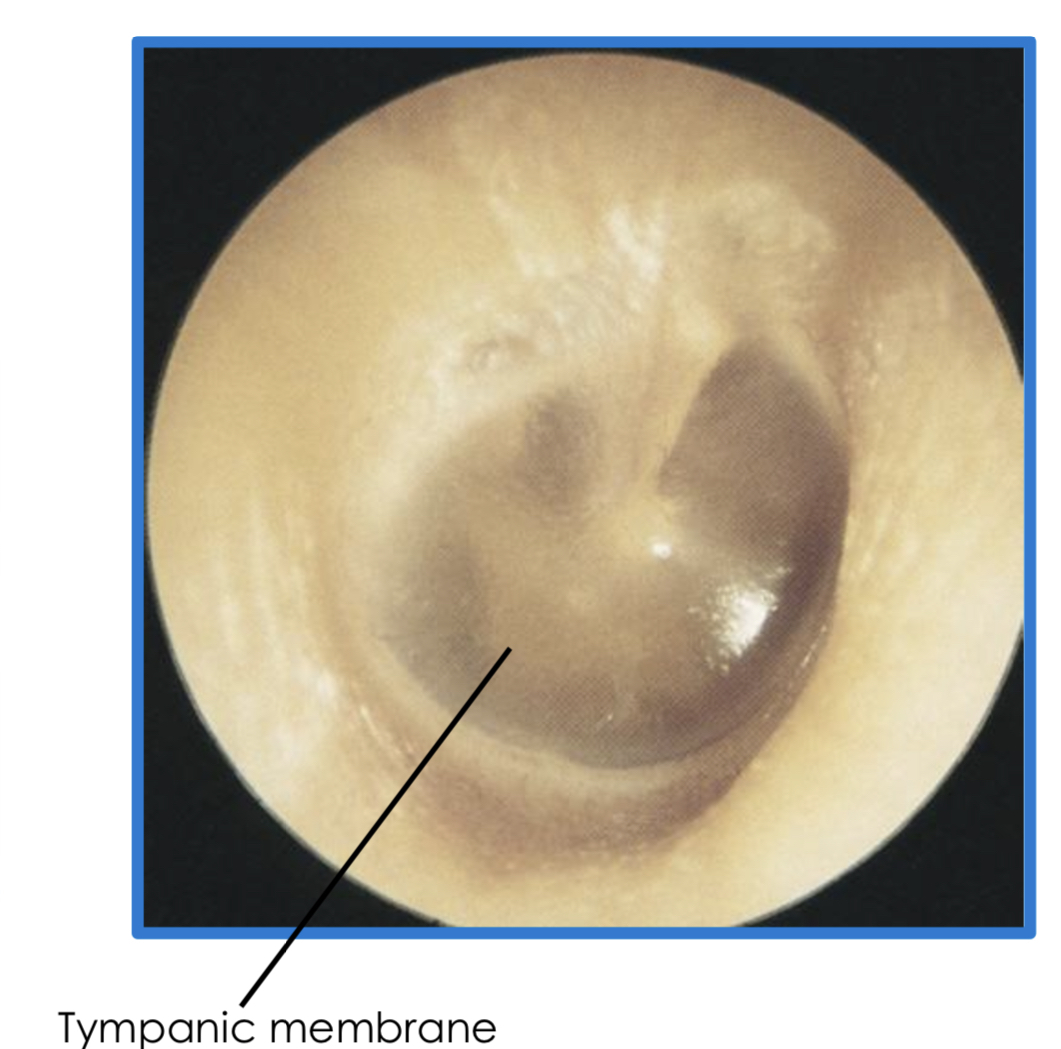
What is the composition of the middle ear like?
Which body part does it communicate with?
It is an air-filled space in the petrous part of the temporal bone
it communicates with the nasopharynx via the Eustachian tube (auditory tube)
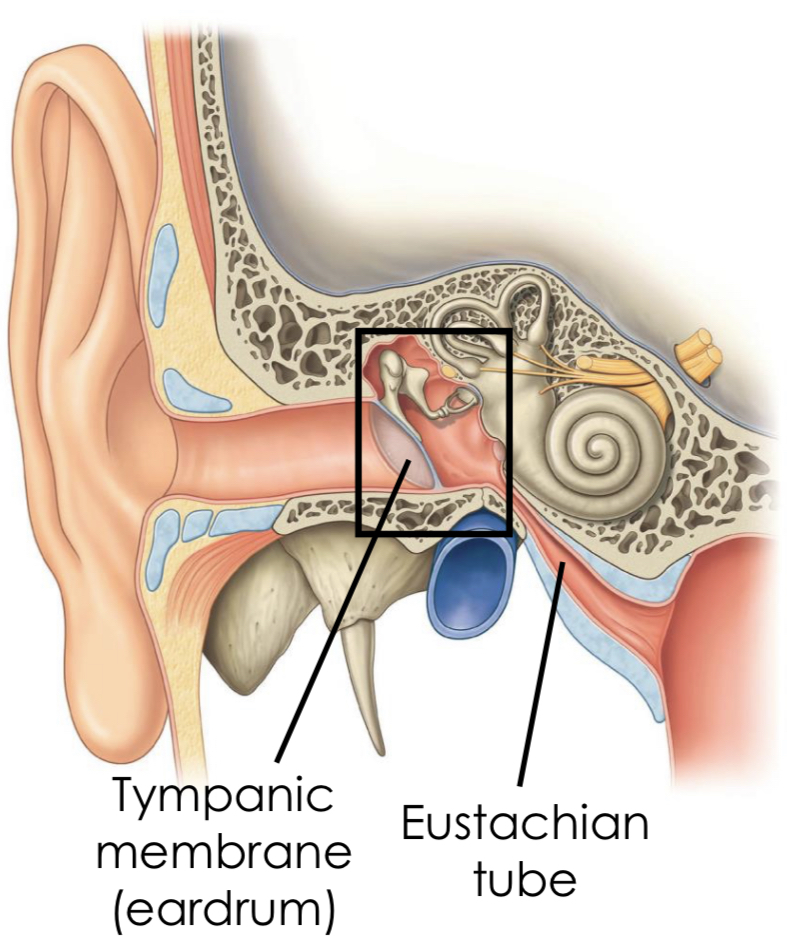
What bones are found within the middle ear?
What is their function?
The ossicles:
- Malleus
- Incus
- Stapes
they vibrate to transmit / amplify sound waves into the cochlea
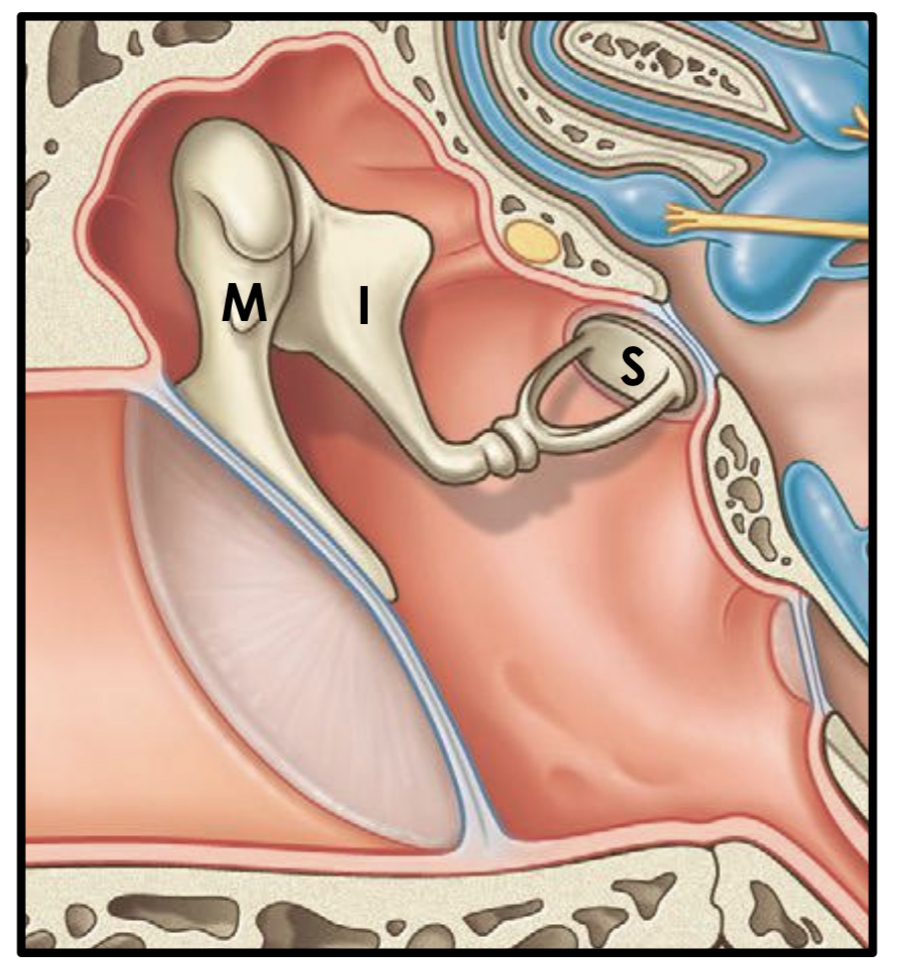
What happens to the ossicles with age?
The ossicles become calcified with age
this means that they are less flexible and able to move and vibrate
this leads to conductive hearing loss
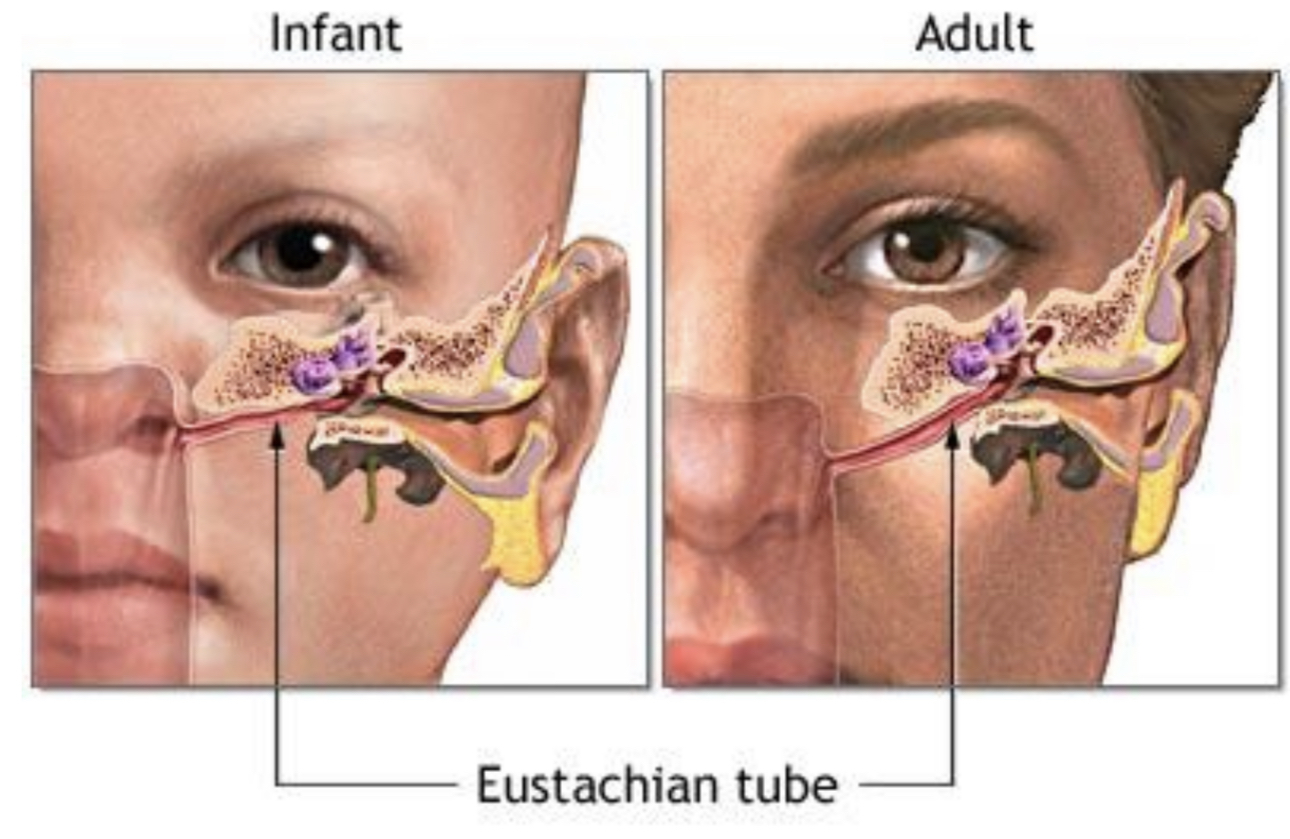
What is the role of the Eustachian tube?
what are its 3 functions?
It connects the nasopharynx to the middle ear
- it drains the middle ear to prevent accumulation of fluid
- it ventilates the middle ear
- it equalises pressure between atmospheric pressure and pressure within the ear
How is the Eustachian tube different in adults and children?
In an infant, the tube is more horizontal
this means there is a more direct route for infection, so more ear infections are seen in young children
Label the middle ear
What are the main connections shown?
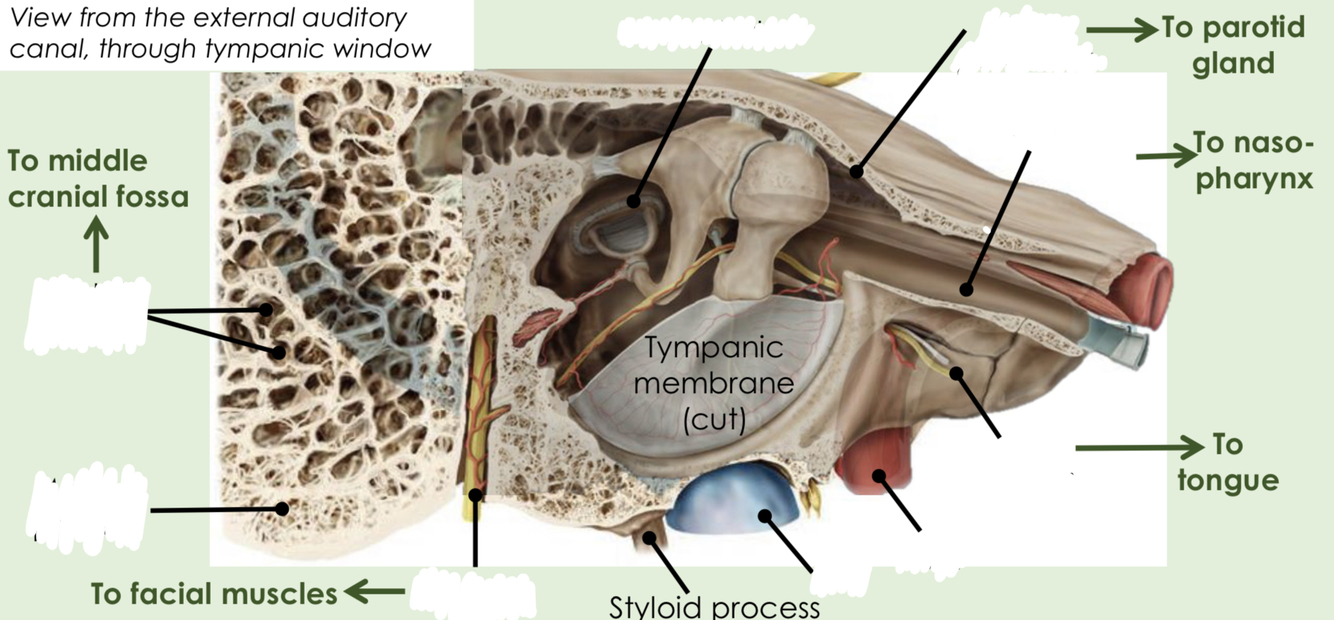
- The facial nerve supplies the facial muscles
- the chorda tympani (branch of facial nerve) supplies the anterior 2/3 of the tongue
- the lesser petrosal nerve (branch of facial nerve) supplies the parotid gland
- the Eustachian tube leads to the nasopharynx
- the mastoid air cells of the mastoid process are connected to the middle cranial fossa
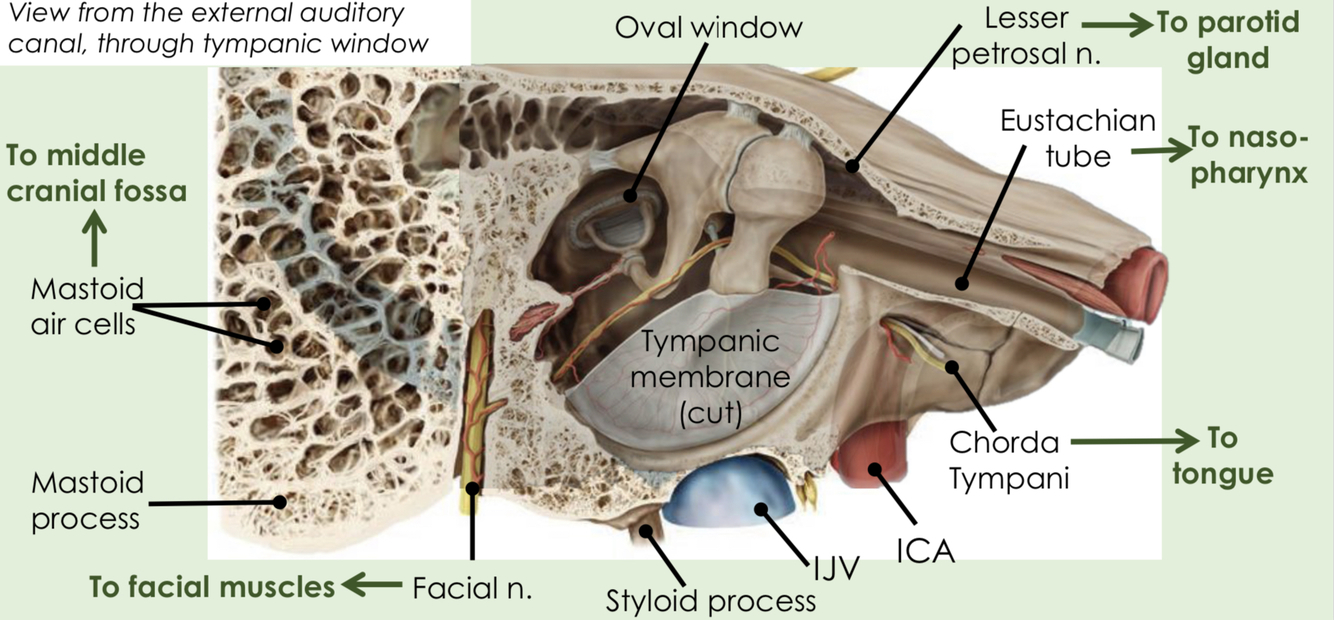
For which 5 reasons is the middle ear known as a high risk space?
- It is connected to the nasopharynx, making it prone to infection
- it is connected to the mastoid air cells - infection may spread to the middle cranial fossa
- the internal jugular vein lies inferior - infection leads to thrombosis risk
- the internal carotid artery lies anterior - link to pulsatile tinnutis
- traversed by chorda tympani & facial canal - risk of infection spreading to regions supplied by the facial nerve
What is meant by pulsatile tinnutis?
Tinnutis is the perception of sound when no external sound is present
it is “pulsatile” when the sound has the same rate as the heart rhythm
this occurs due to a change in blood pressure within the internal carotid artery
Where is the inner ear located?
What is its composition like?
Located within petrous part of temporal bone
it is composed of 2 special sense organs
- Vestibular system - balance & equilibrium (posture)
- Cochlear system (hearing)
What is meant by the cochlea being tonotopically organised?
Different parts of the cochlea detect different frequencies of sound
the apex detects lower frequency sounds
the base detects higher frequency sounds
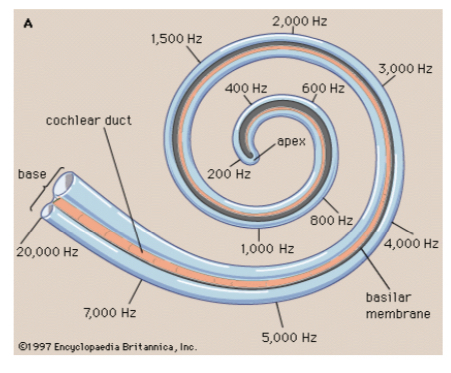
What nerve emerges from the cochlea?
How is it formed?
It is a snail-shaped cavity containing sensory receptors for sound
they synapse with spiral ganglia, whose axons fuse to form the cochlear division of the vestibulocochlear nerve (CN VIII)
this transfers sound information to the rest of the CNS
Label the inner ear
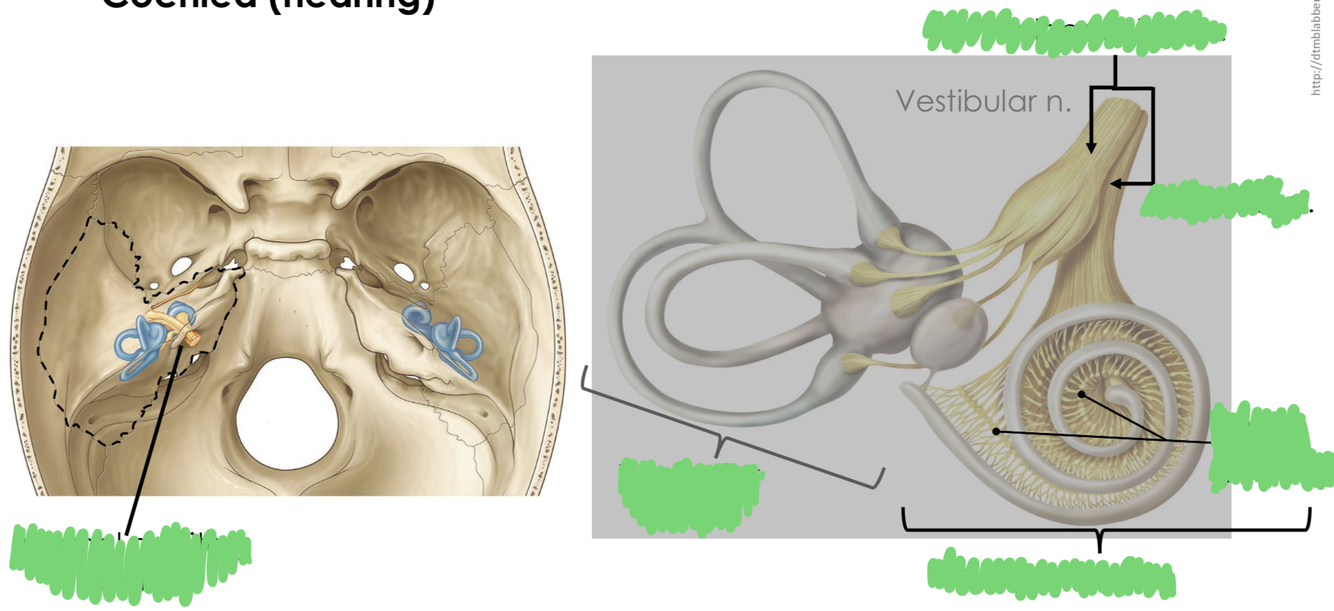
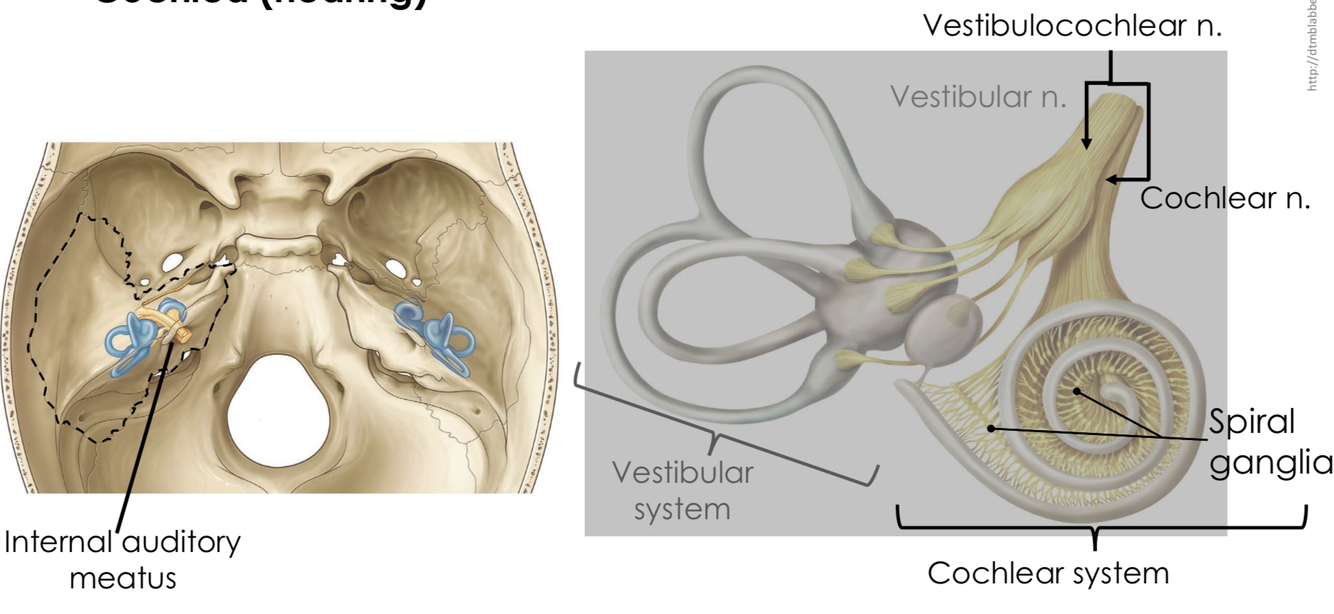
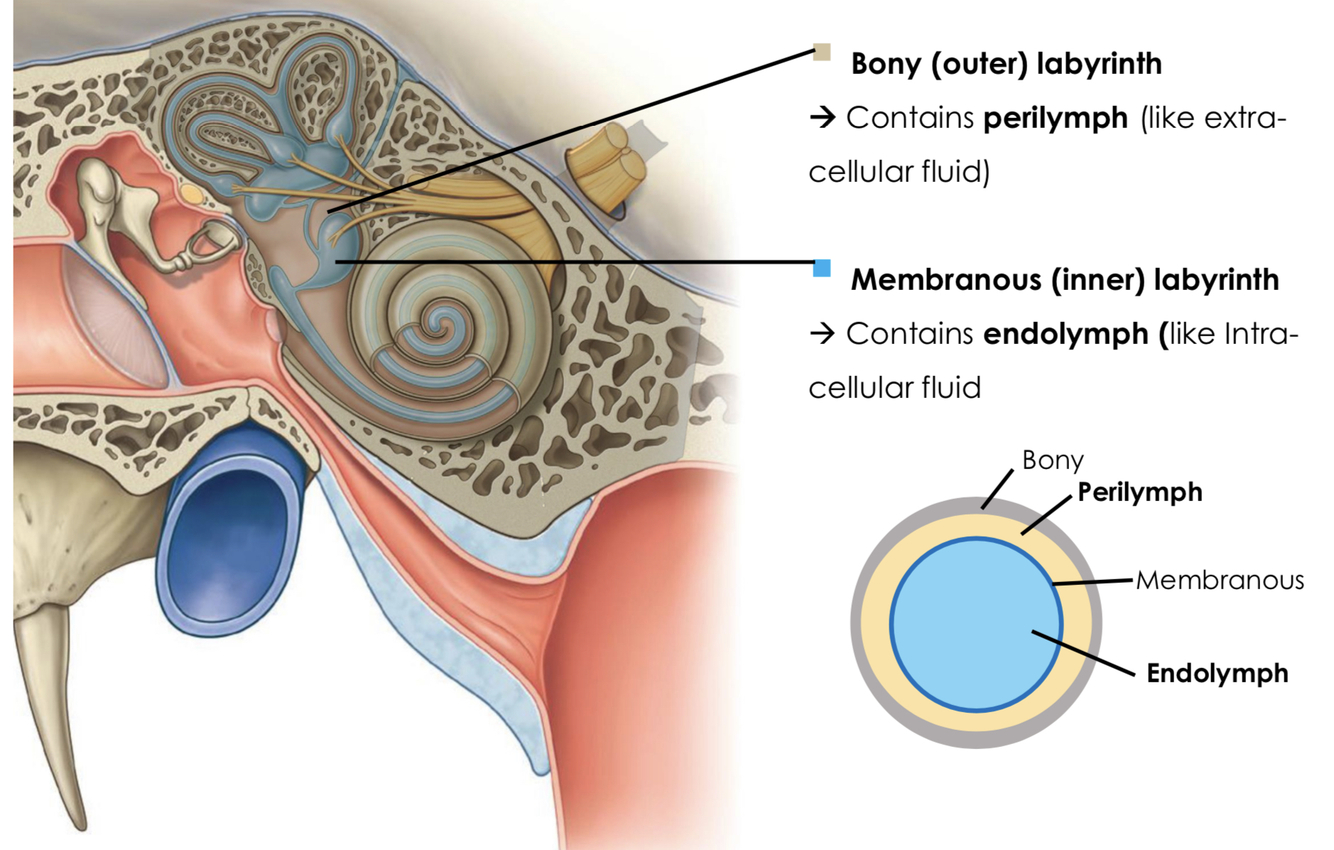
What are the 2 fluid-filled cavities within the inner ear?
What do they contain?
Bony (outer) labyrinth:
- this contains perilymph
- this is similar to extracellular fluid
Membranous (inner) labyrinth:
- this contains endolymph
- this is similar to intracellular fluid
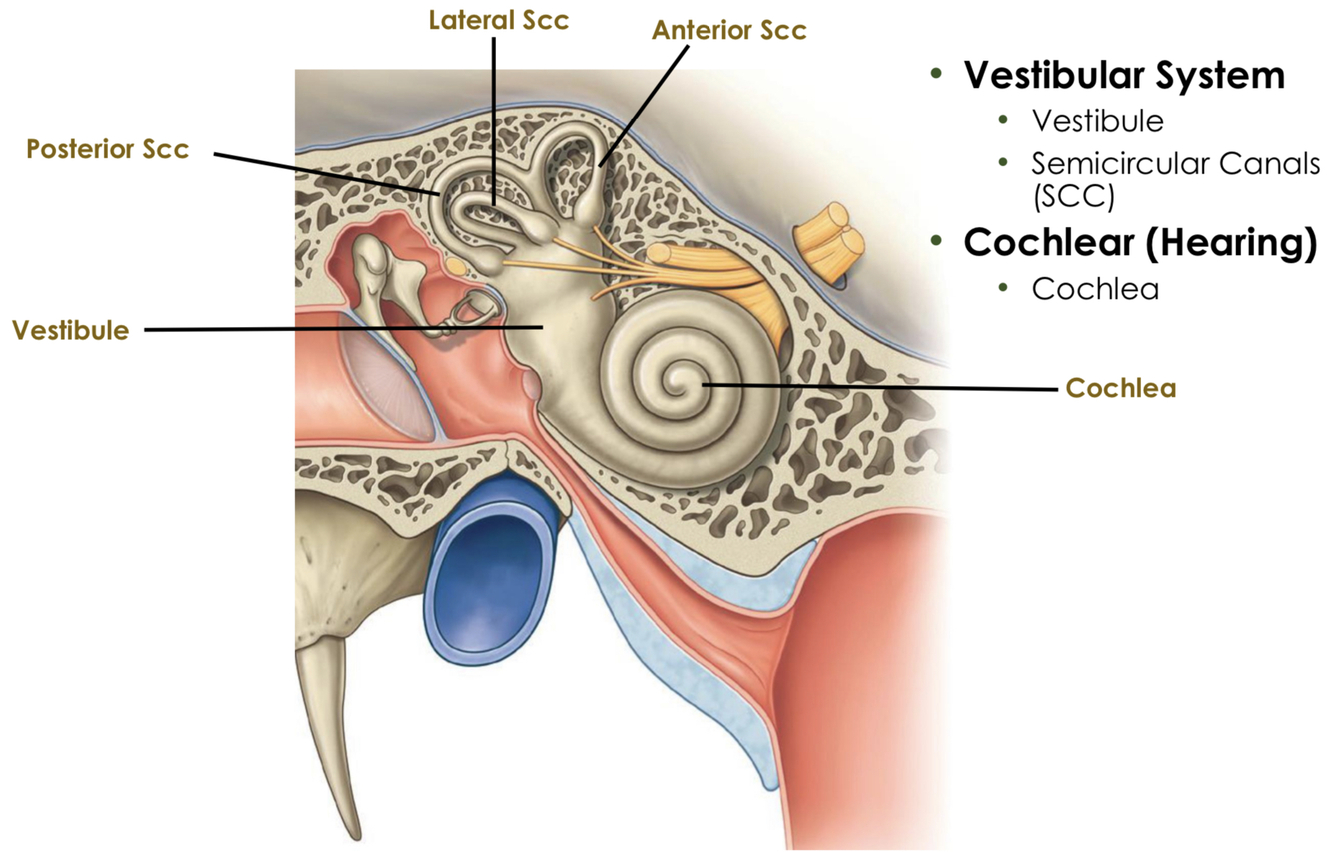
what are the components of the bony (outer) labyrinth?
Vestibular system:
- vestibule
- semicircular canals (SCC)
cochlear system:
- cochlea
these contain perilymph
What is the composition of the membranous (inner) labyrinth like?
Vestibular system:
- vestibule structures
- semicircular ducts
cochlear system:
- cochlear duct
these contain endolymph
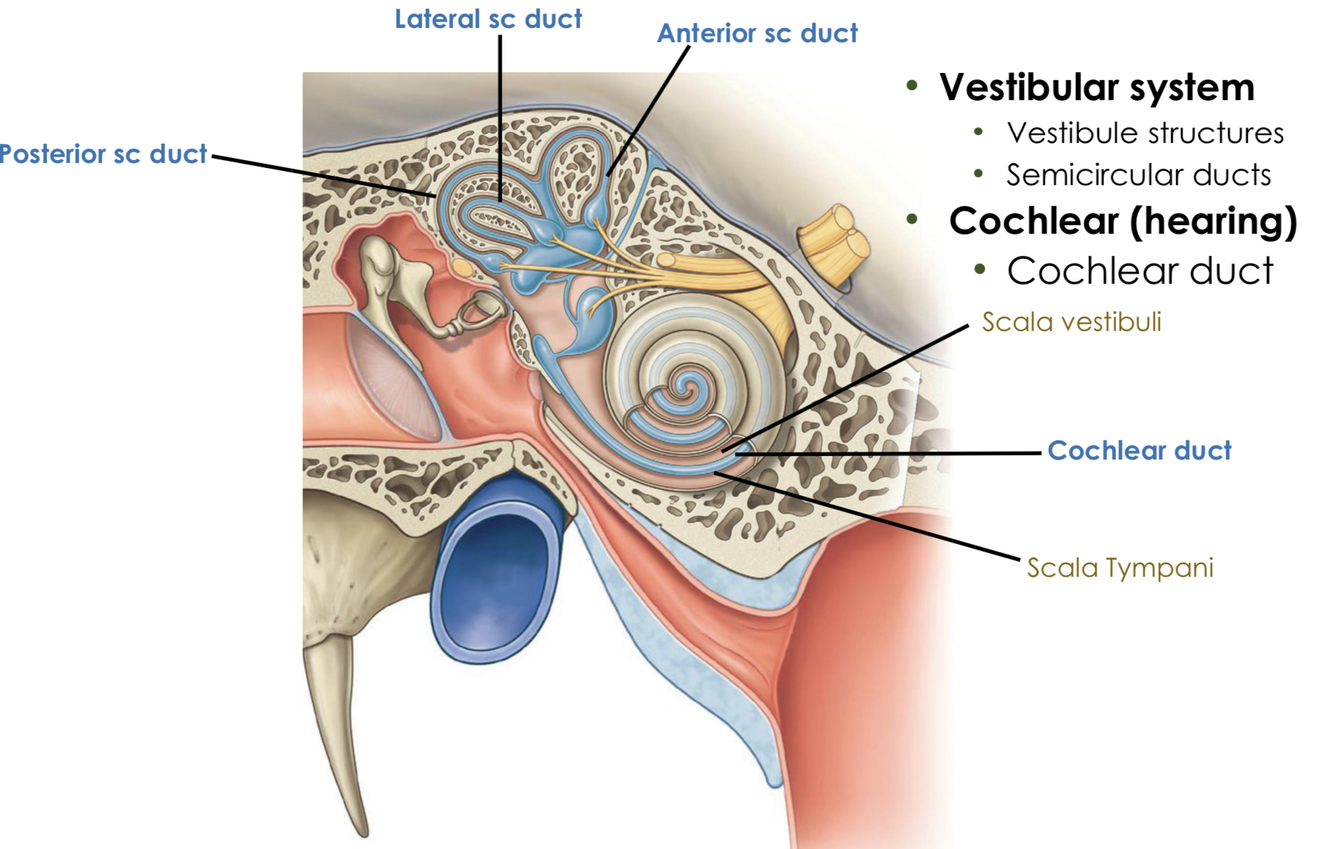
How does the cochlear duct separate the cochlea?
It separates the cochlea into two chambers:
- Scala vestibuli
- Scala tympani
these two chambers are continuous at the apex of the cochlea through a narrow slit (helicotrema)



-
Arthritis58
-
A1 - Pectoral Girdle & Shoulder102
-
A2 - Upper Arm & Elbow94
-
Peripheral Nerve Lesions - Brachial Plexus Injuries34
-
Upper Limb Ultrasound17
-
A3 - Forearm92
-
A4 - Wrist & Hand82
-
L1 - Anatomy of the Vertebral Column94
-
Back Pain51
-
Hip Fracture43
-
L2 - Pelvis & Hip Joint76
-
Gluteal Region & Hip58
-
The Knee Joint72
-
The Thigh & Knee Anatomy68
-
Posterior Thigh & Knee74
-
Leg & Ankle58
-
Vessels of the Lower Limb49
-
The Leg & Ankle Anatomy74
-
The Foot60
-
Lower Limb Radiology36
-
LL Ultrasound and Cases25
-
Lower Limb Muscles100
-
Muscles of the Upper Limb69
-
SDL 1 - FRONT OF NECK67
-
Introduction to the Brain41
-
The Skull22
-
Blood Supply to Brain & Meninges74
-
SDL 2 - Face & Skull89
-
SDL 3 - Brain, Meninges & Blood Supply44
-
Front of Neck Surface Anatomy10
-
Brainstem & Cerebellum65
-
SDL 4 - Brainstem, Cerebellum & Cranial Nerves65
-
Cranial Nerves67
-
Forebrain & Ventricles56
-
Localisation60
-
SDL 5 - FOREBRAIN, VENTRICLES & CSF39
-
Local Anaesthetics43
-
Spinal Cord & Spinal Nerves66
-
Ascending Pathways68
-
Descending Motor Pathways53
-
Transient Ischaemic Attack (TIA)35
-
Stroke37
-
SDL - Vertebral Column & Spinal Cord70
-
SDL 7 - SPINAL CORD & SPINAL NERVES18
-
Parkinson’s Disease58
-
Basal Ganglia55
-
Somatosensory Physiology57
-
Patterns of Sensory Loss40
-
Skin Histology45
-
Epilepsy75
-
Headache - Diagnosis & Management72
-
Radiotherapy & Chemotherapy for CNS Tumours66
-
Dementia84
-
Multiple Sclerosis43
-
Pain 152
-
Clinical Aspects of Pain75
-
General Anaesthesia77
-
The Auditory Pathway48
-
The Visual Pathway55
-
Visual Defects72
-
Cerebellum50
-
The Auditory System78
-
Physiology of Vision54
-
Limbic System49
-
Balance, Posture & Vestibular System0
-
Upper & Lower Motor Neurone Disorders27
-
Gait and Posture41
-
Pharmacology of Movement37
-
Diagnosing Weakness23



