What is meant by “gait and posture”?
What kind of activities could be involved?
gait and posture refers to all activities that we do that transfer the weight of our body and move us in a certain direction
- going from sitting to standing
- standing still
- walking
- running
- jumping
- climbing steps
- rowing
- cycling
What is bipedalism?
the way in which humans walk using two legs, rather than 4
Why do toddlers tend to crawl before learning how to walk?
not all babies crawl before walking
muscle mass has not developed enough
toddlers are going through a rapid change in brain development and they do not have the coordination / balance yet to be able to walk on 2 legs
when babies start to stand, they tend to hold onto things and pull themselves up to stand and balance
What is shown in this image and what does it suggest?
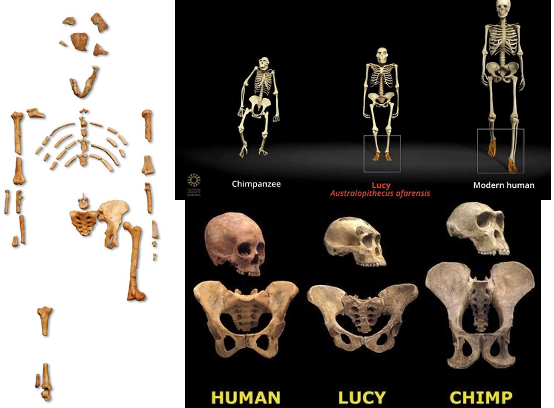
“Lucy” - a skeleton found showing a very small / short figure
but had the anatomy of a biped - broad pelvis and femurs angled towards the midline
When did hominids start to grow taller?
Why did this happen?
the first hominids could walk upright but still have features of a more primitive species - short legs and long arms
1.9 million years ago hominids grew taller, with longer legs
there are many theories about why we move on 2 feet, but no definitive answer
e.g. change of environment made being bipedal more advantageous
What is gait?
how we translocate the centre of body mass in the direction of locomotion
joint motion, muscle activity and load bearing of limbs is generally symmetrical
gait is a cyclic activity with each cycle lasting about 1 second
Why do we study gait?
physicians need sound knowledge of normal gait so they can accurately detect and interpret deviations from normal gait pattern
it is important to note that each individual displays certain variations from the norm, which are superimposed on the normal pattern of walking
Is everyone’s gait the same?
everybody has their own characterisitc pattern:
- stride length
- pelvic movement
- upper body position
What factors affect gait in normal people?
- height
- weight
- build
- clothing
- shoes
- weight carriage
- age
What is meant by “weight carriage” affecting gait?
someone being heavier can affect their gait in different ways
an overweight person tends to walk with wider gait
in pregnancy, the weight is not evenly distributed around the body so this will affect their gait differently
How does alcohol affect gait?
alcohol affects the cerebellum, which is important for balance and posture
posture / gait becomes abnormal and unsteady when the cerebellum is affected by alcohol
the cerebellum can become atrophied if someone abuses alcohol over a long period of time
patients with an alcohol problem have an irreversible change in their gait - tend to have a wider base & difficulty with balance
What 4 factors does normal gait rely on?
Joints:
- intact bones & well functioning joints
Muscles:
- adequate muscle strength to support joints / bodyweight
Nerves:
- CNS & PNS supply the muscles
Vision:
- including vestibular and auditory systems
What is the importance of vision in ensuring normal gait?
provides information about the movement of the head and body relative to the surroundings
it is important for the automatic balance responses to changes in surface conditions
once visual cues are taken away, gait changes and people do not move as fluidly or quickly as they are thinking about potential danger
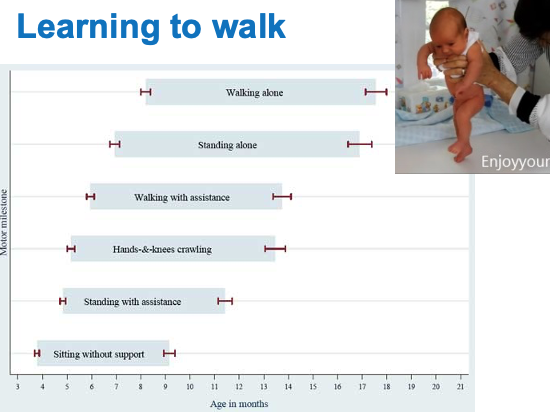
What are the stages involved in learning to walk?
By what age is this usually complete?
- sitting without support
- standing with assistance
- hands and knees crawling
- walking with assitance
- standing alone
- walking alone
the time frame is very variable but most babies are walking by 18 months
they tend to start by pulling themselves up using furniture and using this to balance as they pull themselves along
What are the main factors influencing gait changes in the elderly?
- decreased muscle bulk
- decreased strength and flexibility
- some loss of hearing and vision
Why is it important to encourage elderly people to stay active?
from age 35, people start to lose muscle mass
muscle atrophy is present in the elderly, affecting their gait, even if they do not have any pathology
encouraging the elderly to stay active and maintain the muscle mass reduces the risk of falls
What are the gait changes that can be seen in the elderly?
major changes:
- reduction in velocity
- reduction in step / stride length
minor changes:
- decreased arm swing
- decreased rotation of the pelvis
to increase velocity, the elderly tend to take more steps instead of increasing stride length
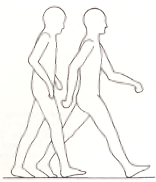
What is the difference in the way drunk and elderly people fall?
elderly:
- elderly people tend to fall forwards and sustain facial injuries
- taking more shorter steps increases this risk
drunk people:
- drunk people tend to fall backwards
- this also affects people with cerebellar damage
What is different in the elderly when it comes to heel strike?
they have a more flat-footed approach to both heel strike and push off
Why are many muscles active during standing?
standing supports body weight and minimises energy expenditure
the hips and knees are stable as they are extended
this minimises the need for muscular contraction during standing
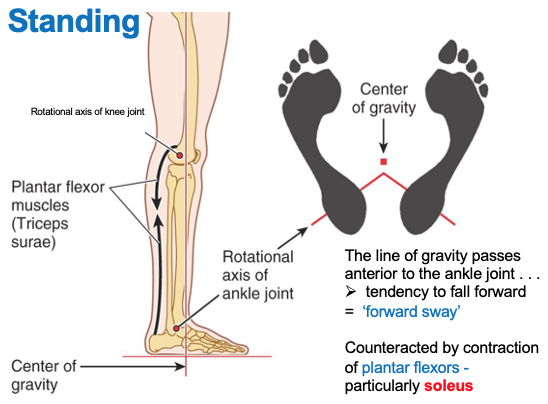
Where is the centre of gravity of the body?
centre of gravity is just anterior to S2 vertebra
it is slightly posterior to the hips
it is anterior to the knee and ankle
muscles in the leg need to be active during standing to maintain the centre of gravity and keep us upright
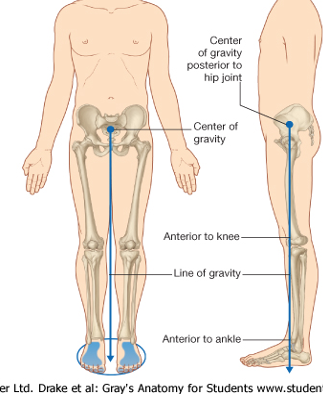
What is the consequence of the centre of gravity passing anterior to the ankle joint?
How is this counteracted?
this leads to a tendency to fall forwards - “forward sway”
this is counteracted by contraction of the plantar flexors
particularly soleus, but also gastrocnemius
the plantar flexors are the muscles which would point the toes towards the floor
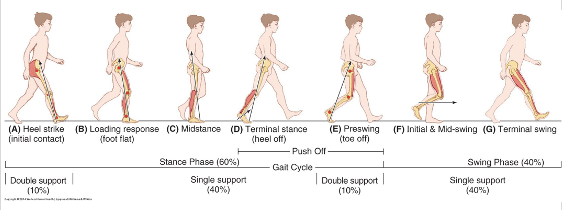
What are the 2 phases of the gait cycle?
stance phase:
- makes up 60% of the gait cycle
- the foot is in contact with the ground
swing phase:
- makes up 40% of the gait cycle
- the foot is in the air
the start and end of the stance phase is marked by a short period of double support (10%) in which both feet are on the ground
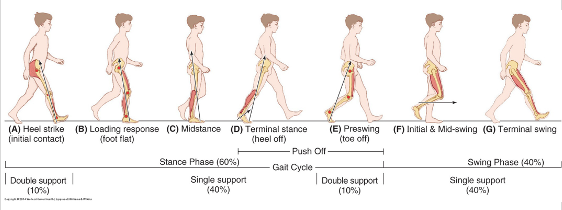
What are the 7 stages involved in the gait cycle?
- heel strike (initial contact)
- loading response (foot flat)
- midstance
- terminal stance (heel off)
- preswing (toe off)
- initial and midswing
- terminal swing



-
Arthritis58
-
A1 - Pectoral Girdle & Shoulder102
-
A2 - Upper Arm & Elbow94
-
Peripheral Nerve Lesions - Brachial Plexus Injuries34
-
Upper Limb Ultrasound17
-
A3 - Forearm92
-
A4 - Wrist & Hand82
-
L1 - Anatomy of the Vertebral Column94
-
Back Pain51
-
Hip Fracture43
-
L2 - Pelvis & Hip Joint76
-
Gluteal Region & Hip58
-
The Knee Joint72
-
The Thigh & Knee Anatomy68
-
Posterior Thigh & Knee74
-
Leg & Ankle58
-
Vessels of the Lower Limb49
-
The Leg & Ankle Anatomy74
-
The Foot60
-
Lower Limb Radiology36
-
LL Ultrasound and Cases25
-
Lower Limb Muscles100
-
Muscles of the Upper Limb69
-
SDL 1 - FRONT OF NECK67
-
Introduction to the Brain41
-
The Skull22
-
Blood Supply to Brain & Meninges74
-
SDL 2 - Face & Skull89
-
SDL 3 - Brain, Meninges & Blood Supply44
-
Front of Neck Surface Anatomy10
-
Brainstem & Cerebellum65
-
SDL 4 - Brainstem, Cerebellum & Cranial Nerves65
-
Cranial Nerves67
-
Forebrain & Ventricles56
-
Localisation60
-
SDL 5 - FOREBRAIN, VENTRICLES & CSF39
-
Local Anaesthetics43
-
Spinal Cord & Spinal Nerves66
-
Ascending Pathways68
-
Descending Motor Pathways53
-
Transient Ischaemic Attack (TIA)35
-
Stroke37
-
SDL - Vertebral Column & Spinal Cord70
-
SDL 7 - SPINAL CORD & SPINAL NERVES18
-
Parkinson’s Disease58
-
Basal Ganglia55
-
Somatosensory Physiology57
-
Patterns of Sensory Loss40
-
Skin Histology45
-
Epilepsy75
-
Headache - Diagnosis & Management72
-
Radiotherapy & Chemotherapy for CNS Tumours66
-
Dementia84
-
Multiple Sclerosis43
-
Pain 152
-
Clinical Aspects of Pain75
-
General Anaesthesia77
-
The Auditory Pathway48
-
The Visual Pathway55
-
Visual Defects72
-
Cerebellum50
-
The Auditory System78
-
Physiology of Vision54
-
Limbic System49
-
Balance, Posture & Vestibular System0
-
Upper & Lower Motor Neurone Disorders27
-
Gait and Posture41
-
Pharmacology of Movement37
-
Diagnosing Weakness23



