How many bones make up the skull?
What types of joints connect these bones?
22 bones
These are connected by fibrous sutures - a type of joint that is not moveable
The temporomandibular joints are synovial and moveable
Label the visible bones of the skull
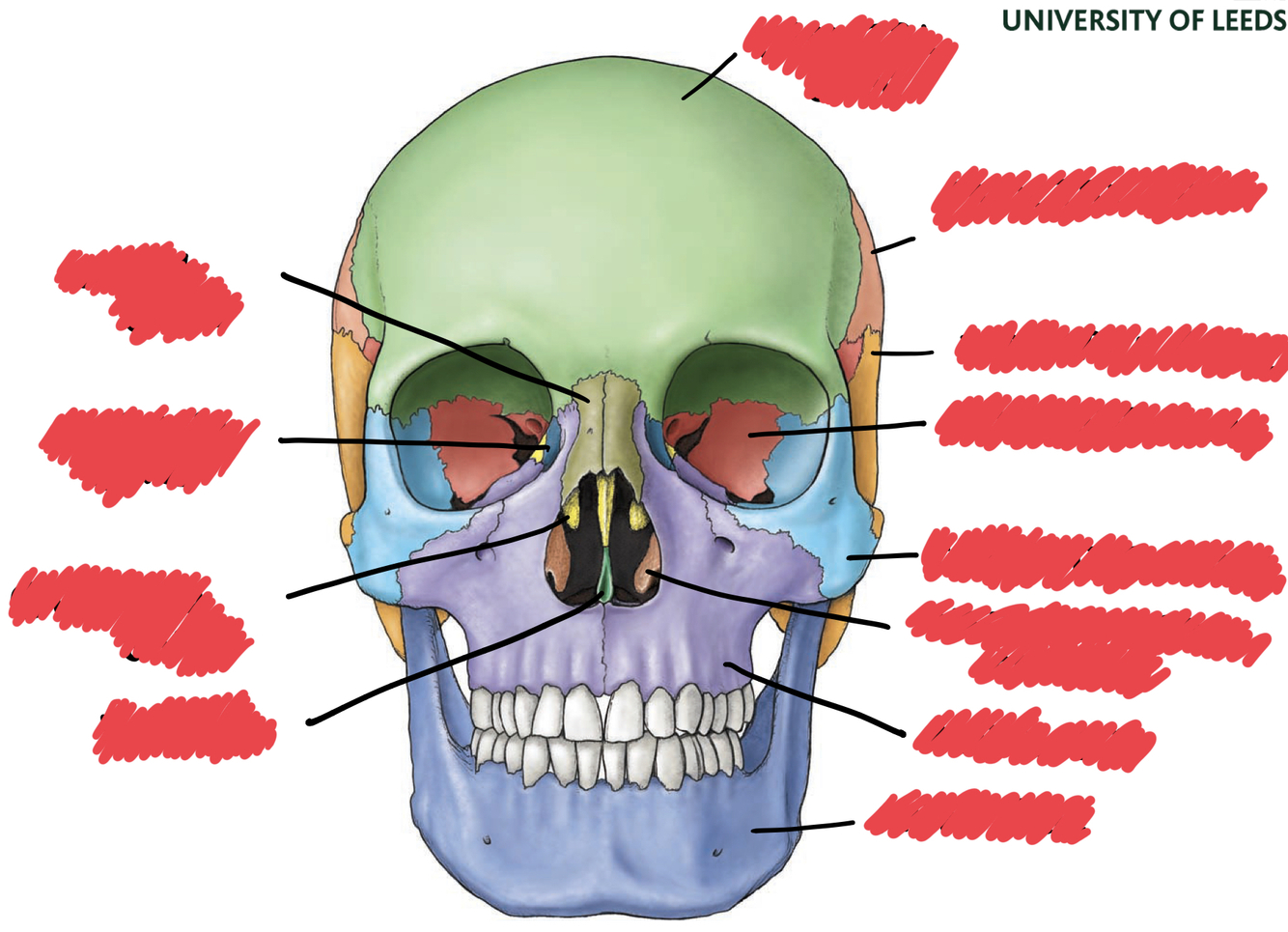
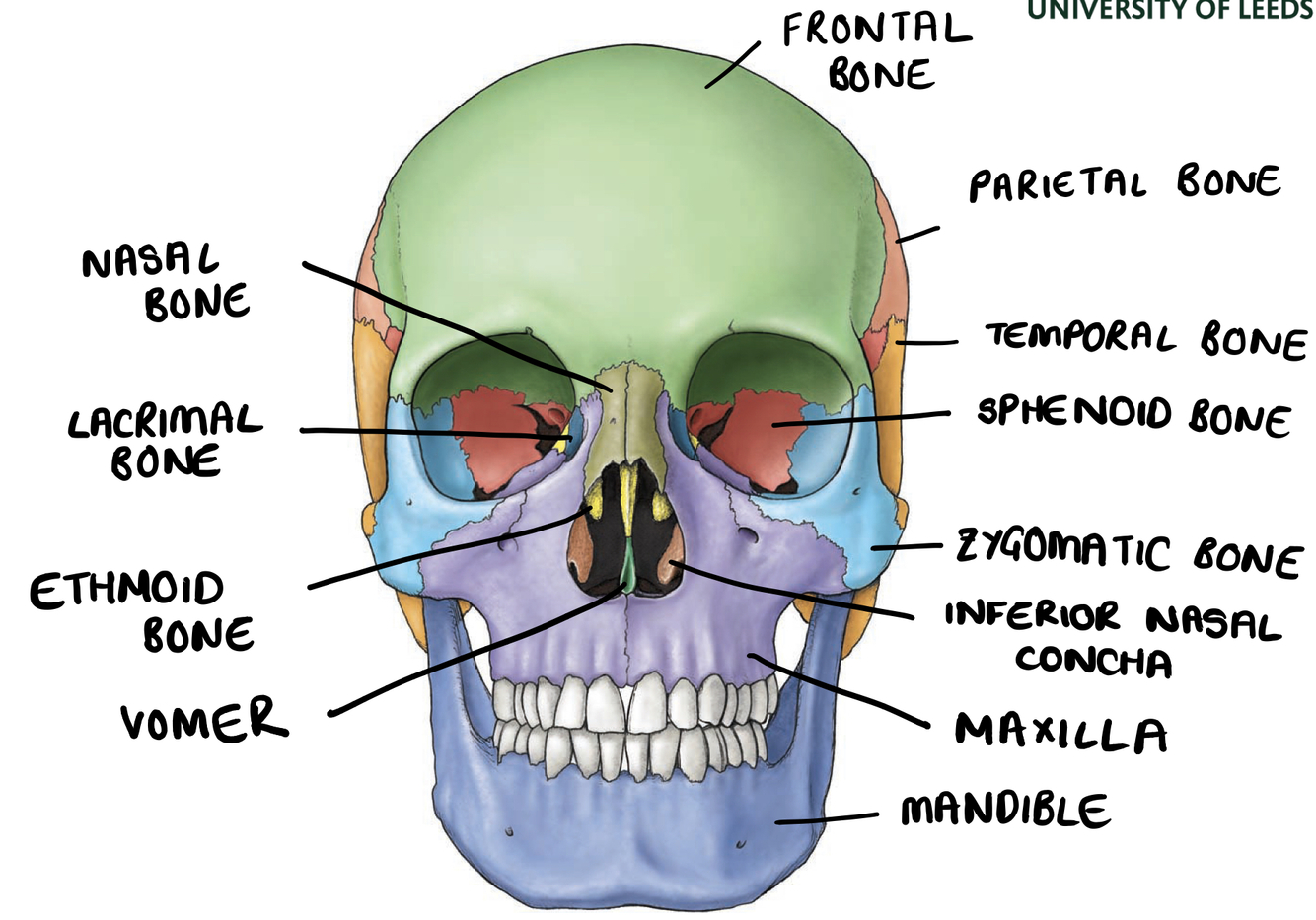
What 2 bones make up the nasal septum?
ethmoid and vomer
Why is there only an inferior nasal concha?
The superior and middle conchae are part of the ethmoid bone
What are the 4 paranasal sinuses?
- Frontal sinuses
- Ethmoidal cells
- Maxillary sinuses
- Sphenoidal sinus
Label the paranasal sinuses
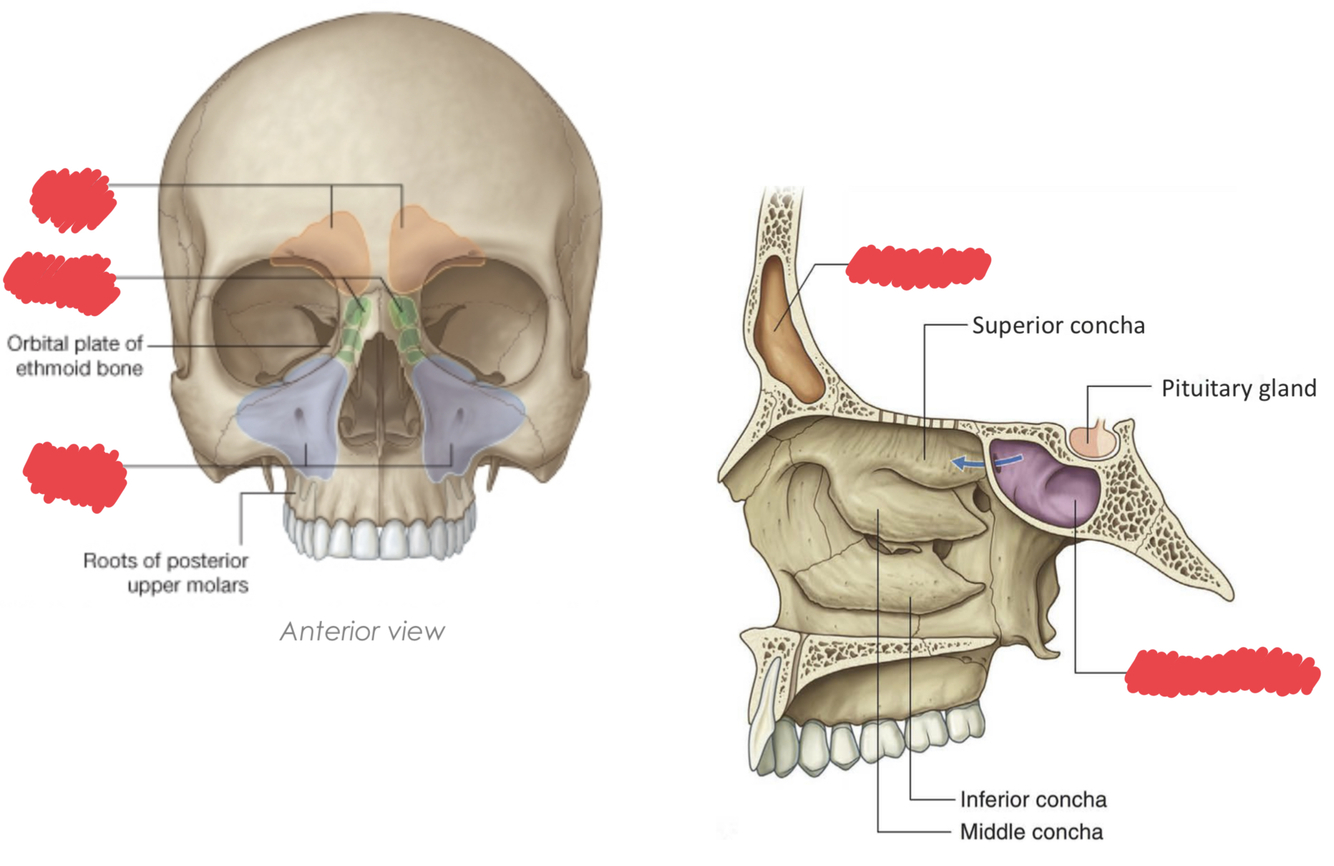
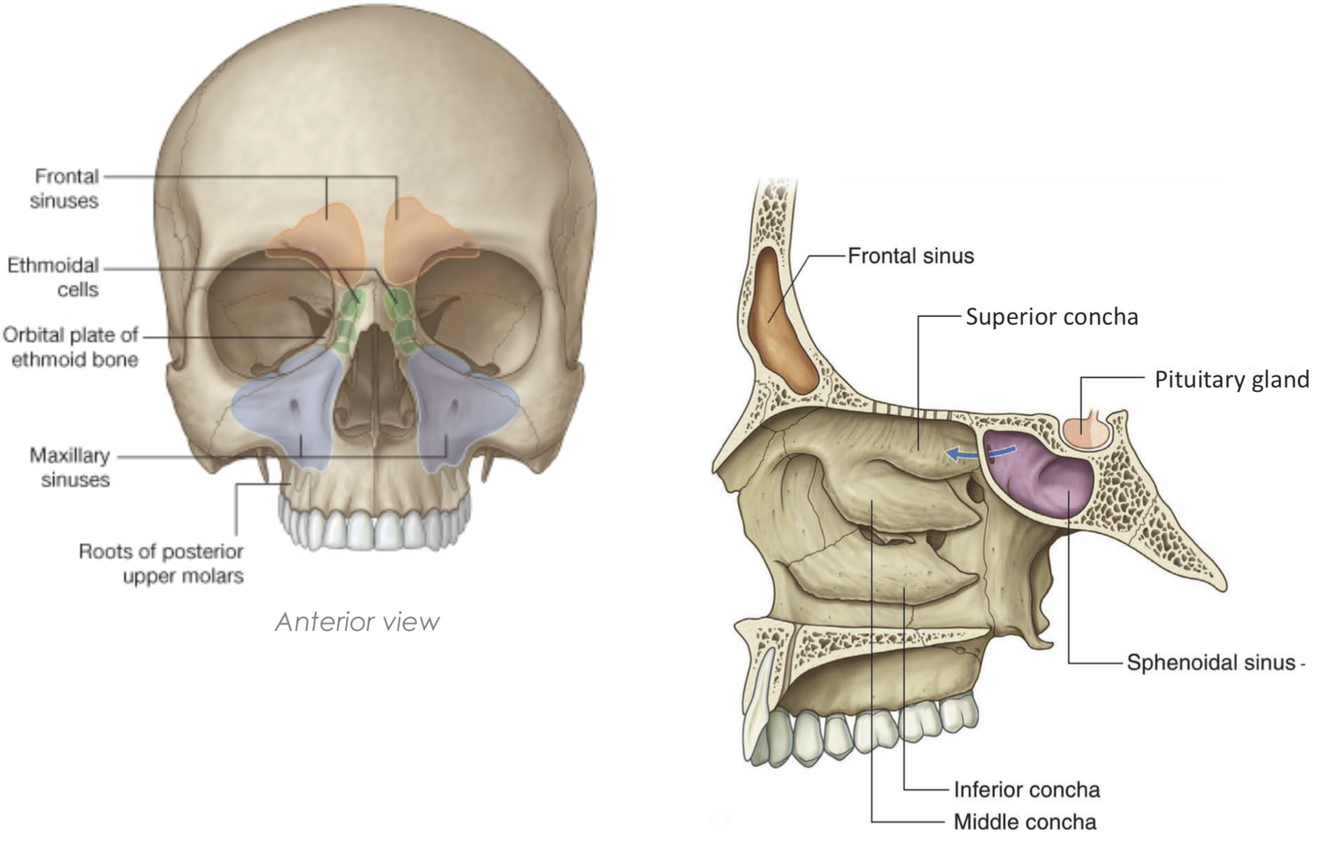
What are the functions of the paranasal sinuses?
- To lighten the weight of the skull
- Drainage into specific areas of the nasal cavity
- Humidify the air
What are the meatuses?
what drains into them?
an opening for the passage of air, located underneath the corresponding concha
superior meatus:
- ethmoidal and sphenoidal sinuses drain here
middle meatus:
- maxillary and frontal sinuses drain here
inferior meatus:
- nasolacrimal duct drains here
Label the bones of the skull from a lateral view
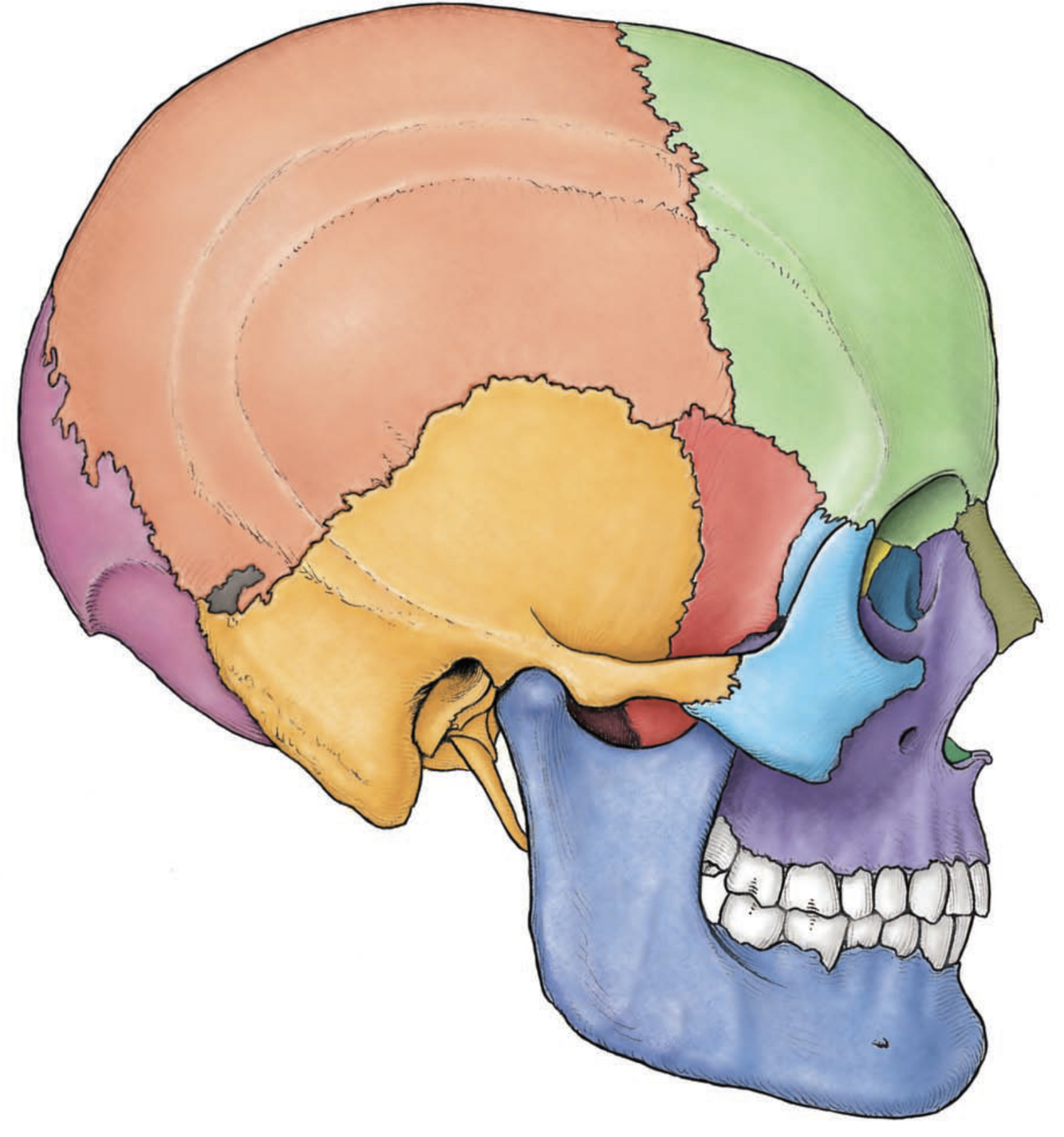
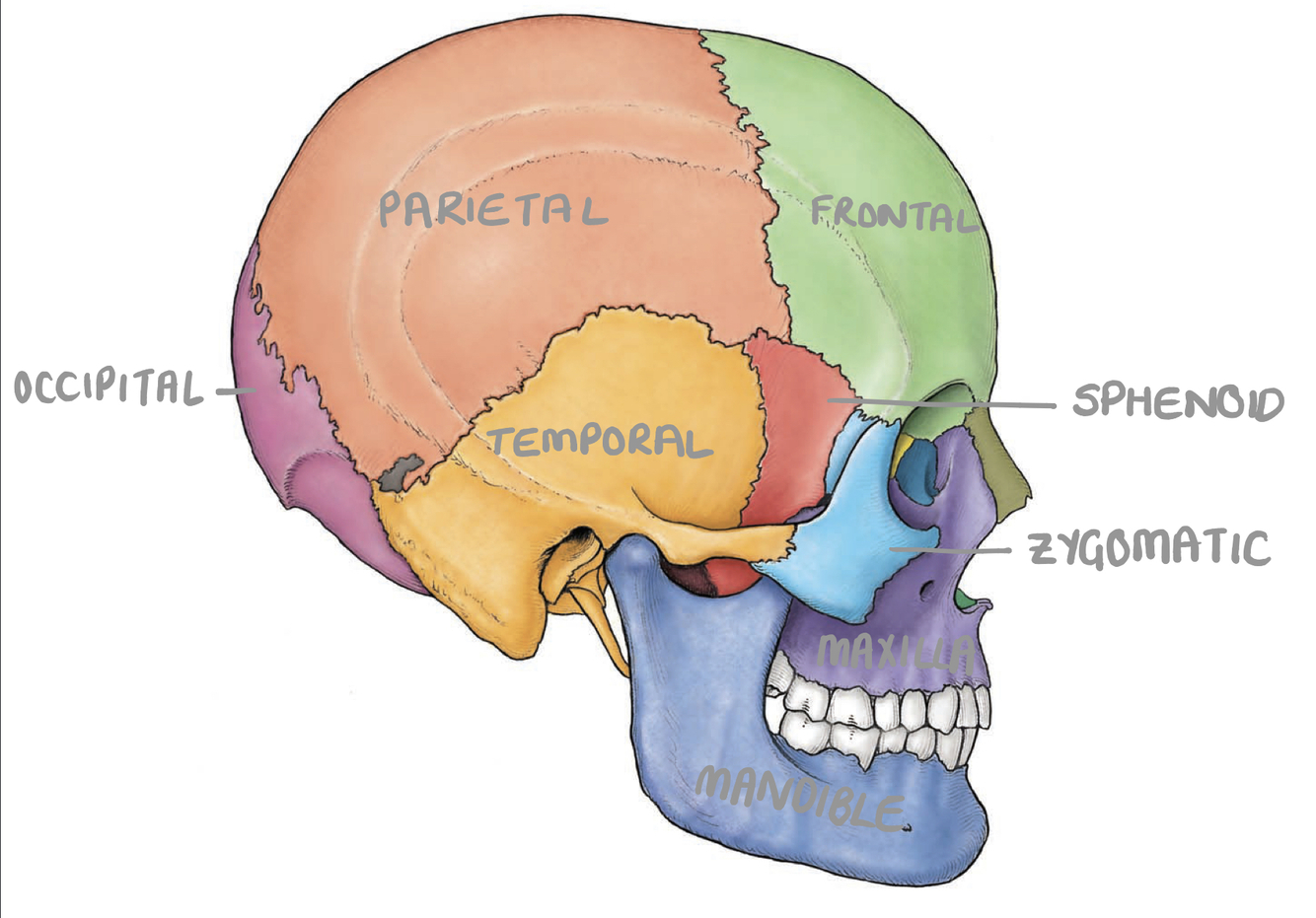
Label the important features of the skull
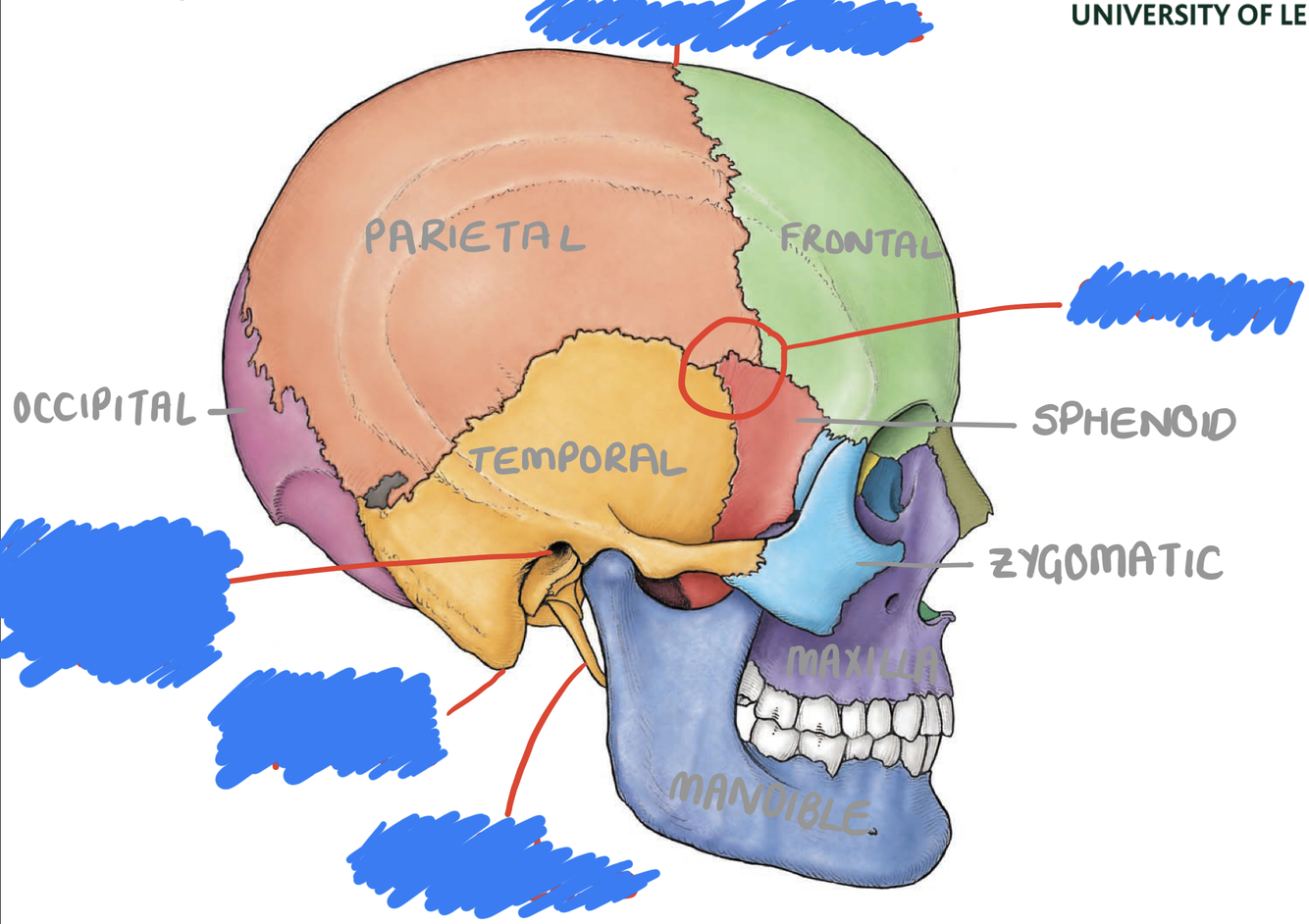
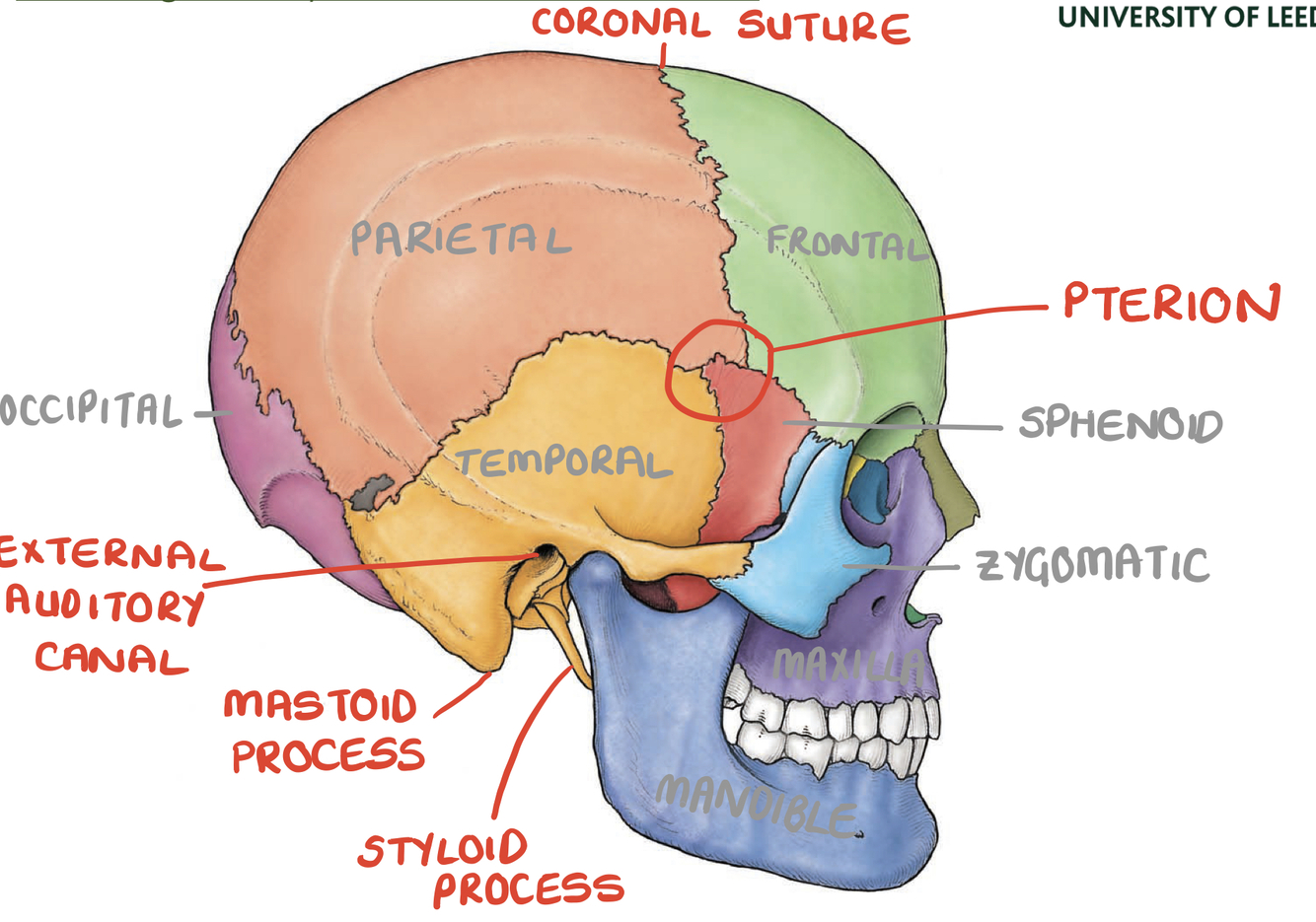
What is significant about the mastoid process?
It is a site for muscle attachment
the sternocleidomastoid muscle attaches here
What is the pterion?
why is it clinically significant?
The area where the following bones meet:
- Frontal
- Temporal
- Sphenoid
- Parietal
The skull is particularly thin at this point and it overlies the middle meningeal artery
What can a fracture of the pterion lead to?
fracture here can lacerate the middle meningeal artery (anterior branch), resulting in a extradural haematoma.
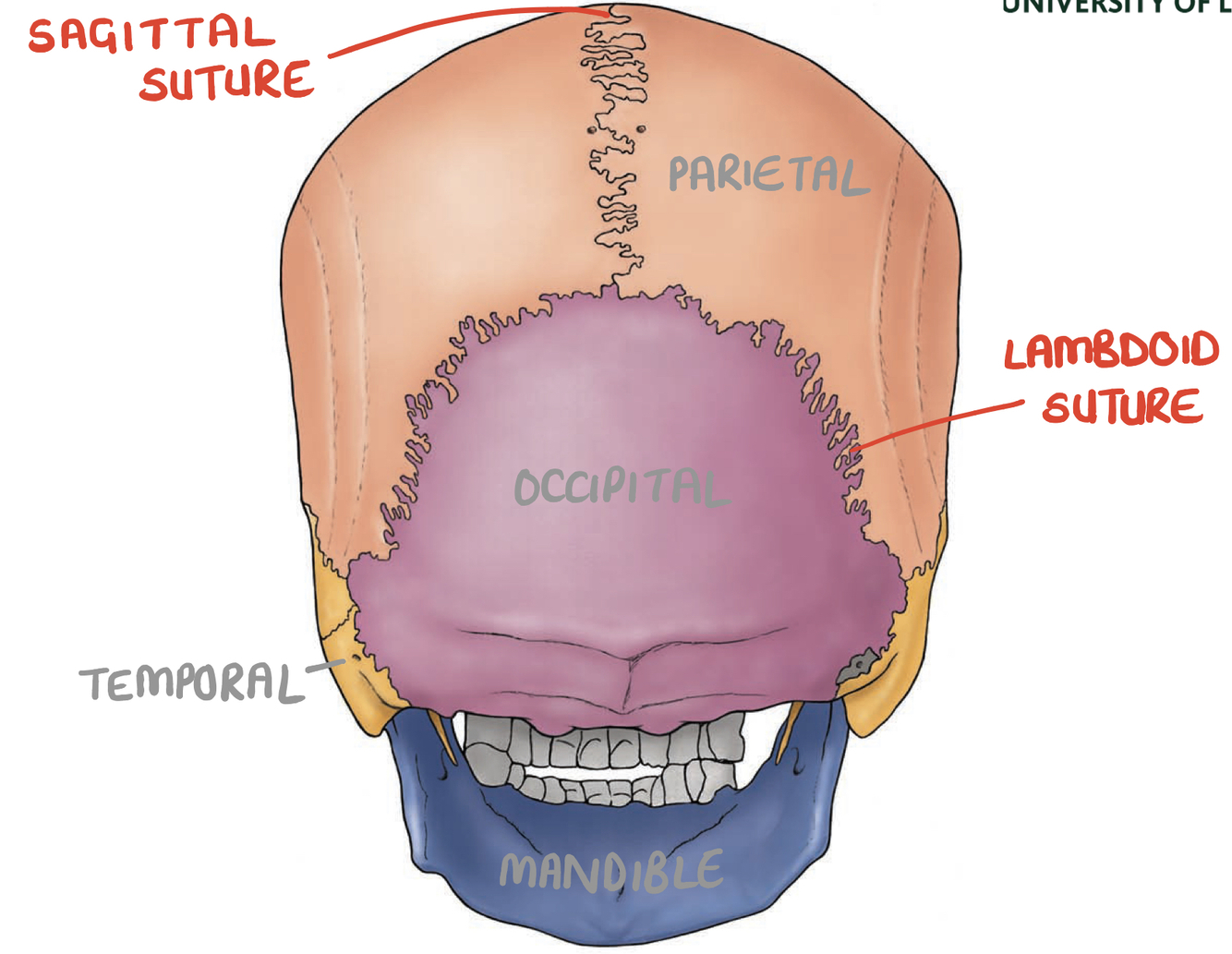
Label the bones and sutures of the posterior skull
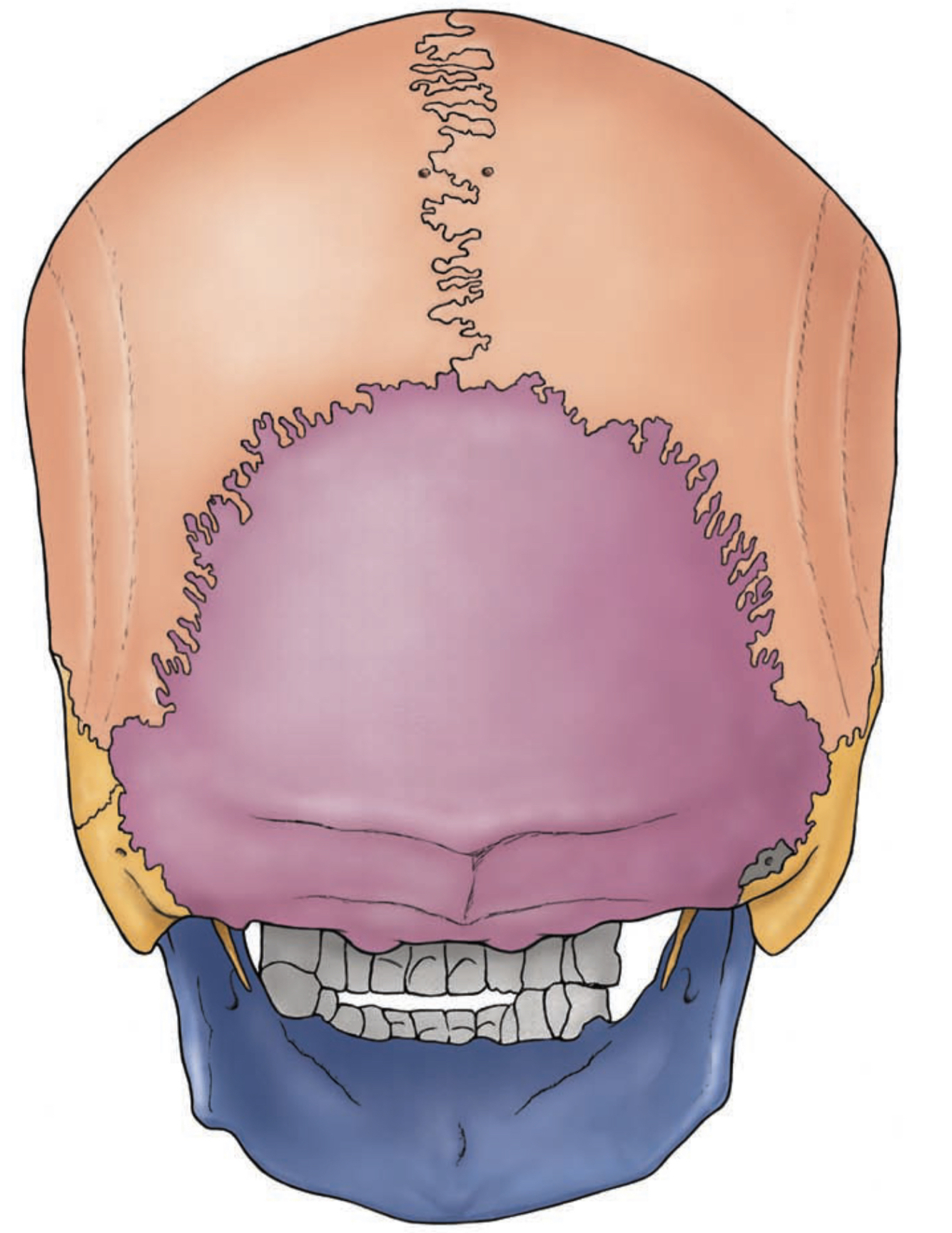
Sagittal suture:
- Between the 2 parietal bones of the skull
Lambdoid suture:
- connects parietal bones with occipital bone
What are some significant differences in the skull of a newborn?
The bones have not properly fused together
the spaces between them are fontanelles
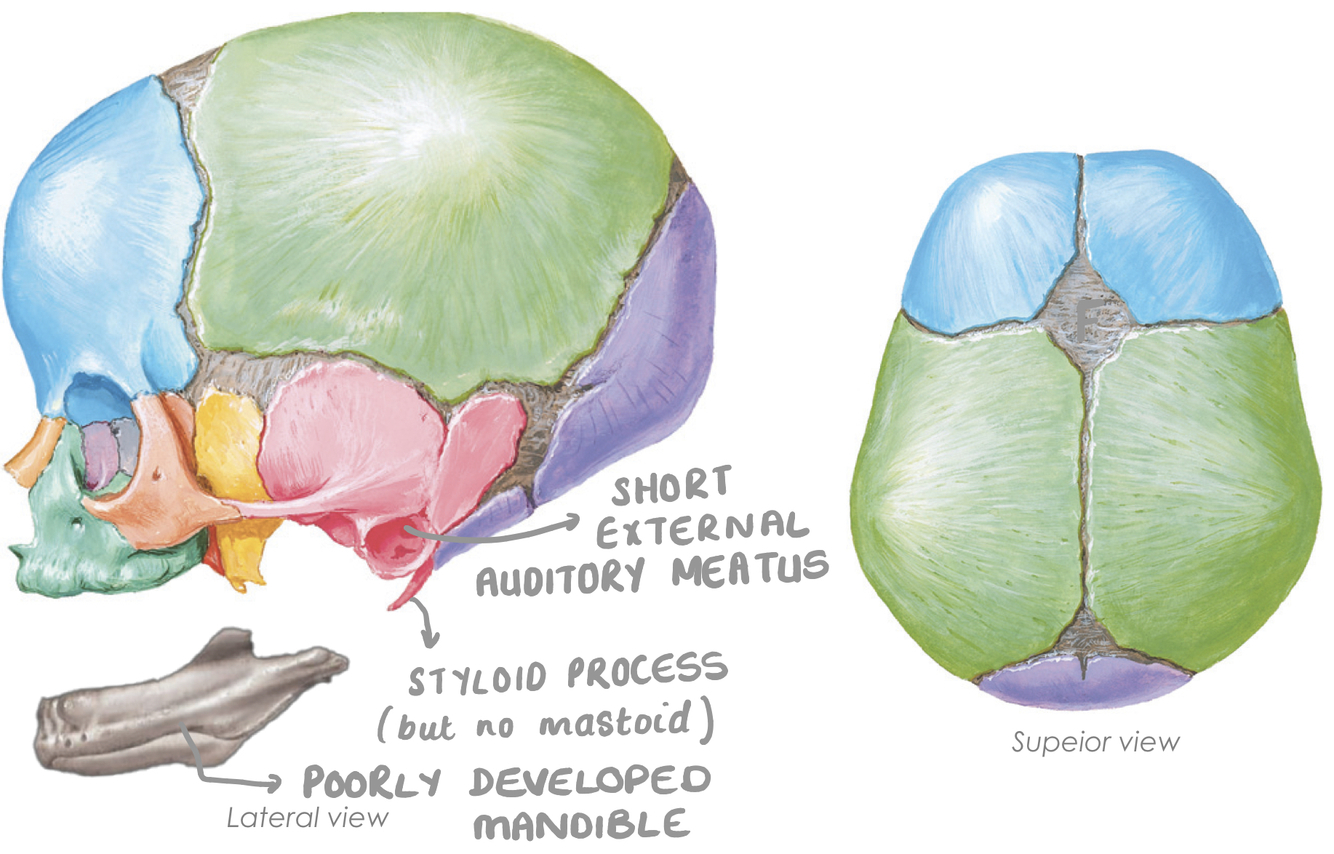
What is the purpose of fontanelles?
They allow for growth of the brain after birth
they allow for the skull to deform during birth
Why is there no mastoid process on the newborn skull?
The mastoid process develops as the sternocleidomastoid muscle develops and begins to be used
Label the following fossae and features of the skull
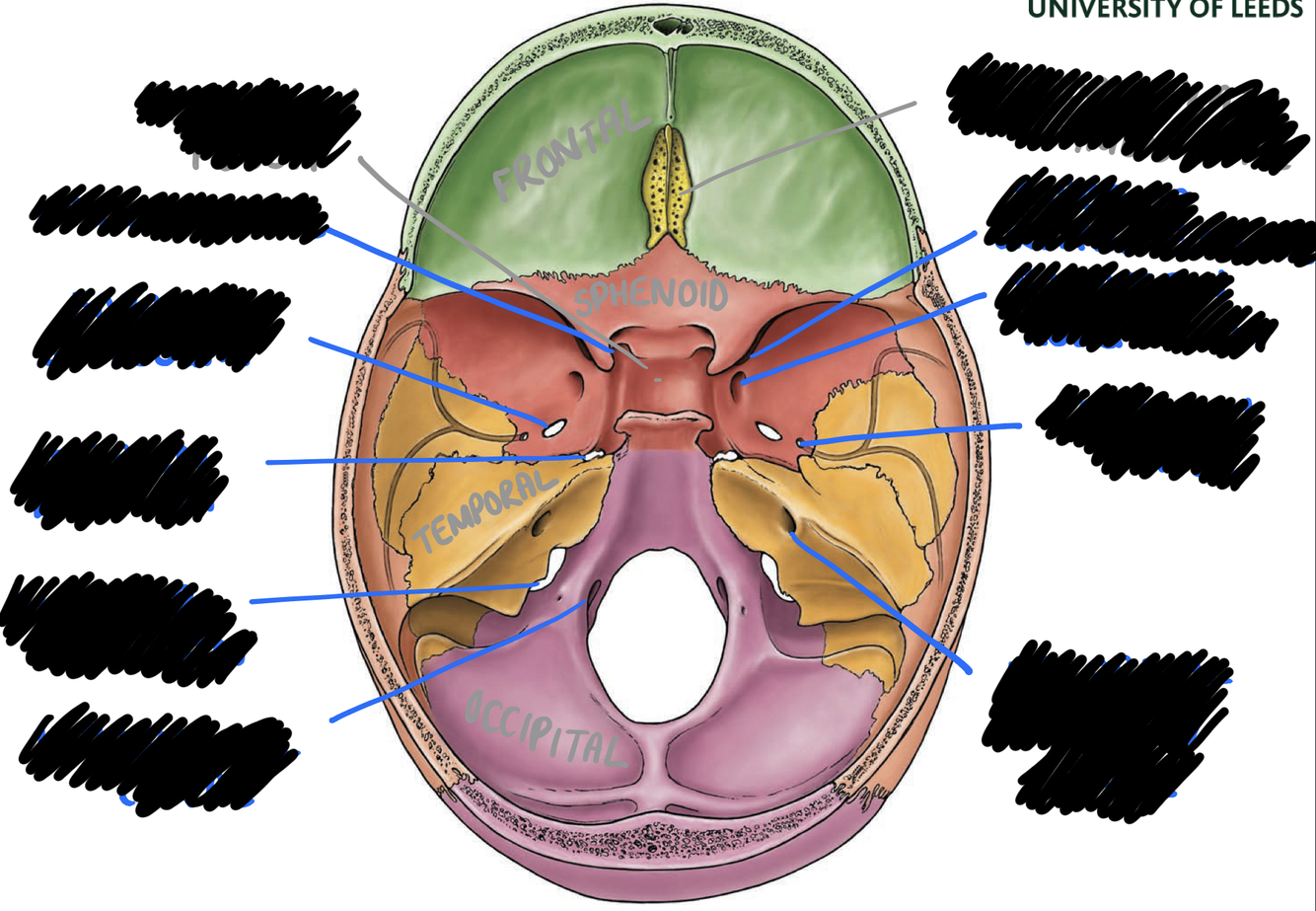
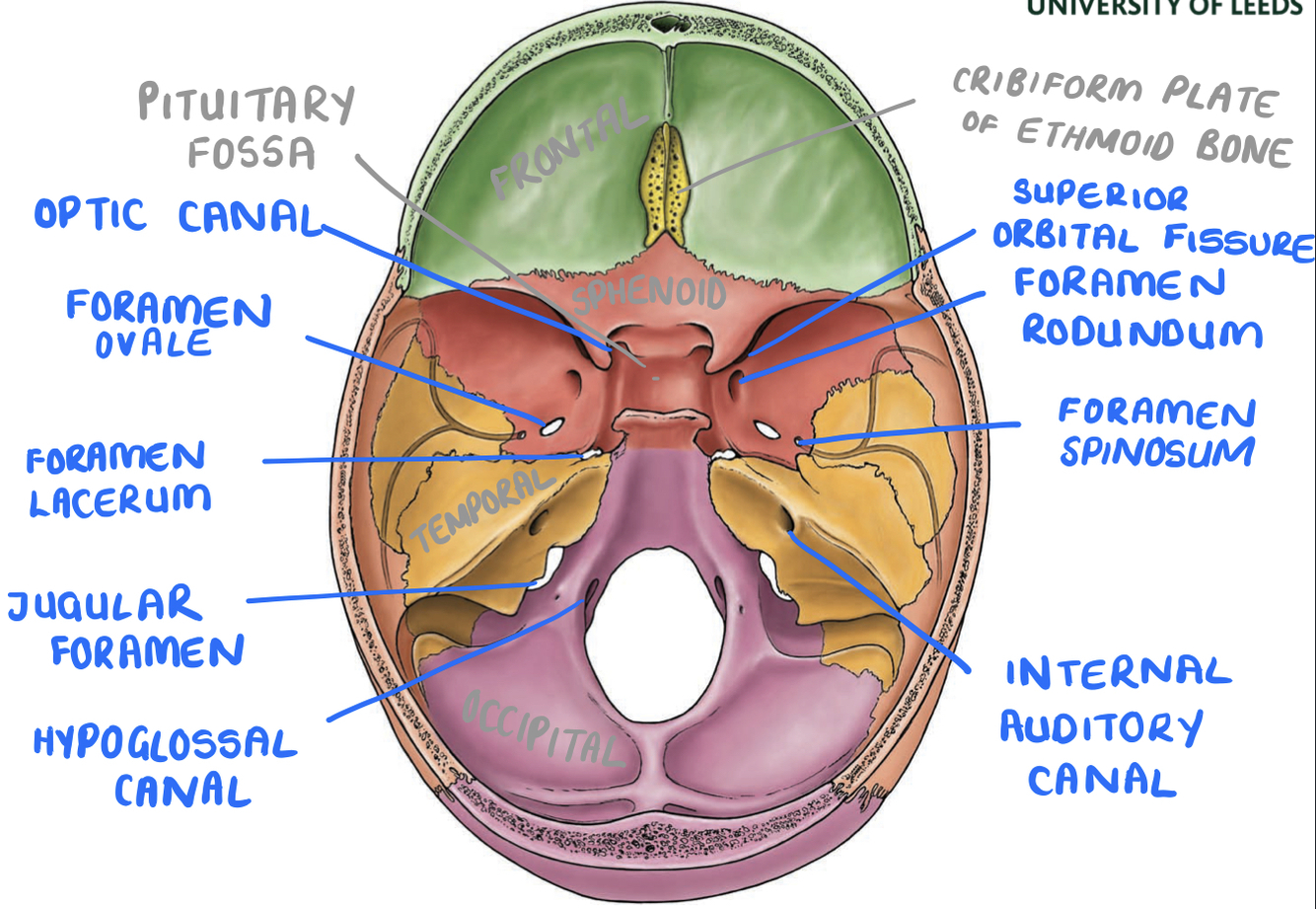
Which cranial nerves pass through the structures listed?
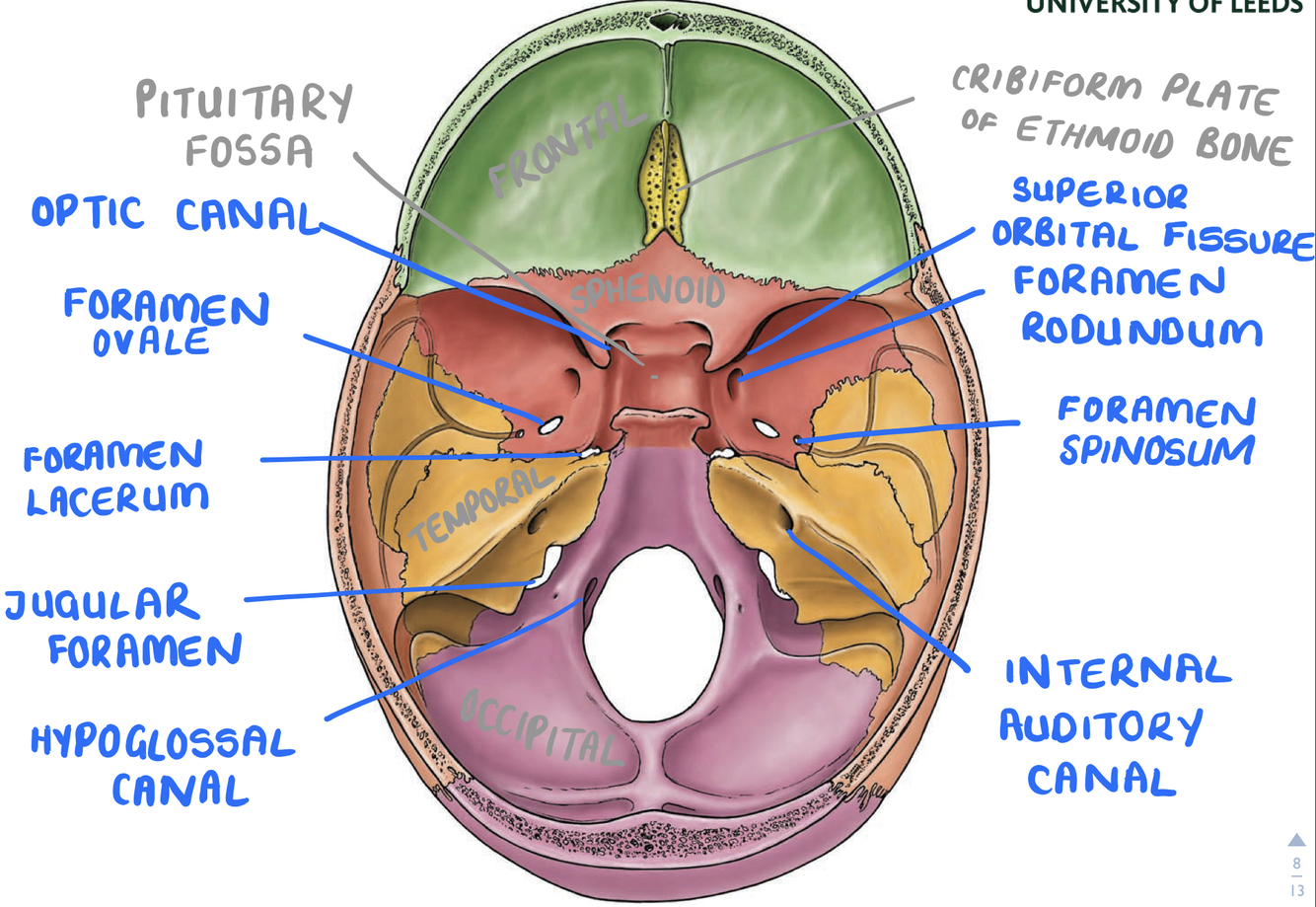
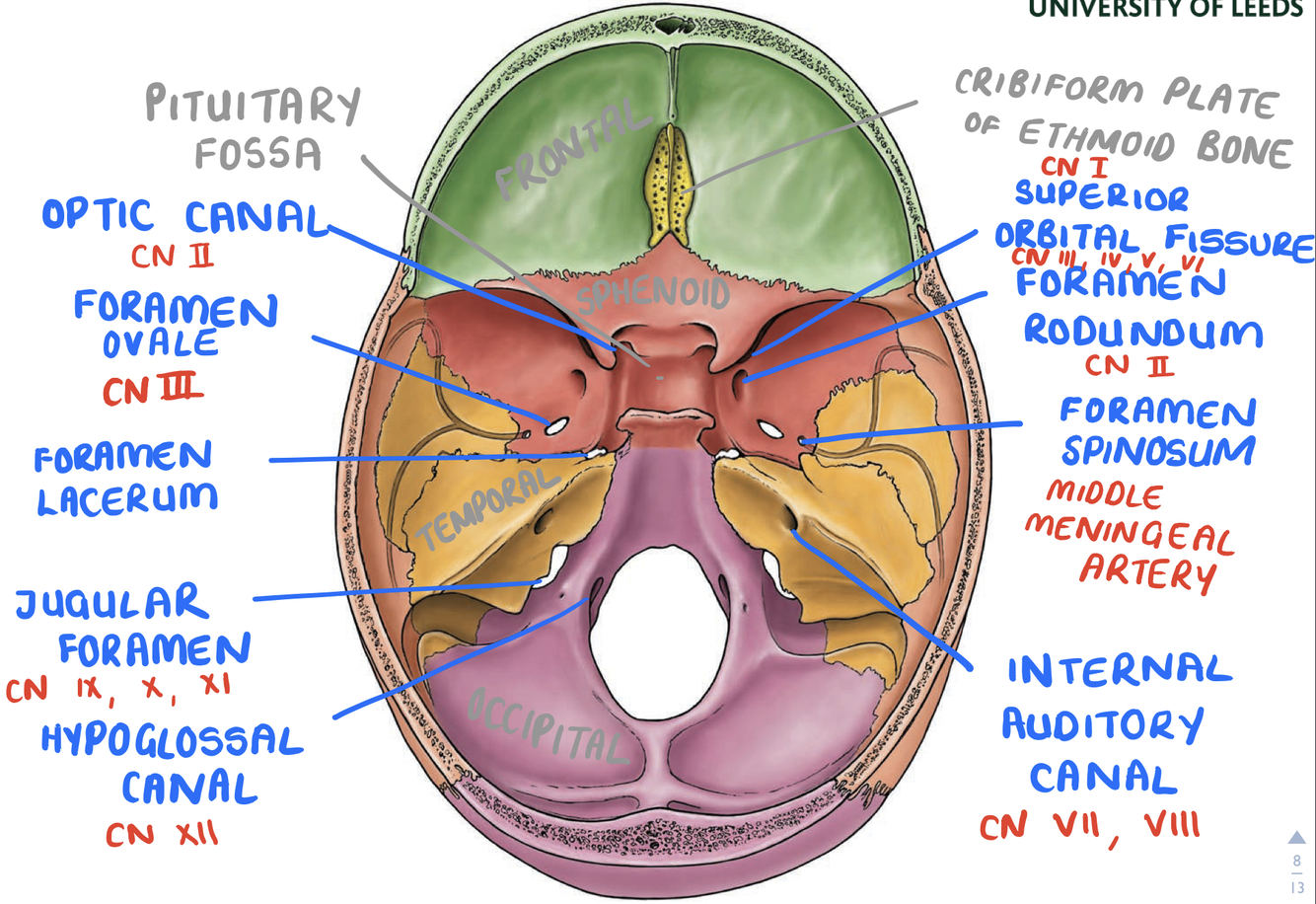
What are the contents of the 3 cranial fossae?
Anterior cranial fossa:
- Frontal lobe
Middle cranial fossa:
- Temporal lobe
Posterior cranial fossa:
- cerebellum and brainstem
Label the following features of the skull
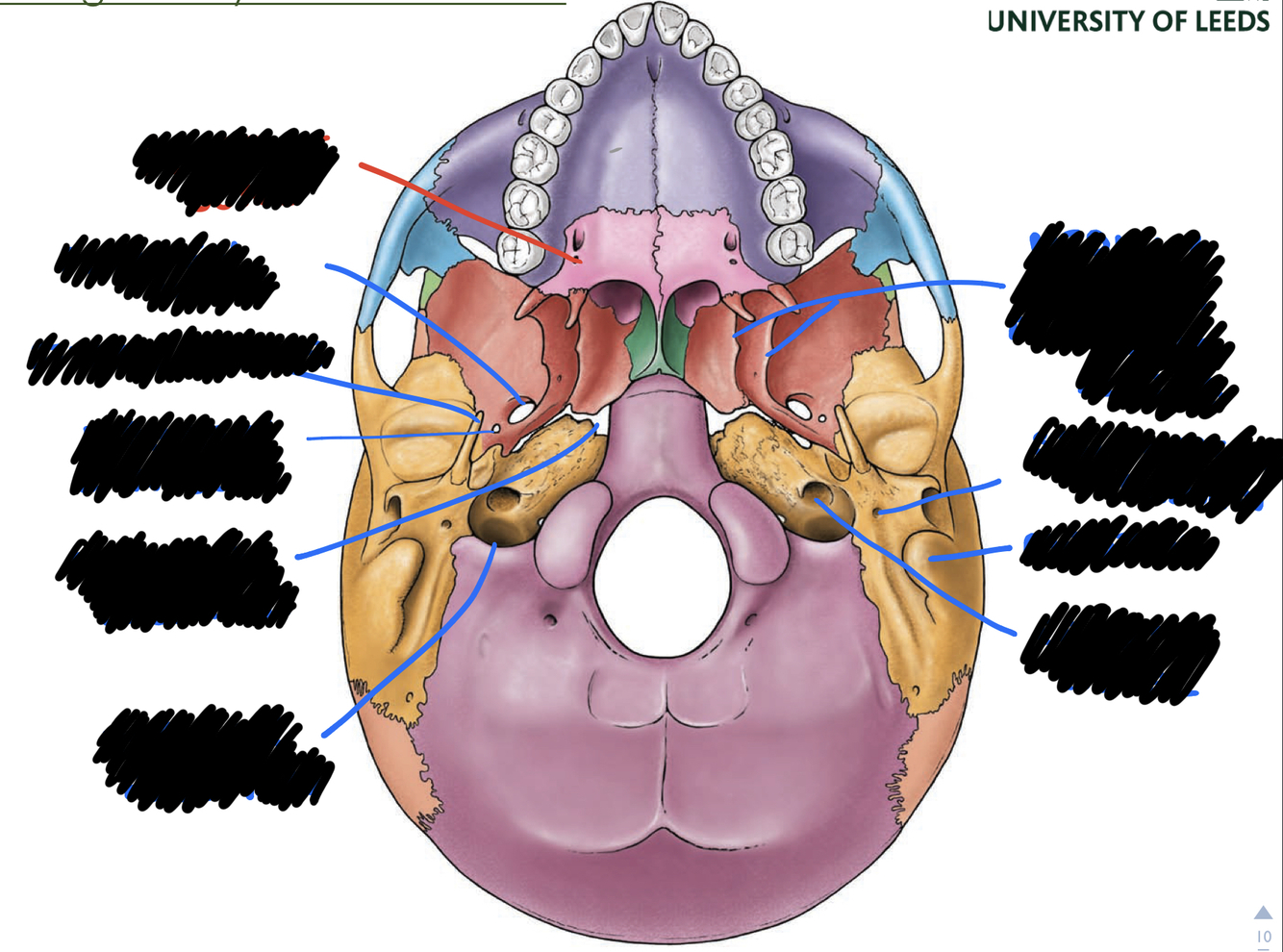
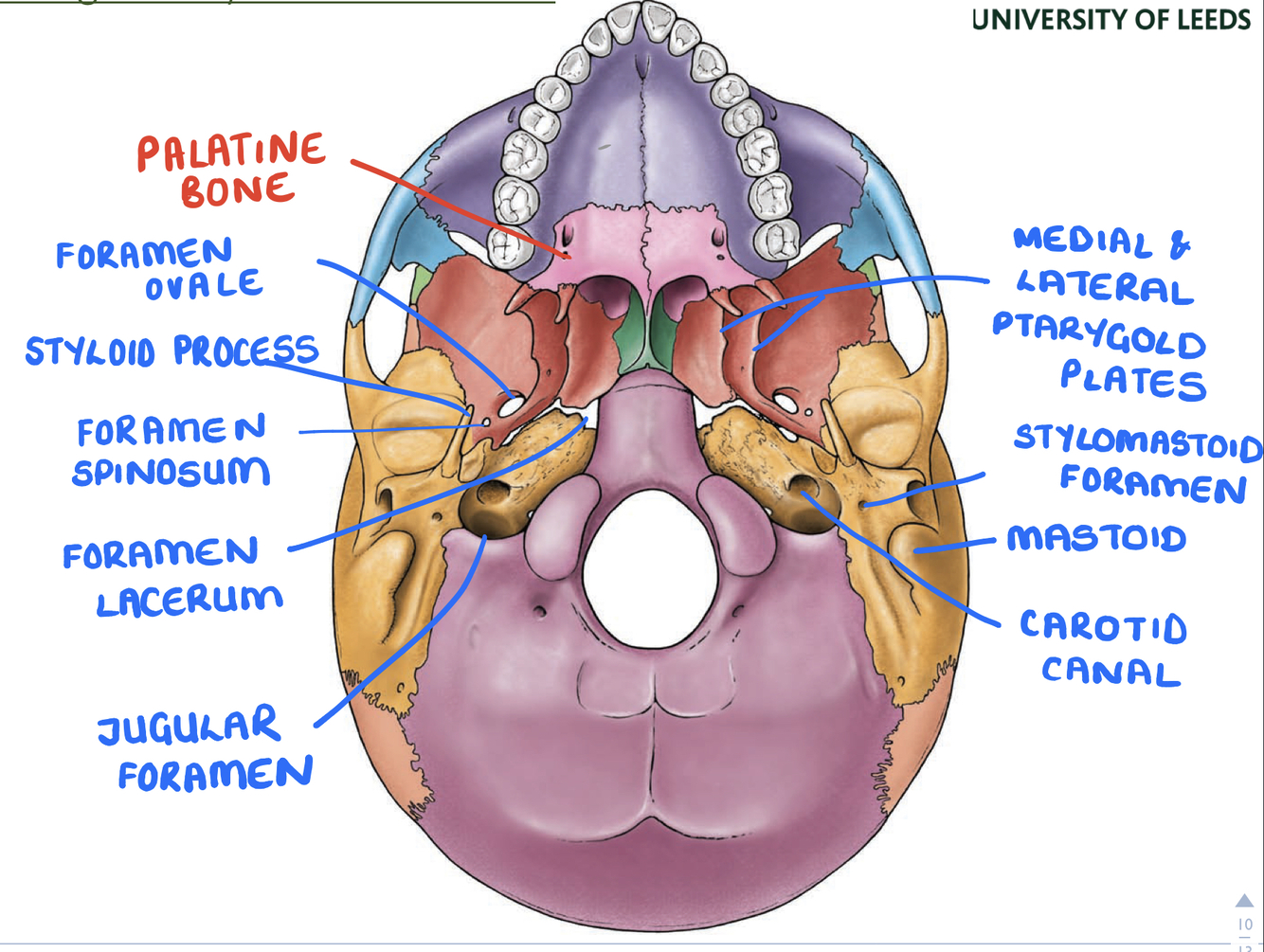
Which bones make up the hard palate?
maxilla and palatine bones

-
Arthritis58
-
A1 - Pectoral Girdle & Shoulder102
-
A2 - Upper Arm & Elbow94
-
Peripheral Nerve Lesions - Brachial Plexus Injuries34
-
Upper Limb Ultrasound17
-
A3 - Forearm92
-
A4 - Wrist & Hand82
-
L1 - Anatomy of the Vertebral Column94
-
Back Pain51
-
Hip Fracture43
-
L2 - Pelvis & Hip Joint76
-
Gluteal Region & Hip58
-
The Knee Joint72
-
The Thigh & Knee Anatomy68
-
Posterior Thigh & Knee74
-
Leg & Ankle58
-
Vessels of the Lower Limb49
-
The Leg & Ankle Anatomy74
-
The Foot60
-
Lower Limb Radiology36
-
LL Ultrasound and Cases25
-
Lower Limb Muscles100
-
Muscles of the Upper Limb69
-
SDL 1 - FRONT OF NECK67
-
Introduction to the Brain41
-
The Skull22
-
Blood Supply to Brain & Meninges74
-
SDL 2 - Face & Skull89
-
SDL 3 - Brain, Meninges & Blood Supply44
-
Front of Neck Surface Anatomy10
-
Brainstem & Cerebellum65
-
SDL 4 - Brainstem, Cerebellum & Cranial Nerves65
-
Cranial Nerves67
-
Forebrain & Ventricles56
-
Localisation60
-
SDL 5 - FOREBRAIN, VENTRICLES & CSF39
-
Local Anaesthetics43
-
Spinal Cord & Spinal Nerves66
-
Ascending Pathways68
-
Descending Motor Pathways53
-
Transient Ischaemic Attack (TIA)35
-
Stroke37
-
SDL - Vertebral Column & Spinal Cord70
-
SDL 7 - SPINAL CORD & SPINAL NERVES18
-
Parkinson’s Disease58
-
Basal Ganglia55
-
Somatosensory Physiology57
-
Patterns of Sensory Loss40
-
Skin Histology45
-
Epilepsy75
-
Headache - Diagnosis & Management72
-
Radiotherapy & Chemotherapy for CNS Tumours66
-
Dementia84
-
Multiple Sclerosis43
-
Pain 152
-
Clinical Aspects of Pain75
-
General Anaesthesia77
-
The Auditory Pathway48
-
The Visual Pathway55
-
Visual Defects72
-
Cerebellum50
-
The Auditory System78
-
Physiology of Vision54
-
Limbic System49
-
Balance, Posture & Vestibular System0
-
Upper & Lower Motor Neurone Disorders27
-
Gait and Posture41
-
Pharmacology of Movement37
-
Diagnosing Weakness23



