What is too much blood flow called and what are the two types of it?
Too much blood is called hyperaemia. It can be separated into active where too much blood is being delivered or passive where not enough blood is being taken away
Is hyperaemia localised or generalised and is it pathological or physiological?
Hyperaemia can be both localised or generalised and can be physiological or pathological (part of the acute phase of inflammation to deliver cytokines and cells)
What is the name for too little blood delivery?
ischemia
The two different types of ischemia that occurs are hypovolaemia and anemia, explain the difference between them.
Hypovolaemia- all of them Anaemia- just the red blood cells (note that neither of these are never likely to just be localised)
How would passive hyperaemia appear histologically?
Lower venous drainage causing capillary beds to become engorged with blood
What is the cause of the histological slide seen below?
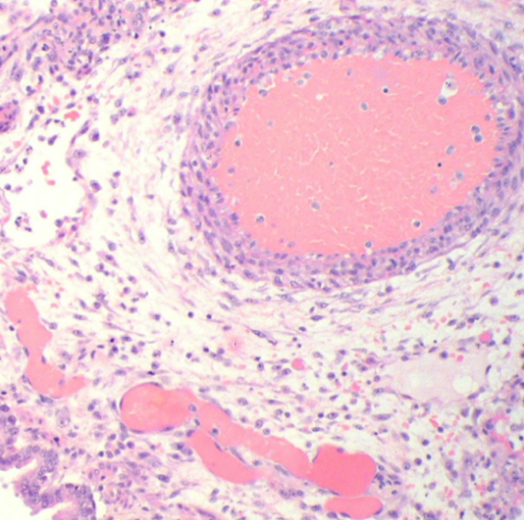
This is likely caused by active hyperaemia. Notice in the image that there is increased arterial blood supply and that the capillary beds are engorged with blood. However, this is not fool proof as you can get a backing of venous that backs up into the artery
Explain the physiological conditions at play with blood volume expansion:
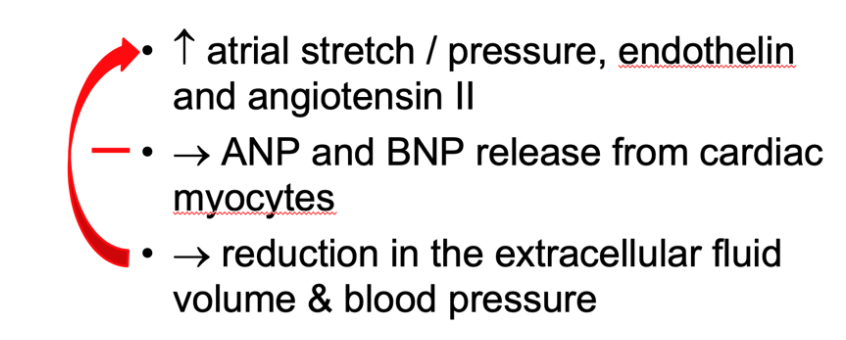
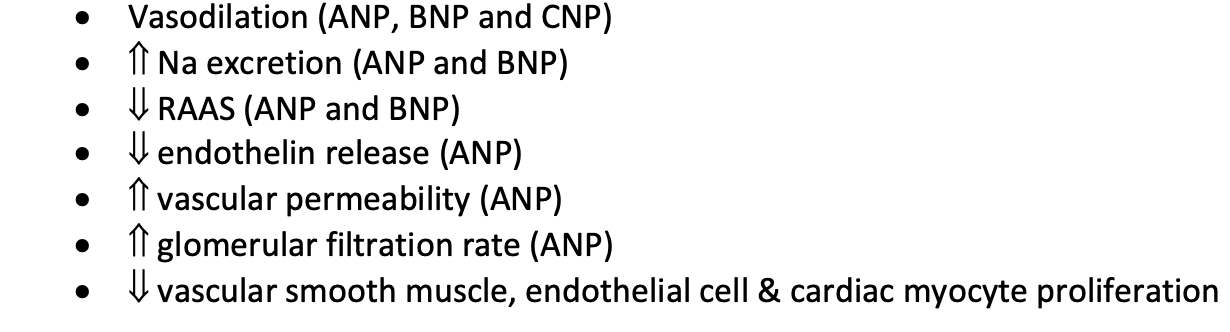
What are the effects of natriuretic peptides?
How does reduced tissue perfusion (hypoxia) result?
- Local obstruction of vessels
- Local obstruction (stagnation)
- Decrease cardiac output
What is the occurs in the first stage of hypovolaemia (residistribution)?
- venous return decreases
- cardiac output is reduced
- arterial blood pressure decreases
- carotid and arotic bodies leads to stimulation of the vasomotor centres that then leads to strong sympathetic stimulation
- Blood supply to vital organs maitained (brain and respiratory centres
- Tachycardia continues
- Adrenalin and nor-adrenaline are released causing general vasocontriction and coronary artery dilation
- Decreasing blood volume leads to renin release leads to angiotensin 2 production and aldosterone production
What is involved in stage two (restoration of blood volume) physiological response to hypovolaemia?
- Blood volume continues to drop despite phase one
- Fluid moves from extravascular space into circulation to replace lost fluid
What is involved in stage three - replacement of blood cellular components in response to hypovolemia?
- This phase is one of erythropoiesis – number of erythrocytes & haemoglobin content is restored to normal – enhanced manufacture of plasma proteins within the liver (hyperplasia of the bone marrow)
- Reticulocytes and metarubricytes (immature blood cells) will be pushed out into the circulation) – takes approximately 4 days
What is involved in shock?
- failure of one and two leads to shock
- shock = inadequete perfusion of organ microcirculation
- shock leads to multi organ failure exacerbating inadequete organ perfusion

-
Lecture Two7
-
Lecture 314
-
Lecture Four20
-
Lecture 524
-
Lecture 714
-
Lecture 811
-
Lecture 93
-
Lecture 1116
-
Lecture 108
-
Lecture 1223
-
Lecture 11 - simplified18
-
Lecture 10- the basics15
-
Lecture 1424
-
Lecture 1522
-
Lecture 1626
-
Lecture 179
-
Lecture 2324
-
Lecture 247
-
Lecture 2514
-
Lecture 2615
-
Lecture 1918
-
Lecture 2717
-
Lecture 2024
-
Lecture 28 - Neo 213
-
Lecture 30 - Neo 421
-
Lecture 29 - Neo 315
-
Lecture 1317
-
Lecture 31 - Neo 60
-
Lecture 33 - Teratology 111
-
Lecture 34 - Teratology 25



