What is meant by the term per diapedesis? (what are some potential causes)
loss of the functional continuity of the vessel wall despite maintenance of morphological continuity. Potential causes could include hypoxia, abnormal coagulation and toxic injury
What is meant by the term per rhexis?
loss of the morphological and functional continuity of vessel wall. This could be caused by trauma, vessel wall necrosis or primary vascular disease
What is meant by the term petechiae?
(less than 2 mm in size) per diapedesis associated with minor vascular damage. Locally increased intravascular pressure, thrombocytopenia or defective platelet function
What is meant by the term purpura?
(up to 3mm) These are slightly larger. Associated with many of the same disorders as above but also secondary to trauma, vasculitis or increased vascular fragility.
What is meant by the term ecchymosis?
subcutaneous haematoma (more extensive vascular damage (trauma) can be massive or submassive in size
What is meant by the term haematomesis?
vomiting of blood (comes from the upper stomach)
What is meant by the term melena?
when digested blood from the stool from the stomach/small intestine haemorrhages (very dark/black because a significant portion of it is digested)
What is meant by the term haematochezia?
from the colon (not digested)
What is meant by the term haemoptysis?
blood that comes from the airway
What is meant by the term haematuria?
blood that comes from the urine
What is meant by the term epistaxis?
blood coming from the nose
What is meant by the term haemarthrosis?
blood that is going into the joint space
What is meant by the term hyphema?
blood into the anterior chamber of the eye
When we are viewing haemorrhage at tissue level what should be observed?
RBC + WBC + plasma proteins are released into the tissues (often you do not observe platelets as the have all been used up by this point)
Explain how red blood cells are recycled :
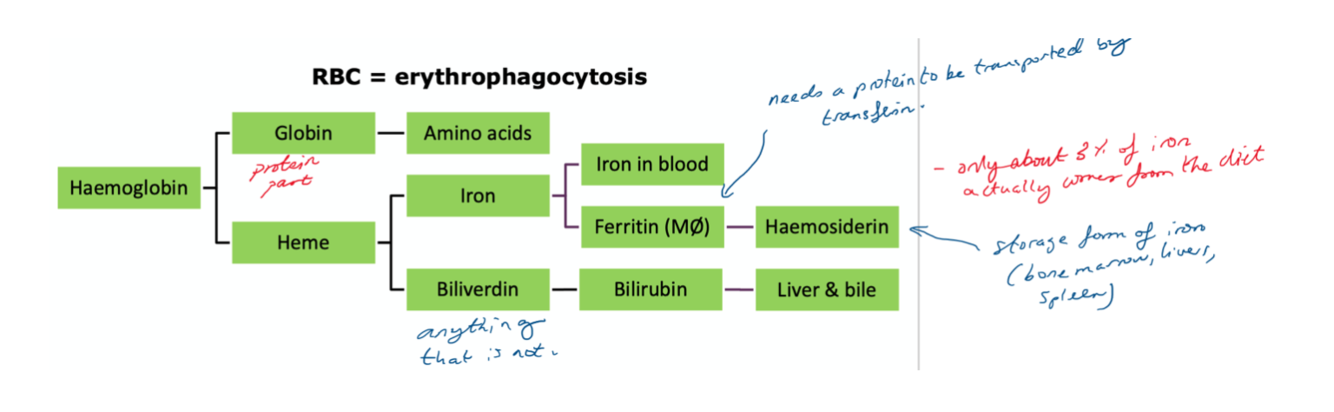
Briefly describe how the process of tissue repair occurs:
Plamsa proteins are released into the tissues (where fibrinogen is converted to fibrin which is white and stringy) and then fibroblasts are activated that allows for collagen and tissue repair.
Explain how the consequences of significant haemorage both for blood losses above 20% and below 20%
Rapid blood loss of above 20% will lead to hypovolemic shock and inevitably death.
The process of losses below 20% or above 20% but in small volumes in shown below:
- Hypovolemia that leads to decreased cardiac output, hypotension and decreased venous return
- Carotid & aortic bodies stimulate vasomotor centres and adrenaline release = tachycardia and vasocontriction
- Blood supply to vital organs (brain and respiratory muscles) is maintained
- Hypotension is detected by kidneys and RAAS axis is activated
- Osmotic pressure replaces lost fluid
- Regeneration (increased erythropoiesis) and increases protein synthesis
What is the cause of chronic haemmorage and what is the usual result of it?
Caused by gastro-intestinal ulcers and by blood sucking parasites. This causes chronic anemia due to iron deficiency (non-generative)
What is a thrombus and are the two different types of them?
A solid aggregate of fibrin, platelets and other blood elements on the wall of a blood/lymphatic vessel. A thrombus attached to the wall of a lymph/blood vessel is a mural thrombus. In a lumen is the thromboembolus.
Why/how does a thrombus form?
- Reduced blood flow and turbulence meaning much more frequent in veins in comparison to arteries because of the much slower rate of flow)
- Injury to the epithelium (trauma, vasculitis, toxins) meaning exposure of tissue factor and subendothelial matrix
- Increased production of coagulant molecules and decreased production of anti—coagulant molecules
What are the consequences of a thrombus?
The significance of a thrombus is determined by the location, size and rate of developement and ability to produce ischaemia.
- Immediate death will occur from occlusion at critical sites
- Lysis- where small thrombi are removed by fibrinolysis allowing return to normal function. Larger thrombi will be resolved by removal of thrombotic debris by phagocytosis (subsequent granulation tissue formation)
- Organisation- large mural or occlusion thrombi cannot be removed by fibrinolysis. Invasion of fibroblasts and endothelium required for recanalisation
What is an embolism?
A thrombus or portions of a thrombus that break loose and proceed to enter circulation
What are the consequences of thrombosis/embolism?
- Passive hyperhaemia = congestion
- Ischemia = decreased oxygen of tissue
- Infarction = necrosis of tissue caused by a lack of oxygen to the site
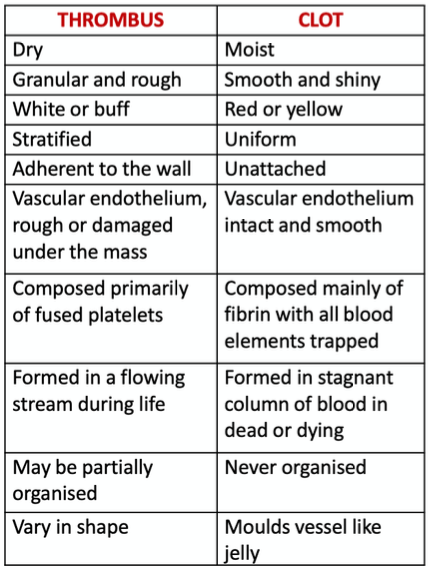
How is it possible to tell the difference between thrombus and a post-mortem clot?

-
Lecture Two7
-
Lecture 314
-
Lecture Four20
-
Lecture 524
-
Lecture 714
-
Lecture 811
-
Lecture 93
-
Lecture 1116
-
Lecture 108
-
Lecture 1223
-
Lecture 11 - simplified18
-
Lecture 10- the basics15
-
Lecture 1424
-
Lecture 1522
-
Lecture 1626
-
Lecture 179
-
Lecture 2324
-
Lecture 247
-
Lecture 2514
-
Lecture 2615
-
Lecture 1918
-
Lecture 2717
-
Lecture 2024
-
Lecture 28 - Neo 213
-
Lecture 30 - Neo 421
-
Lecture 29 - Neo 315
-
Lecture 1317
-
Lecture 31 - Neo 60
-
Lecture 33 - Teratology 111
-
Lecture 34 - Teratology 25



