PROSTATE
Primary Tumor (pT)
___ Not identified
___ pT2:
+ ___ pT2a:
+ ___ pT2b:
+ ___ pT2c:
pT3:
___ pT3a:
___ pT3b:
___ pT4:
Regional Lymph Nodes (pN)
___ pNX:
___ pN0:
___ pN1:
Distant Metastasis (pM)
___ Not applicable
___ pM1:
___ pM1a:
___ pM1b:
___ pM1c:
PROSTATE
Primary Tumor (pT)
___ Not identified
___ pT2: Organ confined
+ ___ pT2a: Unilateral, involving one-half of 1 side or less
+ ___ pT2b: Unilateral, involving more than one-half of 1 side but not both sides
+ ___ pT2c: Bilateral disease
pT3: Extraprostatic extension
___ pT3a: Extraprostatic extension or microscopic invasion of bladder neck
___ pT3b: Seminal vesicle invasion
___ pT4: Invasion of rectum, levator muscles and/or pelvic wall (Note J)
Note: There is no pathologic T1 classification. Subdivision of pT2 disease is problematic and has not proven to be of prognostic significance.
Regional Lymph Nodes (pN)
___ pNX: Cannot be assessed
___ pN0: No regional lymph node metastasis
___ pN1: Metastasis in regional lymph node or nodes
Distant Metastasis (pM)
___ Not applicable
___ pM1: Distant metastasis
___ pM1a: Nonregional lymph nodes(s)
___ pM1b: Bone(s)
___ pM1c: Other site(s) with or without bone disease
Note: When more than 1 site of metastasis is present, the most advanced category is used. pM1c is most advanced.
Prostate Staging
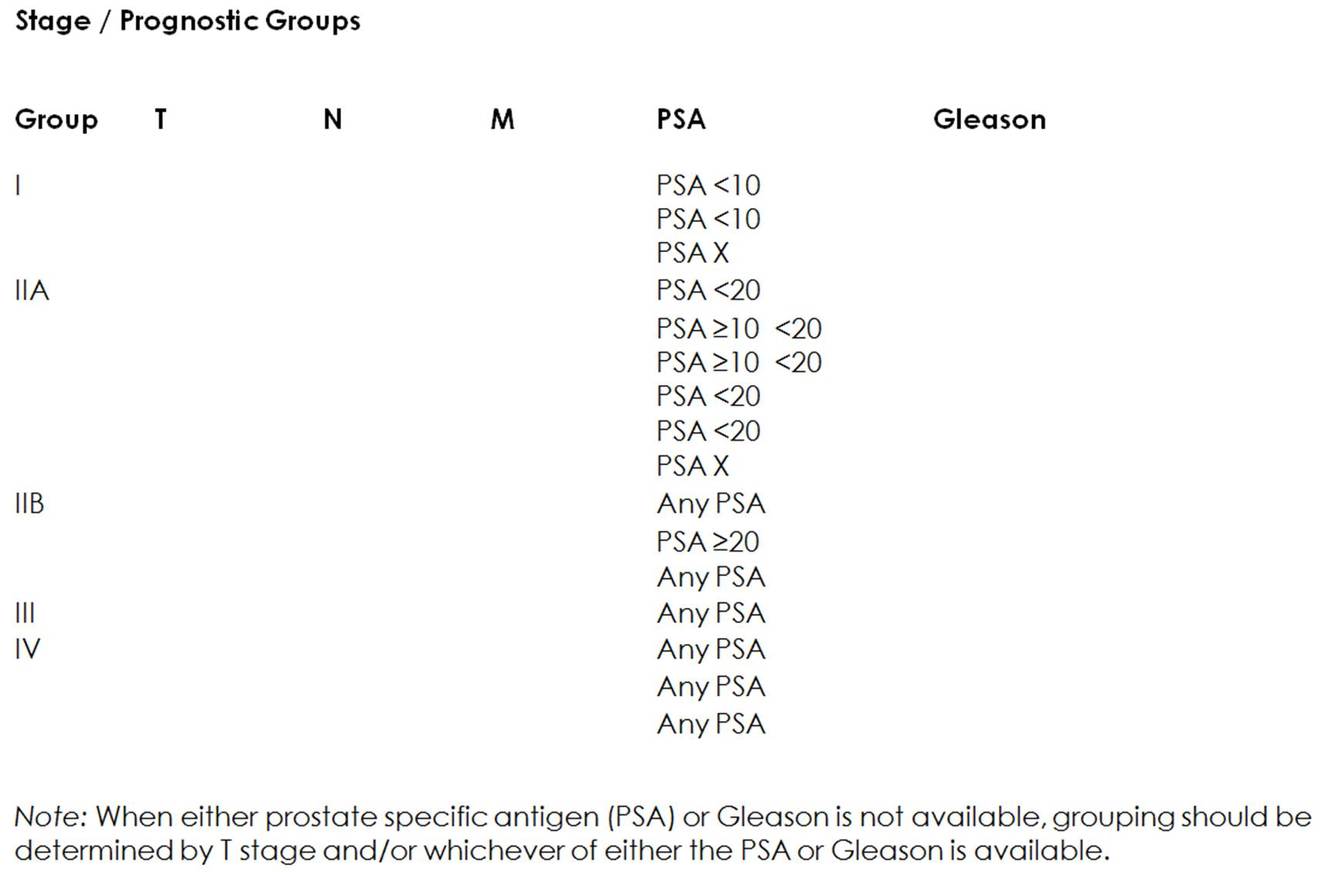
Prostate Staging
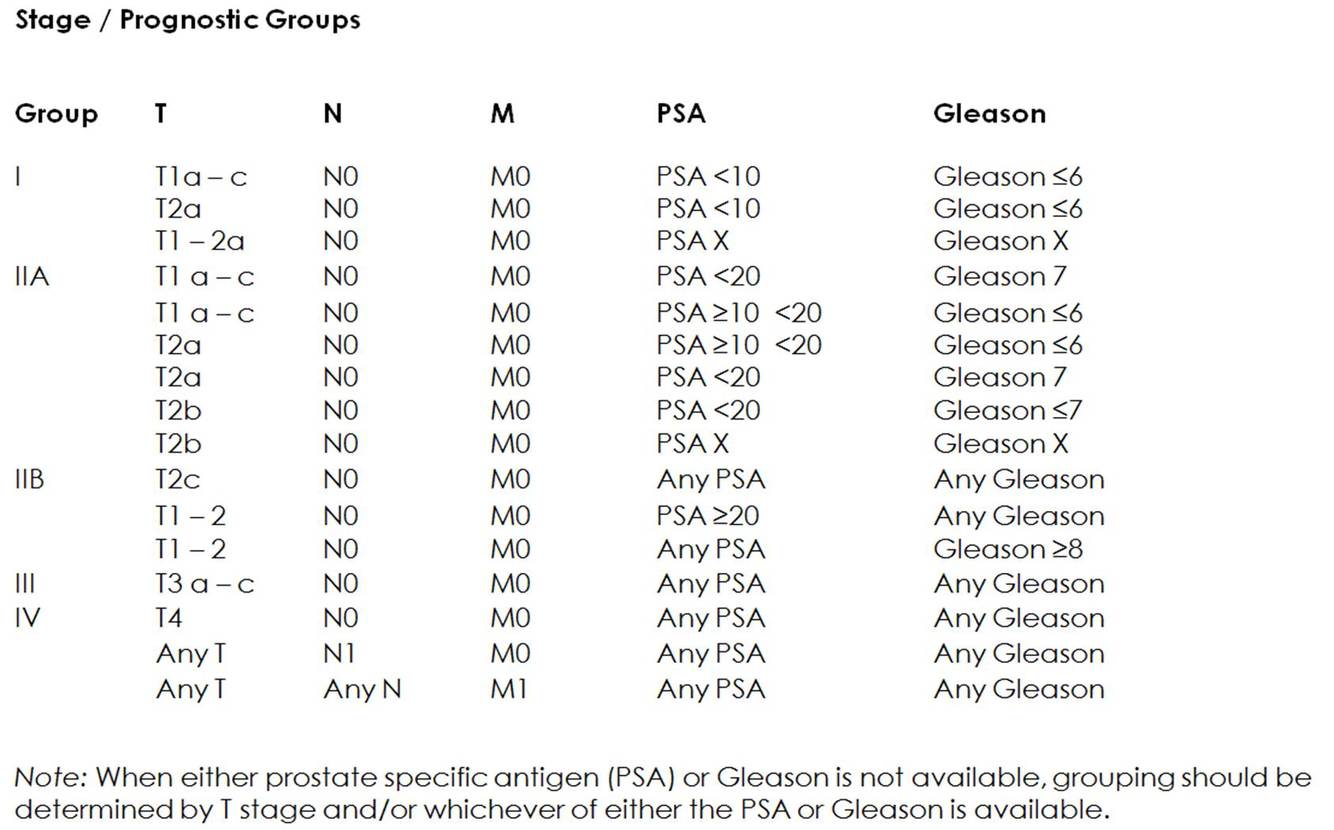
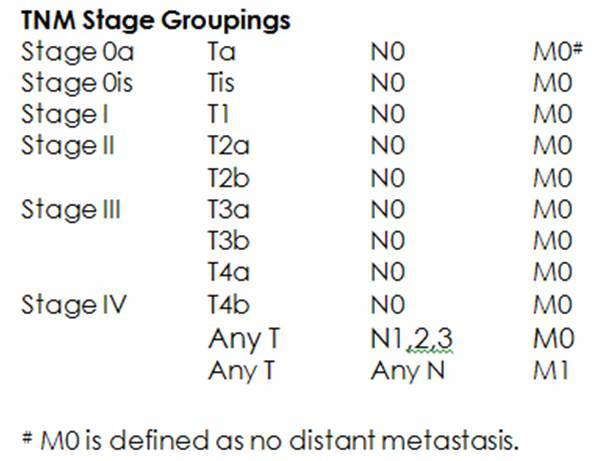
BLADDER
Primary Tumor (pT)
___ pTX:
___ pT0:
___ pTa:
___ pTis:
___ pT1:
pT2:
___ pT2a:
___ pT2b:
pT3:
___ pT3a:
___ pT3b:
pT4:
___ pT4a:
___ pT4b:
Regional Lymph Nodes (pN)
___ pNX:
___ pN0:
___ pN1:
___ pN2:
___ pN3:
Distant Metastasis (pM)
___ Not applicable
___ pM1:
BLADDER
Primary Tumor (pT)
___ pTX: Primary tumor cannot be assessed
___ pT0: No evidence of primary tumor
___ pTa: Noninvasive papillary carcinoma
___ pTis: Carcinoma in situ: “flat tumor”
___ pT1: Tumor invades subepithelial connective tissue (lamina propria)
pT2: Tumor invades muscularis propria (detrusor muscle)
___ pT2a: Tumor invades superficial muscularis propria (inner half)
___ pT2b: Tumor invades deep muscularis propria (outer half)
pT3: Tumor invades perivesical tissue
___ pT3a: Microscopically
___ pT3b: Macroscopically (extravesicular mass)
pT4: Tumor invades any of the following: prostatic stroma, seminal vesicles, uterus, vagina, pelvic wall, abdominal wall
___ pT4a: Tumor invades prostatic stroma or uterus or vagina
___ pT4b: Tumor invades pelvic wall or abdominal wall
Regional Lymph Nodes (pN)
___ pNX: Lymph nodes cannot be assessed
___ pN0: No lymph node metastasis
___ pN1: Single regional lymph node metastasis in the true pelvis (hypogastric, obturator, external iliac or presacral lymph node)
___ pN2: Multiple regional lymph node metastasis in the true pelvis (hypogastric, obrutrator, external iliac or presacral lymph node metastasis)
___ pN3: Lymph node metastasis to the common iliac lymph nodes
Distant Metastasis (pM)
___ Not applicable
___ pM1: Distant metastasis
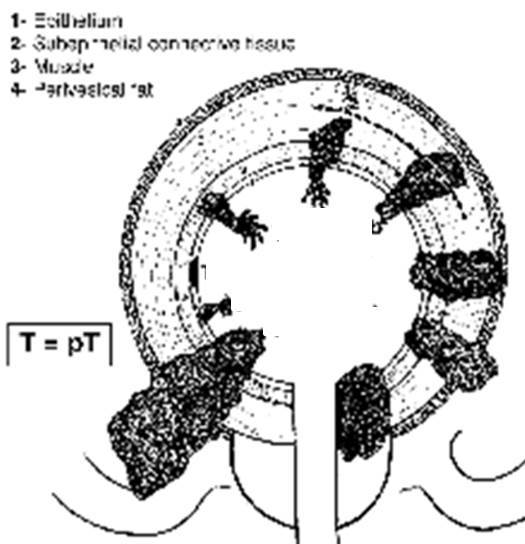
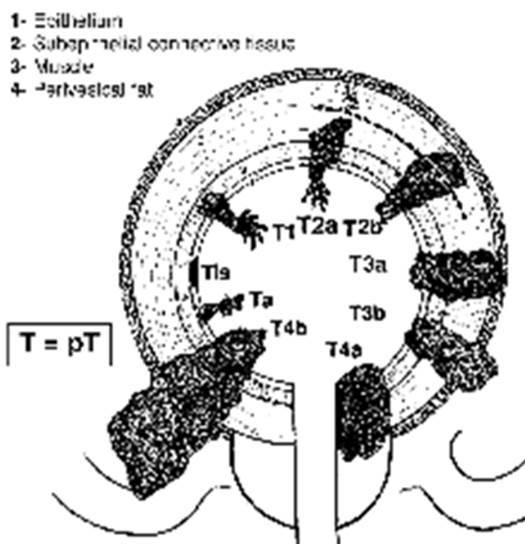
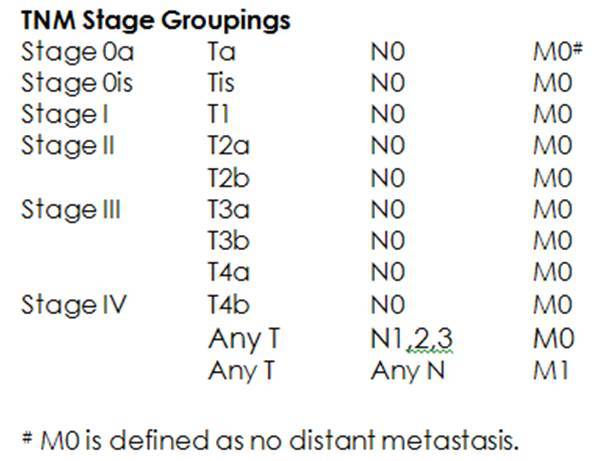
Bladder Staging
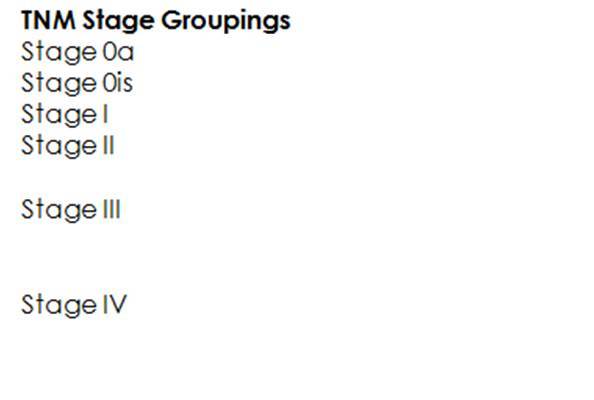
Bladder Staging
Histologic Grade (Fuhrman Nuclear Grade)
- GX:
- G1:
- G2:
- G3:
- G4:
Primary Tumor (pT)
- pTX:
- pT0:
- pT1:
- pT1a:
- pT1b:
- pT2:
- pT2a:
- pT2b:
- pT3:
- pT3a:
- pT3b:
- pT3c:
- pT4:
Regional Lymph Nodes (pN)
- pNX:
- pN0:
- pN1:
Distant Metastasis (pM)
- Not applicable
- pM1:
Histologic Grade (Fuhrman Nuclear Grade)
- Not applicable
- GX: Cannot be assessed
- G1: Nuclei round, uniform, approximately 10 µm; nucleoli inconspicuous or absent
- G2: Nuclei slightly irregular, approximately 15 µm; nucleoli evident
- G3: Nuclei very irregular, approximately 20 µm; nucleoli large and prominent
- G4: Nuclei bizarre and multilobated, 20 µm or greater, nucleoli prominent, chromatin clumped
Primary Tumor (pT)
- pTX: Primary tumor cannot be assessed
- pT0: No evidence of primary tumor
- pT1: Tumor 7 cm or less in greatest dimension, limited to the kidney
- pT1a: Tumor 4 cm or less in greatest dimension, limited to the kidney
- pT1b: Tumor more than 4 cm but not more than 7 cm in greatest dimension, limited to the kidney
- pT2: Tumor more than 7 cm in greatest dimension, limited to the kidney
- pT2a: Tumor more than 7 cm but less than or equal to 10 cm in greatest dimension, limited to the kidney
- pT2b: Tumor more than 10 cm, limited to the kidney
- pT3: Tumor extends into major veins or perinephric tissues but not into the ipsilateral adrenal gland and not beyond Gerota’s fascia
- pT3a: Tumor grossly extends into the renal vein or its segmental (muscle containing) branches, or tumor invades perirenal and/or renal sinus fat but not beyond Gerota’s fascia
- pT3b: Tumor grossly extends into the vena cava below the diaphragm
- pT3c: Tumor grossly extends into vena cava above diaphragm or invades the wall of the vena cava
- pT4: Tumor invades beyond Gerota’s fascia (including contiguous extension into the ipsilateral adrenal gland)
Regional Lymph Nodes (pN)
- pNX: Regional lymph nodes cannot be assessed
- pN0: No regional lymph node metastasis
- pN1: Metastasis in regional lymph node(s)
Distant Metastasis (pM)
- Not applicable
- pM1: Distant metastasis
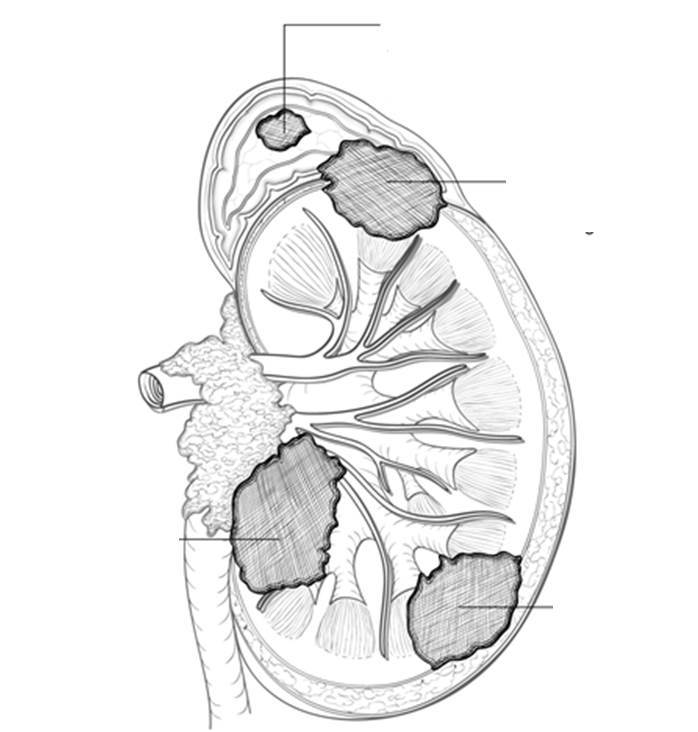
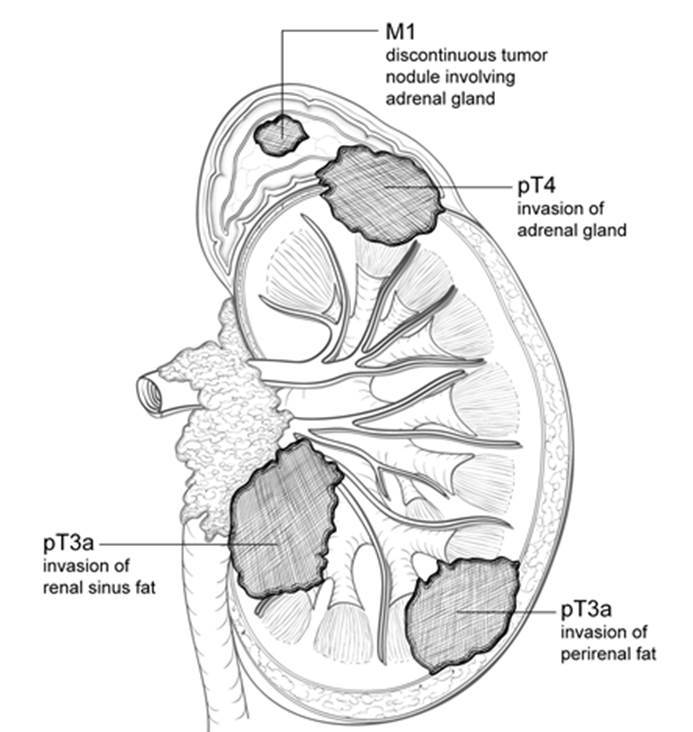
Kidney Staging

Kidney Staging
Breast
Primary Tumor (Invasive Carcinoma) (pT)
- pTX:
- pT0:
- pTis (DCIS):
- pTis (LCIS):
- pTis (Paget):
- pT1:
- pT1mi:
- pT1a:
- pT1b:
- pT1c:
- pT2:
- pT3:
- pT4:
- pT4a:
- pT4b:
- pT4c:
- pT4d:
Regional Lymph Nodes (pN)
- pNX:
- pN0:
- pN0 (i-):
- pN0 (i+):
- pN0 (mol-):
- pN0 (mol+):
- pN1mi:
- pN1a:
- pN2a:
- pN3a: .
Distant Metastasis (pM) (required only if confirmed pathologically in this case)
- pM1:
Primary Tumor (Invasive Carcinoma) (pT)
- pTX: Primary tumor cannot be assessed
- pT0: No evidence of primary tumor#
- pTis (DCIS): Ductal carcinoma in situ#
- pTis (LCIS): Lobular carcinoma in situ#
- pTis (Paget): Paget disease of the nipple not associated with invasive carcinoma and/or carcinoma in situ (DCIS and/or LCIS) in the underlying breast parenchyma#
- pT1: Tumor ≤20 mm in greatest dimension
- pT1mi: Tumor ≤1 mm in greatest dimension (microinvasion)
- pT1a: Tumor >1 mm but ≤5 mm in greatest dimension
- pT1b: Tumor >5 mm but ≤10 mm in greatest dimension
- pT1c: Tumor >10 mm but ≤20 mm in greatest dimension
- pT2: Tumor >20 mm but ≤50 mm in greatest dimension
- pT3: Tumor >50 mm in greatest dimension
- pT4: Tumor of any size with direct extension to the chest wall and/or to the skin (ulceration or skin nodules). Note: Invasion of the dermis alone does not qualify as pT4.
- pT4a: Extension to chest wall, not including only pectoralis muscle adherence/invasion
- pT4b: Ulceration and/or ipsilateral satellite nodules and/or edema (including peau d’orange) of the skin which do not meet the criteria for inflammatory carcinoma
- pT4c: Both T4a and T4b
- pT4d: Inflammatory carcinoma
Regional Lymph Nodes (pN)
- pNX: Regional lymph nodes cannot be assessed (eg, previously removed, or not removed for pathologic study)
- pN0: No regional lymph node metastasis identified histologically
- pN0 (i-): No regional lymph node metastases histologically, negative IHC
- pN0 (i+): Malignant cells in regional lymph node(s) no greater than 0.2 mm and no more than 200 cells (detected by H&E or IHC including ITC)
- pN0 (mol-): No regional lymph node metastases histologically, negative molecular findings (reverse transcriptase polymerase chain reaction [RT-PCR])
- pN0 (mol+): Positive molecular findings (RT-PCR), but no regional lymph node metastases detected by histology or IHC
- pN1mi: Micrometastases (greater than 0.2 mm and/or more than 200 cells, but none greater than 2.0 mm).
- pN1a: Metastases in 1 to 3 axillary lymph nodes, at least 1 metastasis greater than 2.0 mm#
- pN2a: Metastases in 4 to 9 axillary lymph nodes (at least 1 tumor deposit greater than 2.0 mm)#
- pN3a: Metastases in 10 or more axillary lymph nodes (at least 1 tumor deposit greater than 2.0 mm)#
Nodes containing only ITCs are excluded from the total positive node count for purposes of N classification but should be included in the total number of nodes evaluated.
Distant Metastasis (pM) (required only if confirmed pathologically in this case)
- pM1: Distant detectable metastasis as histologically proven larger than 0.2 mm
Breast Staging
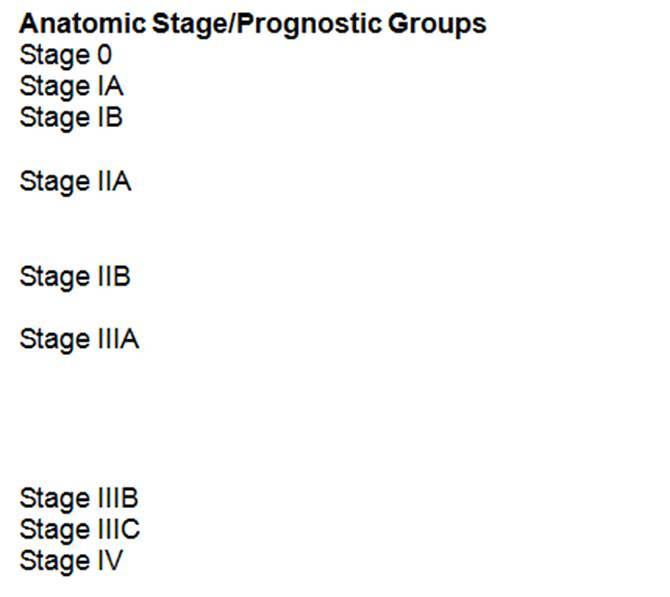
Breast Staging
Cervix
Cervix
Histologic Grade
- Not applicable
- GX:
- G1:
- G2:
- G3:
Primary Tumor (pT)
- pTX:
- pT1:
- pT1a:
- pT1a1:
- pT1a2:
- pT1b:
- pT1b1:
- pT1b2:
- pT1a:
- pT2:
- pT2a:
- pT2a1:
- pT2a2:
- pT2b:
- pT2a:
- pT3:
- pT3a:
- pT3b:
- pT4:
Regional Lymph Nodes (pN) (select all that apply)
- pNX:
- pN0:
- pN1:
Distant Metastasis (pM) (required only if confirmed pathologically in this case)
- pM1:
Cervix
Histologic Grade
- Not applicable
- GX: Cannot be assessed
- G1: Well differentiated
- G2: Moderately differentiated
- G3: Poorly differentiated
Primary Tumor (pT)
- pTX: Cannot be assessed
- pT1: Cervical carcinoma confined to uterus (extension to corpus should be disregarded)
- pT1a: Invasive carcinoma diagnosed by microscopy only. All macroscopically visible lesions (even with superficial invasion) are pT1b/1B.
- pT1a1: Stromal invasion ≤3.0 mm in depth and horizontal spread ≤7.0 mm
- pT1a2: Stromal invasion >3.0 mm but not more than 5.0 mm in depth and horizontal spread ≤7.0 mm
- pT1b: Clinically visible lesion confined to the cervix or microscopic lesion greater than T1a2/IA2
- pT1b1: Clinically visible lesion ≤4.0 cm in greatest dimension
- pT1b2: Clinically visible lesion >4.0 cm in greatest dimension
- pT1a: Invasive carcinoma diagnosed by microscopy only. All macroscopically visible lesions (even with superficial invasion) are pT1b/1B.
- pT2: Tumor invades beyond the uterus but not to pelvic wall or to lower third of vagina
- pT2a: Tumor without parametrial invasion
- pT2a1: Clinically visible lesion ≤4.0 cm in greatest dimension
- pT2a2: Clinically visible lesion >4.0 cm in greatest dimension
- pT2b: Tumor with parametrial invasion
- pT2a: Tumor without parametrial invasion
- pT3: Tumor extends to the pelvic wall and/or involves the lower third of the vagina and/or causes hydronephrosis or nonfunctioning kidney
- pT3a: Tumor involves lower third of vagina, but not pelvic wall
- pT3b: Tumor extends to pelvic wall and/or causes hydronephrosis or nonfunctioning kidney
- pT4: Tumor invades the mucosa of bladder or rectum and/or extends beyond true pelvis (bullous edema is not sufficient evidence to classify a tumor as pT4)
Regional Lymph Nodes (pN) (select all that apply)
- pNX: Cannot be assessed
- pN0: No regional lymph node metastasis
- pN1: Regional lymph node metastasis
+ Number of lymph nodes with isolated tumor cells (<0.2 mm):
+ Number of lymph nodes with micrometastasis (>0.2 mm to 2 mm):
Distant Metastasis (pM) (required only if confirmed pathologically in this case)
- pM1: Distant metastasis
Cervix
FIGO Stage
- I:
- IA:
- IA1:
- IA2:
- IB:
- IB1:
- IB2:
- IA:
- II:
- IIA:
- IIA1:
- IIA2:
- IIB:
- IIA:
- III:
- IIIA:
- IIIB:
- IV:
- IVA:
- IVB:
Cervix
FIGO Stage
- I: Carcinoma is strictly confined to the cervix (extension to the uterine corpus should be disregarded).
- IA: Invasive cancer identified only microscopically. (All gross lesions even with superficial invasion are stage IB cancers.) Invasion is limited to measured stromal invasion with a maximum depth of 5 mm and no wider than 7 mm.
- IA1: Measured invasion of stroma ≤3 mm in depth and ≤7 mm width.
- IA2: Measured invasion of stroma >3 mm and <5 mm in depth and ≤7 mm width.
- IB: Clinical lesions confined to the cervix, or preclinical lesions greater than stage IA.
- IB1: Clinical lesions ≤4 cm in size.
- IB2: Clinical lesions >4cm in size.
- IA: Invasive cancer identified only microscopically. (All gross lesions even with superficial invasion are stage IB cancers.) Invasion is limited to measured stromal invasion with a maximum depth of 5 mm and no wider than 7 mm.
- II: The carcinoma extends beyond the uterus, but has not extended onto the pelvic wall or to the lower third of vagina.
- IIA: Involvement of up to the upper two-thirds of the vagina. No obvious parametrial involvement.
- IIA1: Clinically visible lesion ≤4 cm
- IIA2: Clinically visible lesion >4 cm
- IIB: Obvious parametrial involvement but not onto the pelvic sidewall.
- IIA: Involvement of up to the upper two-thirds of the vagina. No obvious parametrial involvement.
- III: The carcinoma has extended onto the pelvic sidewall. On rectal examination, there is no cancer-free space between the tumor and pelvic sidewall. The tumor involves the lower third of the vagina. All cases of hydronephrosis or nonfunctioning kidney should be included unless they are known to be due to other causes.
- IIIA: Involvement of the lower vagina but no extension onto pelvic sidewall.
- IIIB: Extension onto the pelvic sidewall, or hydronephrosis/nonfunctioning kidney.
- IV: Carcinoma has extended beyond the true pelvis or has clinically involved the mucosa of the bladder and/or rectum.
- IVA: Spread to adjacent pelvic organs.
- IVB: Spread to distant organs.
Note: The depth of invasion should not be more than 5 mm taken from the base of the epithelium, either surface or glandular, from which it originates. Vascular space invasion should not alter the staging.
Colon
Primary Tumor (pT)
- pTX:
- pT0:
- pTis:
- pTis:
- pT1:
- pT2:
- pT3:
- pT4
- pT4a:
- pT4b:
Regional Lymph Nodes (pN)
- pNX:
- pN0:
- pN1
- pN1a:
- pN1b:
- pN1c:
- pN2
- pN2a:
- pN2b:
Distant Metastasis (pM) (required only if confirmed pathologically in this case)
- pM1: Distant metastasis
- pM1a: Metastasis to single organ or site (eg, liver, lung, ovary, nonregional lymph node)
- pM1b: Metastasis to more than 1 organ/site or to the peritoneum
Colon
Primary Tumor (pT)
- pTX: Cannot be assessed
- pT0: No evidence of primary tumor
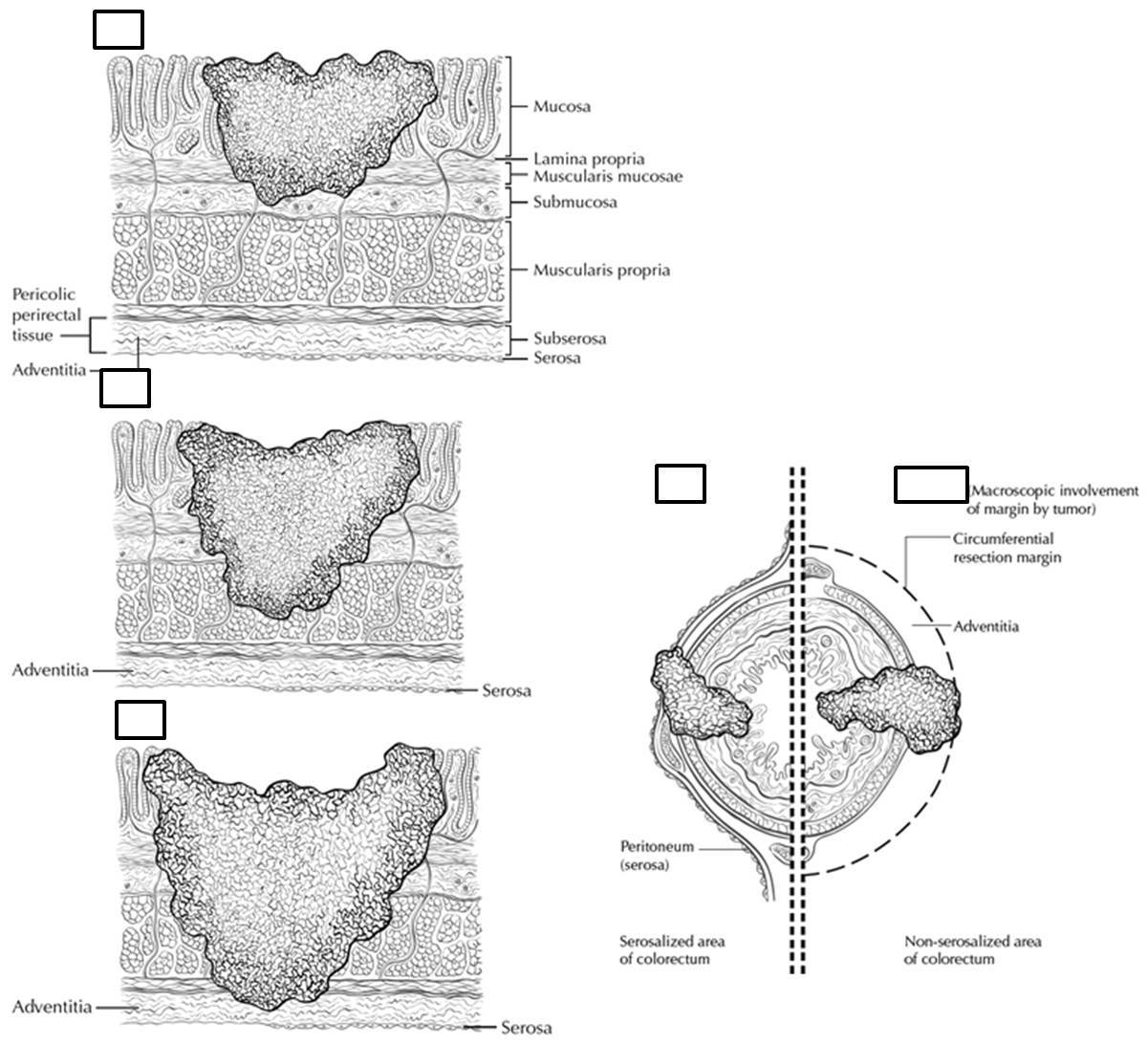
- pTis: Carcinoma in situ, intraepithelial (no invasion of lamina propria)
- pTis: Carcinoma in situ, invasion of lamina propria/muscularis mucosae
- pT1: Tumor invades submucosa
- pT2: Tumor invades muscularis propria
- pT3: Tumor invades through the muscularis propria into pericolorectal tissues
- pT4
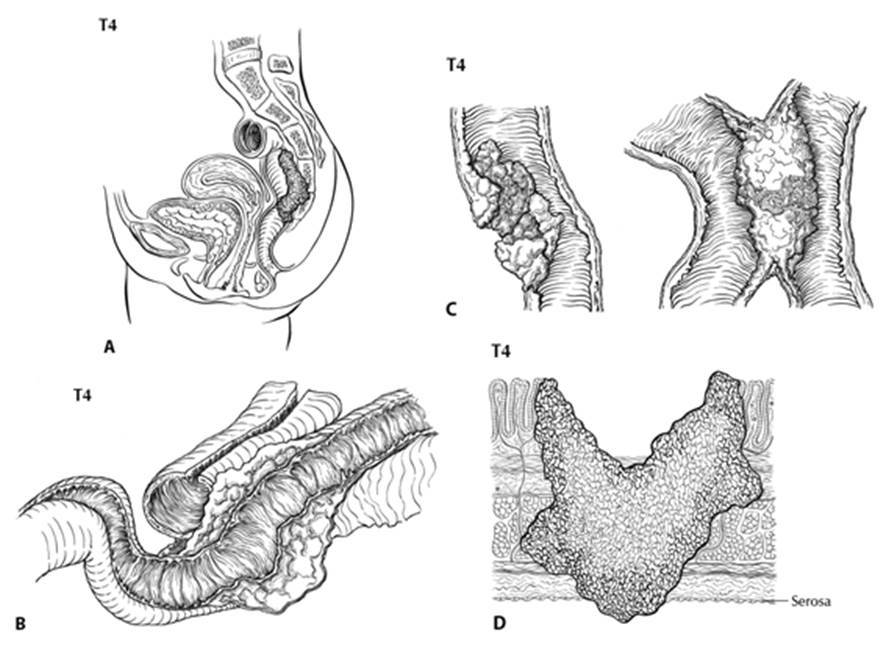
- pT4a: Tumor penetrates the visceral peritoneum
- pT4b: Tumor directly invades or is adherent to other organs or structures
Regional Lymph Nodes (pN)
- pNX: Cannot be assessed
- pN0: No regional lymph node metastasis
- pN1
- pN1a: Metastasis in 1 regional lymph node
- pN1b: Metastasis in 2 to 3 regional lymph nodes
- pN1c: Tumor deposit(s) in the subserosa, or non-peritonealized pericolic or perirectal tissues without regional lymph node metastasis
- pN2
- pN2a: Metastasis in 4 to 6 regional lymph nodes
- pN2b: Metastasis in 7 or more regional lymph nodes
Distant Metastasis (pM) (required only if confirmed pathologically in this case)
- pM1: Distant metastasis
- pM1a: Metastasis to single organ or site (eg, liver, lung, ovary, nonregional lymph node)
- pM1b: Metastasis to more than 1 organ/site or to the peritoneum
Colon
Colon
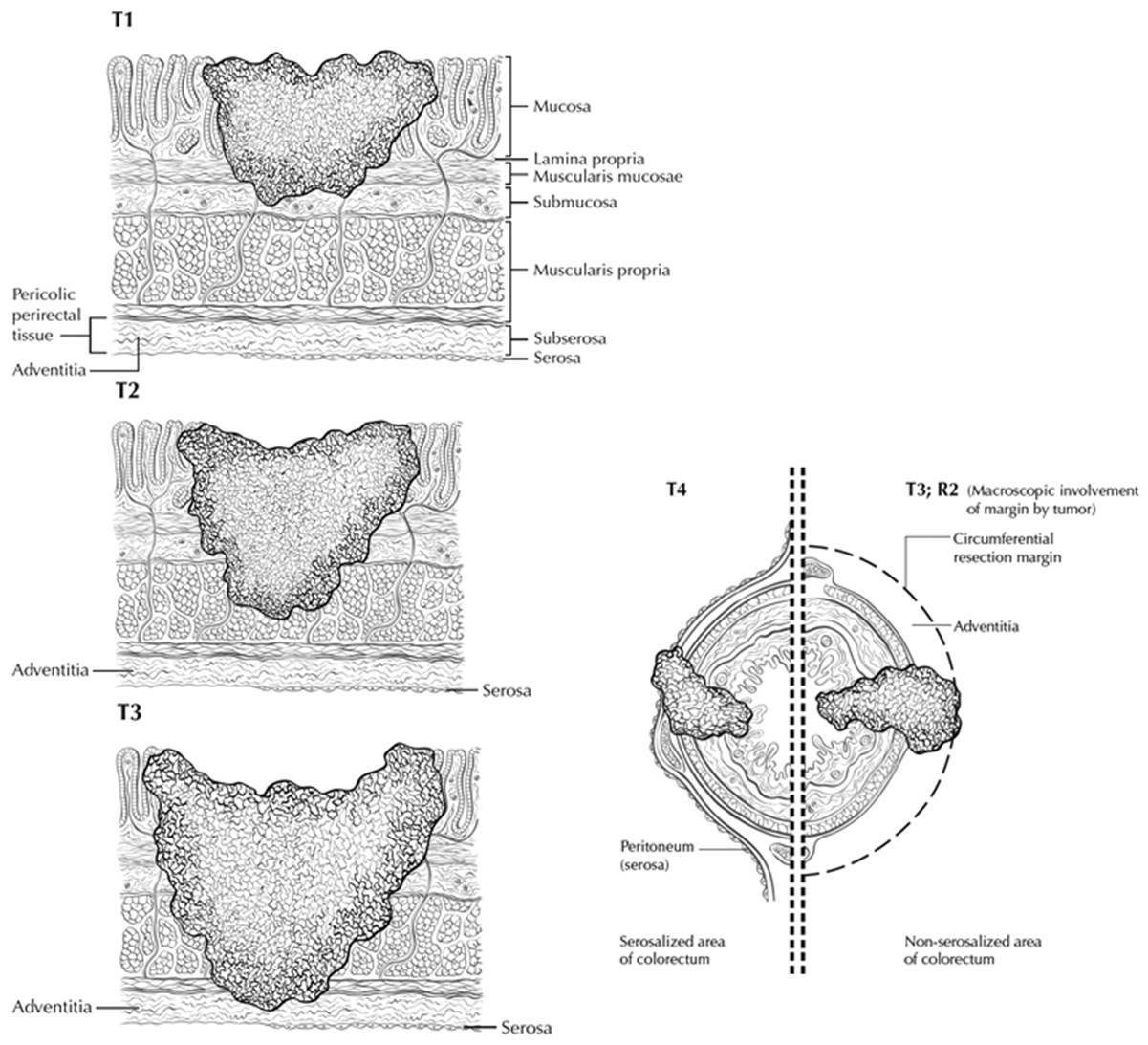
Colon T4
Colon T4
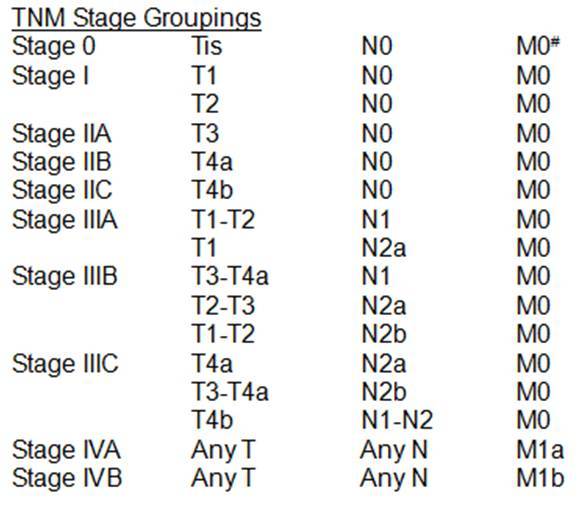
Colon Staging
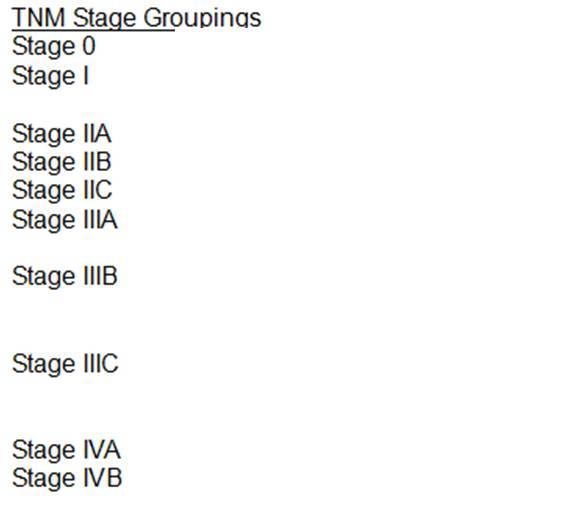
Colon Staging
Endometrium
Primary Tumor (pT)
- pTX:
- pT0:
- pT1
- pT1a:
- pT1b:
- pT2:
- pT3
- pT3a:
- pT3b:
- pT4:
Regional Lymph Nodes (pN)
- pNX:
- pN0:
- pN1:
- pN2:
Distant Metastasis (pM) (required only if confirmed pathologically in this case)
- pM1:
Endometrium
Primary Tumor (pT)
- pTX: Primary tumor cannot be assessed
- pT0: No evidence of primary tumor
- pT1
- pT1a: Tumor limited to endometrium or invades less than one-half of the myometrium
- pT1b: Tumor invades greater than or equal to one-half of the myometrium
- pT2: Tumor invades stromal connective tissue of the cervix, but does not extend beyond uterus
- pT3
- pT3a: Tumor involves serosa and/or adnexa (direct extension or metastasis)
- pT3b: Vaginal involvement (direct extension or metastasis) or parametrial involvement
- pT4: Tumor invades bladder mucosa and/or bowel mucosa (bullous edema is not sufficient to classify a tumor as T4)
Regional Lymph Nodes (pN)
- pNX: Cannot be assessed
- pN0: No regional lymph node metastasis
- pN1: Regional lymph node metastasis to pelvic lymph nodes
- pN2: Regional lymph node metastasis to para-aortic lymph nodes, with or without positive pelvic lymph nodes
Distant Metastasis (pM) (required only if confirmed pathologically in this case)
- pM1: Distant metastasis (includes metastasis to inguinal lymph nodes, intraperitoneal disease, or lung, liver, or bone metastasis. It excludes metastasis to para-aortic lymph nodes, vagina, pelvic serosa, or adnexa)
Endometrium
FIGO Stage
- I:
- IA:
- IB:
- II:
- III:
- IIIA:
- IIIB:
- IIIC:
- IIIC1:
- IIIC2:
- IV:
- IVA:
- IVB:
Endometrium
FIGO Stage
- I: Tumor confined to the corpus uteri
- IA: No or less than half myometrial invasion
- IB: Invasion equal to or more than half of the myometrium
- II: Tumor invades cervical stroma, but does not extend beyond the uterus
- III: Local and/or regional spread of the tumor
- IIIA: Tumor invades the serosa of the corpus uteri and/or adnexae
- IIIB: Vaginal involvement and/ or parametrial involvement
- IIIC: Metastases to pelvic and/or para-aortic lymph nodes
- IIIC1: Positive pelvic nodes
- IIIC2: Positive para-aortic nodes with or without positive pelvic lymph nodes
- IV: Tumor invades bladder and/or bowel mucosa, and/or distant metastases
- IVA: Tumor invasion of bladder and/or bowel mucosa
- IVB: Distant metastasis, including intraabdominal metastases and/or inguinal nodes
Endometrium TNM Staging
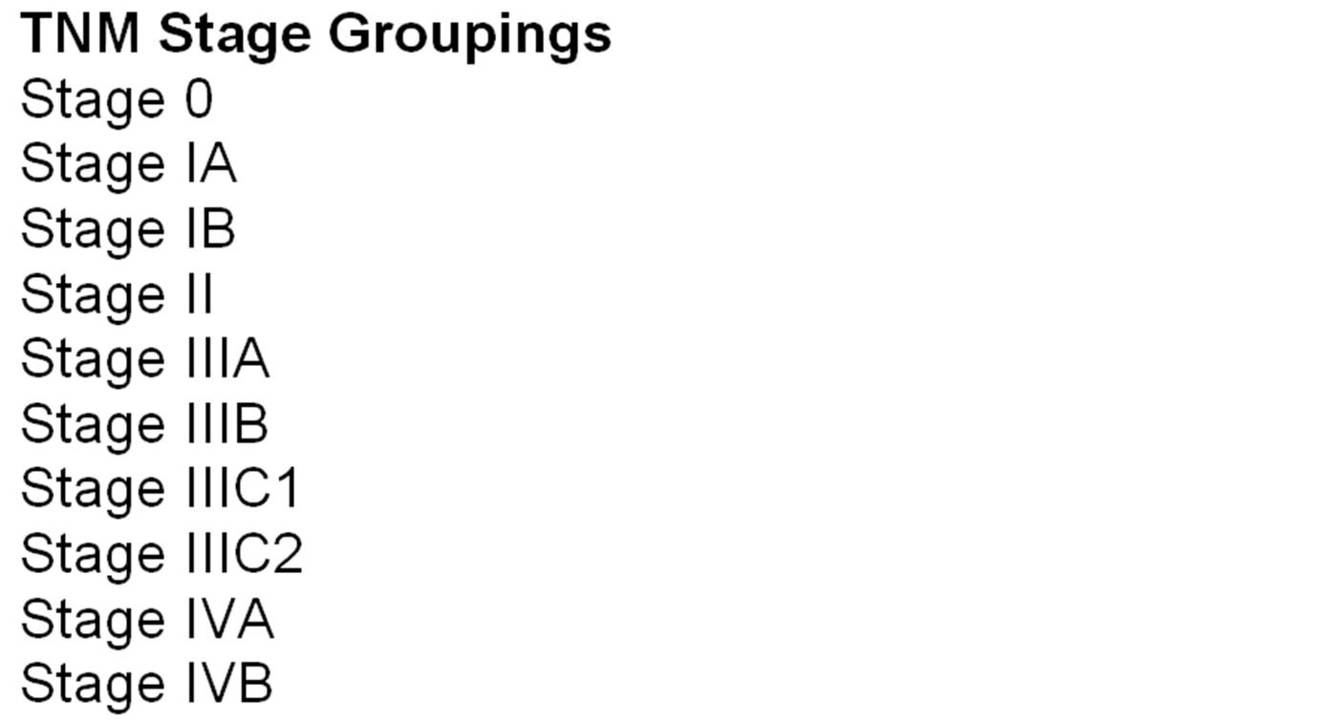
Endometrium TNM Staging
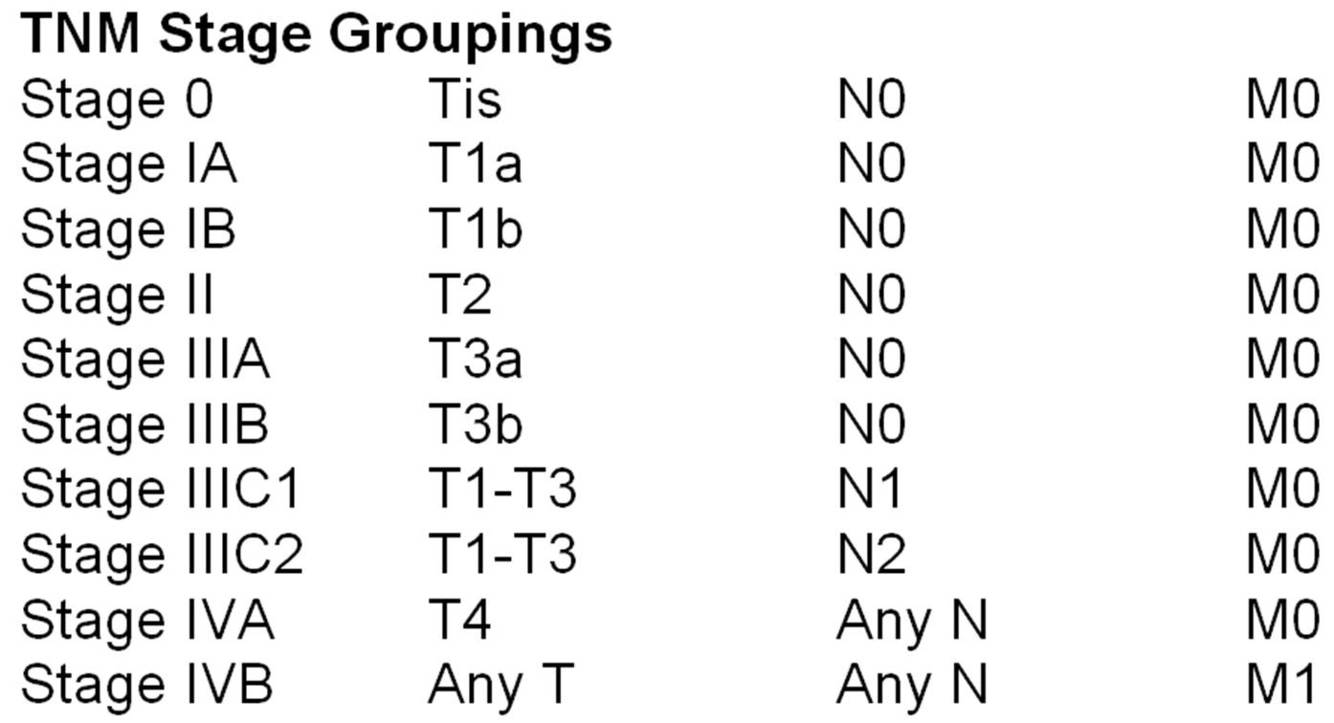
Esophagus
Primary Tumor (pT)
- pTX:
- pT0:
- pTis:
- pT1:
- pT1a:
- pT1b:
- pT2:
- pT3:
- pT4:
- pT4a:
- pT4b:
Regional Lymph Nodes (pN)
- pNX:
- pN0:
- pN1:
- pN2:
- pN3:
Distant Metastasis (pM) (required only if confirmed pathologically in this case)
- pM1:
Esophagus
Primary Tumor (pT)
- pTX: Cannot be assessed
- pT0: No evidence of primary tumor
- pTis: High-grade dysplasia
- pT1: Tumor invades lamina propria, muscularis mucosae, or submucosa
- pT1a: Tumor invades lamina propria or muscularis mucosae
- pT1b: Tumor invades submucosa
- pT2: Tumor invades muscularis propria
- pT3: Tumor invades adventitia
- pT4: Tumor invades adjacent structures (specify):
- pT4a: Resectable tumor invading pleura, pericardium, or diaphragm
- pT4b: Unresectable tumor invading other adjacent structures, such as aorta, vertebral body, trachea, etc
Regional Lymph Nodes (pN)
- pNX: Cannot be assessed
- pN0: No regional lymph node metastasis
- pN1: Regional lymph node metastasis involving 1 to 2 nodes
- pN2: 3 to 6 nodes involved
- pN3: 7 or more nodes involved
Distant Metastasis (pM) (required only if confirmed pathologically in this case)
- pM1: Distant metastasis
Esophagus
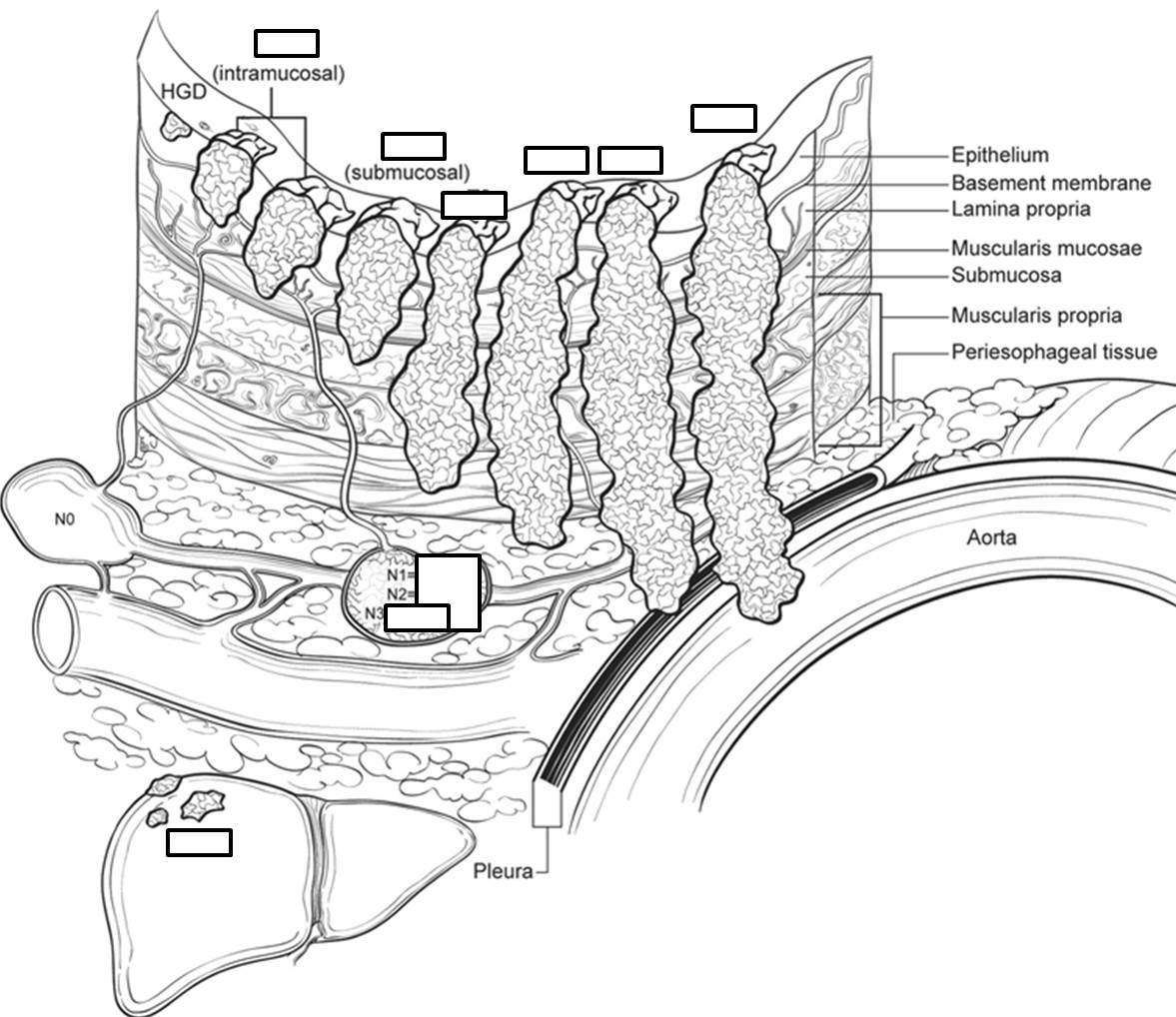
Esophagus
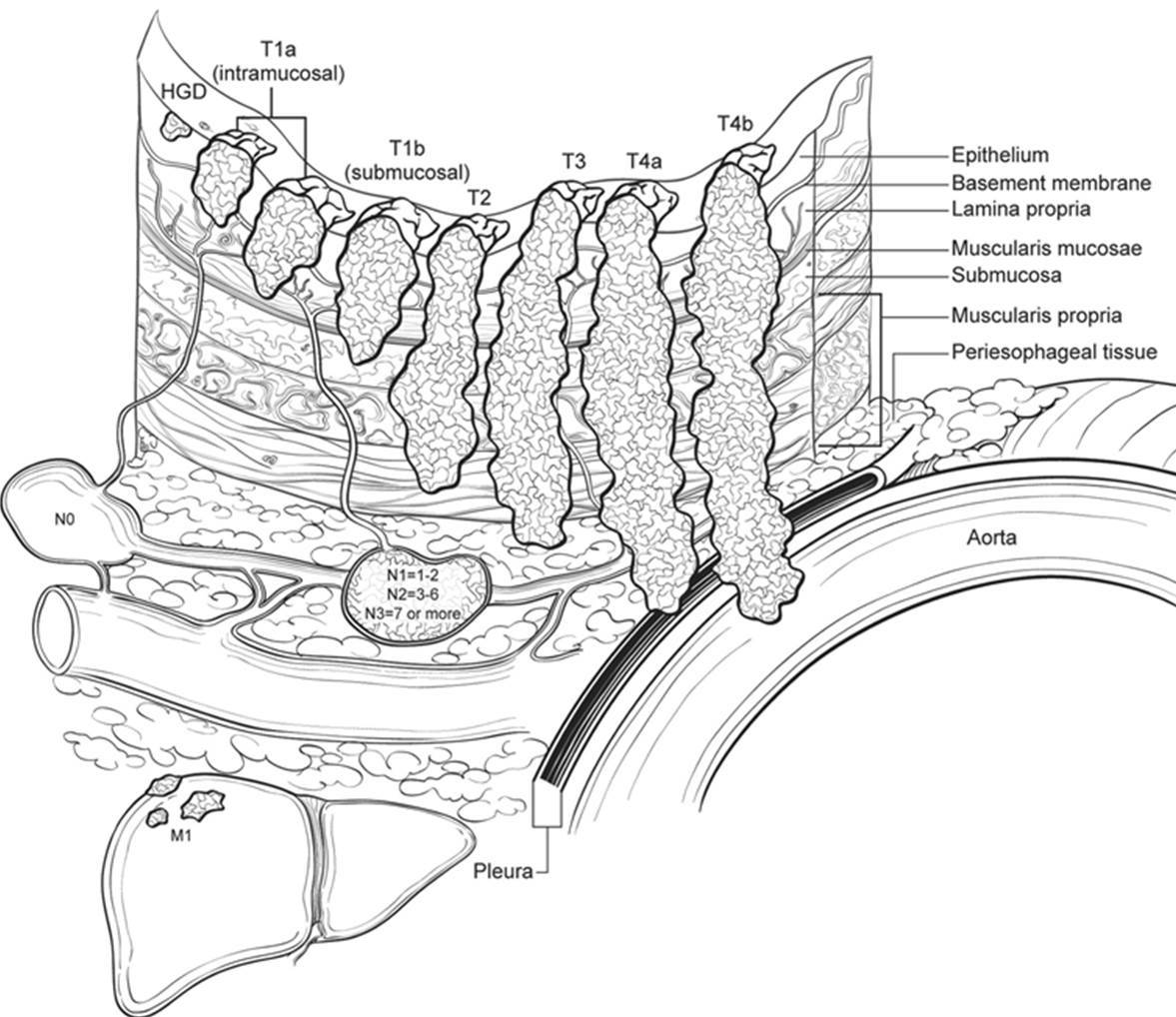
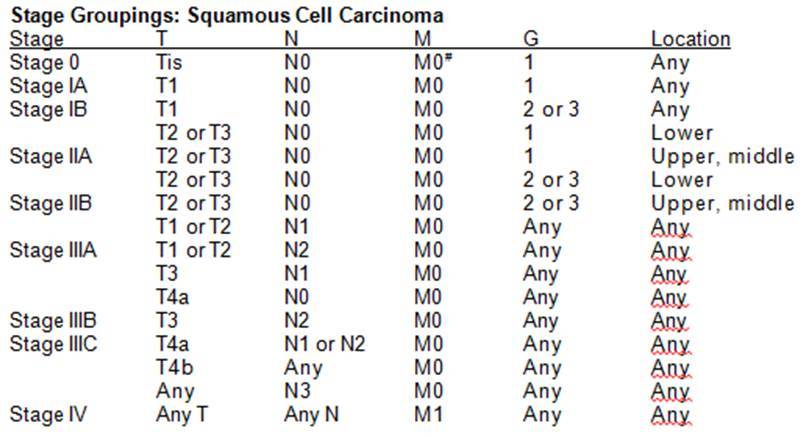
Esophagus Staging - Squamous Cell Carcinoma
Esophagus Staging - Squamous Cell Carcinoma
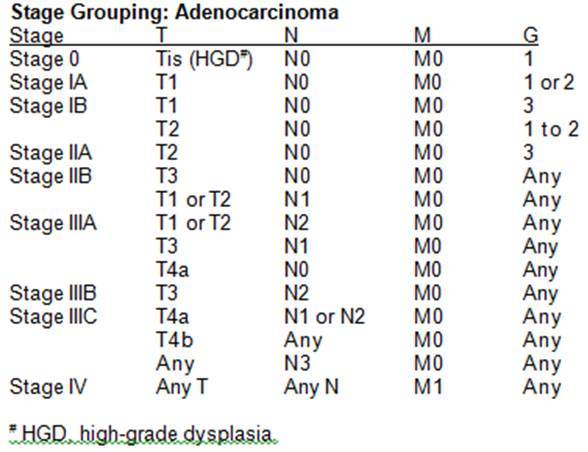
Esophagus Staging - Adenocarcinoma
Esophagus Staging -
Lung
Primary Tumor (pT)
- pTX:
- pT0:
- pTis:
- pT1
- pT1a:
- pT1b:
- pT2
- pT2a:
- pT2b:
- pT3:
- pT4:
Regional Lymph Nodes (pN)
- pNX:
- pN0:
- pN1:
- pN2:
- pN3:
Distant Metastasis (pM) (required only if confirmed pathologically in this case)
- pM1:
- pM1a:
- pM1b:
Lung
Primary Tumor (pT)
- pTX: Cannot be assessed, or tumor proven by presence of malignant cells in sputum or bronchial washings but not visualized by imaging or bronchoscopy
- pT0: No evidence of primary tumor
- pTis: Carcinoma in situ
- pT1
- pT1a: Tumor 2 cm or less in greatest dimension, surrounded by lung or visceral pleura, without bronchoscopic evidence of invasion more proximal than the lobar bronchus (ie, not in the main bronchus); or
- Superficial spreading tumor of any size with its invasive component limited to the bronchial wall, which may extend proximally to the main bronchus
- pT1b: Tumor greater than 2 cm, but 3 cm or less in greatest dimension, surrounded by lung or visceral pleura, without bronchoscopic evidence of invasion more proximal than the lobar bronchus (ie, not in the main bronchus)
- pT1a: Tumor 2 cm or less in greatest dimension, surrounded by lung or visceral pleura, without bronchoscopic evidence of invasion more proximal than the lobar bronchus (ie, not in the main bronchus); or
- pT2
- pT2a: Tumor greater than 3 cm, but 5 cm or less in greatest dimension surrounded by lung or visceral pleura, without bronchoscopic evidence of invasion more proximal than the lobar bronchus (ie, not in the main bronchus); or
- Tumor 5 cm or less in greatest dimension with any of the following features of extent: involves main bronchus, 2 cm or more distal to the carina; invades the visceral pleura; associated with atelectasis or obstructive pneumonitis that extends to the hilar region but does not involve the entire lung
- pT2b: Tumor greater than 5 cm, but 7 cm or less in greatest dimension
- pT2a: Tumor greater than 3 cm, but 5 cm or less in greatest dimension surrounded by lung or visceral pleura, without bronchoscopic evidence of invasion more proximal than the lobar bronchus (ie, not in the main bronchus); or
- pT3: Tumor greater than 7 cm in greatest dimension; or
- Tumor of any size that directly invades any of the following: parietal plural chest wall (including superior sulcus tumors), diaphragm, phrenic nerve, mediastinal pleura, parietal pericardium; or
- Tumor of any size in the main bronchus less than 2 cm distal to the carina but without involvement of the carina; or
- Tumor of any size associated with atelectasis or obstructive pneumonitis of the entire lung; or
- Tumors of any size with separate tumor nodule(s) in same lobe
- pT4: Tumor of any size that invades any of the following: mediastinum, heart, great vessels, trachea, recurrent laryngeal nerve, esophagus, vertebral body, carina; or
- Tumor of any size with separate tumor nodule(s) in a different lobe of ipsilateral lung
Regional Lymph Nodes (pN)
- pNX: Cannot be assessed
- pN0: No regional lymph node metastasis
- pN1: Metastasis in ipsilateral peribronchial and/or ipsilateral hilar lymph nodes, and intrapulmonary nodes, including involvement by direct extension
- pN2: Metastasis in ipsilateral mediastinal and/or subcarinal lymph node(s)
- pN3: Metastasis in contralateral mediastinal, contralateral hilar, ipsilateral or contralateral scalene, or supraclavicular lymph node(s)
Distant Metastasis (pM) (required only if confirmed pathologically in this case)
- pM1: Distant metastasis
- pM1a: Separate tumor nodule(s) in contralateral lung; tumor with pleural nodules or malignant pleural (or pericardial) effusion
- pM1b: Distant metastases (in extrathoracic organs)



-
Microbiology121
-
Mycology55
-
GU107
-
Lefkowitch163
-
Genetics and Syndromes49
-
Mycobacteria51
-
Parasite4
-
Pulmonary4
-
Autopsy14
-
Gyn37
-
Blood Bank17
-
Breast39
-
Cytopath61
-
Derm137
-
Bone41
-
Koneman103
-
Neuro52
-
Staging36
-
Head and Neck82
-
Ro3
-
Stains54
-
GI36
-
EM9
-
Stats and Lab Management7
-
Chemistry86
-
Heme/Coag44
-
Soft tissue42



