Name the cells bordering the lumen [1]
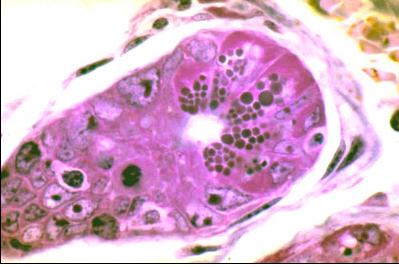
paneth cell
what region of the GI tract is this? [1]
how can you tell? [1]
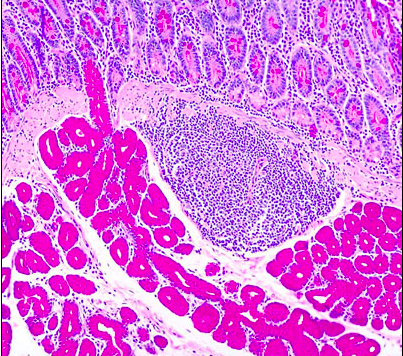
duodenum [1]
brunners glands [1]
label A-E
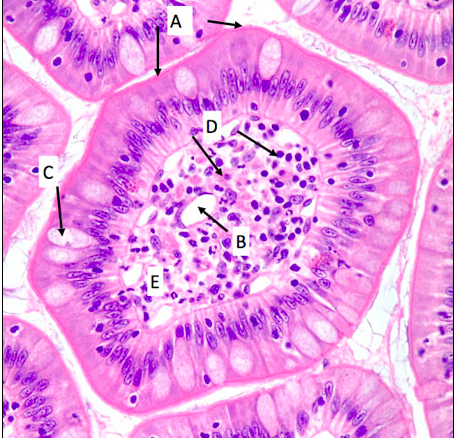
A = **enterocyte brush border**
B = **lacteal**
C = **goblet cell**
D = **immune cells (lymphocytes)**
E = **lamina propria**
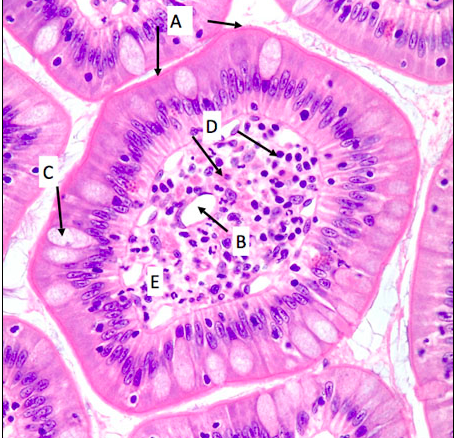
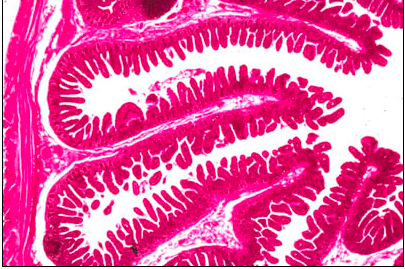
name this region of the intestine [1]
how can you tell [1]
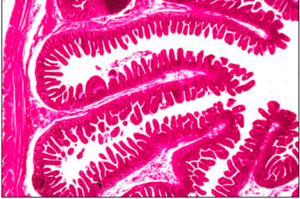
jejunum
plicae circularis
Plicae circulares are out foldings of both the mucosa and submucosa. Projecting from these folds are numerous villi that are outfoldings of the mucosa.
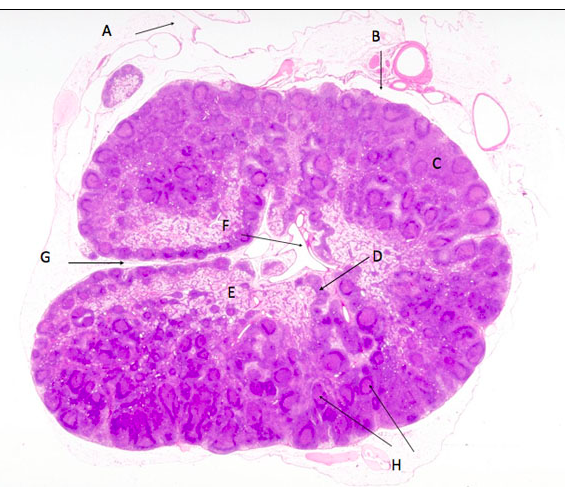
label A-H of the lymph node
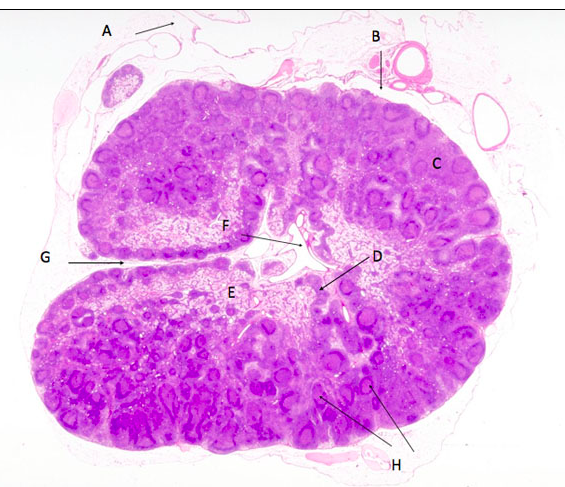
A = afferent lymphatic, B =subcapsular sinus, C = cortex, D = medullary cords, E = medulla, F = efferent lymphatic, G = hilus, H = secondary follicles
what is the name for what dietary lipid is transported in? [1]
which system are dietary lipids transported in? [1]
chylomicrons [1]
lymphatic system [1]
B12 can be only observed where? & what must it first be complexed with?
what is B12 aka?
describe the absorptive pathway of B12 :)
- B12: absorbed only in terminal ileum, after being complexed with stomach-derived intrinsic factor
- B12: aka cobalamin
absorptive pathway:
- bound to dietary protein
- first dissociated by HCl and pepsin, in stomach
- reattaches itself via haptocorrin (from saliva thats now in stomach)
- dissociated from haptocorrin and binds with stomach-derived intrinsic factor
- absorbed only in terminal ileum in enterocytes (although 60-80% still goes into faeces)
- reassociates with transcobalamin and then goes to portal circulation
which 3 antibodies do you get high levels of in CD patients? [3]
antigliadin, tissue transgluataminase, anti endomysial
how do commensal bacteria regulate digestion?
what happens if we have bacterial overgrowth?
dynamic equilibrium between diet-gut microbiome-bile acid pool size:
normally - we have conjugated bile acids, created by liver. Conjugated bile acids (primary bile acids): more efficient in emulsifying fats because at intestinal pH they become more ionized than the unconjugated bile acids.
Commensal bacteria: participate in the synthesis of bile acids. Microbial enzymes de-conjugate bile acids & make them less effecient: (secondary bile acids).
so we have a pool of primary and secondary bile acids: if have bacterial overgrowth in gut: form too much secondary bile acids = struggle to digest fats
what do mutations in:
- LCT gene
- SLC5A1 gene
cause?
which phase of digestion they effect?
mutation in gene LCT - affects mucosal phase of dissachardide absorption. lactose intolerance
gene SLC5A1 - encodes for Sodium dependent GLucose tranpsorter one: SGLT1. so mutation causes glucose-galactose malabsorption. again: mucosal phase
why does muscle not have a role in raising blood glucose levels? [2]
- free glucose cannot be produced / released from skeletal muscle bc **it doesnt have glucose-6-phosphatase (to convert G6P -> glucose) [1]
- muscle doesnt have glucagon receptors [1]**
where is glucagon made?
it is produced by the alpha cells, found in the islets of Langerhans, in the pancreas
what is glycogen breakdown aka?
explain how this occurs (4)
glycogenolysis:
- debranching enzyme: breaks down the a-1,6 glycosidic bonds (the branches of glucose)
- glycogen phosphorylase: breaks down a-1,4 glycosidic bonds: free G1Ps
- phosphoglucomutase: converts G1P to G6P
- in the liver: glucose-6-phosphatase removes the P group = free glucose
(but step 4 does not occur in the muscle - instead, it is immediately used in glycolysis)
what do two starting materials do you need before glycogen synthesis?
- *glycogen synthesis needs:**
- a primer (protein that glucose will attach to): glycogenin.
- *- glucose-6-phosphate (G6P)**
BUT: NEED TO CONVERT G6P -> UDP-glucose before can be added to glycogen:
- *a) G6P –> G1P
b) G1P –> UDP-glucose**
what do two starting materials do you need before glycogen synthesis?
- *glycogen synthesis needs:**
- a primer (protein that glucose will attach to): glycogenin.
- *- glucose-6-phosphate (G6P)**
BUT: NEED TO CONVERT G6P -> UDP-glucose before can be added to glycogen:
- *a) G6P –> G1P
b) G1P –> UDP-glucose**
glycogen production and breakdown is carried out by which hormone signalling molecules (4) and which do they act on - liver or muscle?
- insulin: muscle and liver - builds glycogen stores
- glucagon: only liver - breaks down glyocgen stores to release glucose
- adrenaline: muscles via a & b adrergic receptors - release glucose
4 calcium: muscles via a & b adrergic receptors - release glucose
when is insulin / glucagon released?
what do insulin and glucacon to do: & how?
a) glycogen synthase
b) glycogen phosphorylase
* key - learn this *
insulin: released after meal. insulin works via protein phosphatase (removes Ps):
- *- activates glycogen synthase - by removing P
- inhibits glycogen phosphorylase - by removing P**
glucagon & adrenaline: released between meals / when fasting: works via cAMP, protein kinase A and phosphorylase kinase: adds P
- *- inhibits glycogen synthase - adds P
- activates glycogen phosphorylase - adds P**
what does a lack of cAMP doe regarding glucose release? [1]
lack of cAMP causes glucagon and adrenaline effects to be stopped (and less glucose released)
what are the two pathways that insulin causes glycogen synthase to be activated and cause glucose -> glycogen?
insulin:
- activates phosphodiesterase
- activates protein phosphastase
which are two different pathways that both end up in the glucose –> glycogen
Mc Ardle’s disease:
- what type of disease (autosomal dom etc?)
- caused by?
what does this mean with regards to exercise ? second wind can occur from?
Herrs Disease
same>?
Mc Ardle’s disease:
autosomal recessive disease
caused by: deficiency in glycogen phosophorylase gene: PYGM. cant breakdown glycogen in the muscle = muscle weakness
when exercise: can only exercise in short bursts, otherwise muscles will cramp, lock and they will fall over in intense pain. This is due to their muscles running out of energy.
second wind: muscles use alternative fuel to glucose
//
Her’s disease:
caused by: deficiency in glycogen phosphorylase in liver = severe problems maintaining their blood glucose
Treatment: regular, often feeding. This is because they cannot maintain their blood glucose like we can
what is von Gierkes disease? [1]
deficiency in glucose-6-phosphastase: means liver cant produce glucose via glycogen breakdown.
feed patients with carbs day and night
- *gastrooesphageal reflux disease (GERD):**
- caused by?
- associated with? (3)
- what can chronic condition lead to? (3)
- treatments?
gastrooesphageal reflux disease (GERD):
- caused by:
a) movement of stomach contents from fundus -> distal oesophagus after lower oesophagus sphincter is relaxed
b) then get increased frequency of transient relaxations of lower oesph. sphincter
- associated with:
- **weight gain
- gastroparesis
- stress**
- chronic condtion leads to:
- *a) ulcer formation
b) inflammation** - treatment: antacids and alginates - like gaviscon
Q
gastroparesis:
- caused by?
- symptoms?
- which disease is it associated with?
- what can it lead to?
- caused by: delayed gastric emptying
- inability to remove stomach content causes: nausea, vomiting, feeling of fullness, pain and bloating
- associated with diabetes: diabetic gastroparesis
- subsquently can lead to malnutrition (bc people dont eat) and changes in blood sugar
Q
gastroparesis:
- caused by?
- symptoms?
- which disease is it associated with?
- what can it lead to?
- caused by: delayed gastric emptying
- inability to remove stomach content causes: nausea, vomiting, feeling of fullness, pain and bloating
- associated with diabetes: diabetic gastroparesis
- subsquently can lead to malnutrition (bc people dont eat) and changes in blood sugar



-
FunMed EOYS251
-
FunMedEOYS347
-
FunMedEOYS459
-
FunMedEOYS153
-
FunMedEOYS427
-
FunMed EOYS Long 16
-
big boy things51
-
CR EOYS142
-
CR EOYS248
-
CR EOYS351
-
Calculations6
-
CR EOYS421
-
MET EOYS154
-
big boys29
-
MET EOYS253
-
MET EOYS343
-
MET EOYS445
-
MET EOYS538
-
BB EOYS150
-
BBB2
-
BB EOYS255
-
Short king spring65
-
BB EOYS350
-
BB EOYS446
-
:O29
-
BB EOYS447
-
Loco EOYS43
-
LOCO SSS59
-
LOCO EOYS 441
-
Loco EOYS344
-
LOCO EOYS 553
-
LOCO SSS246
-
LOCO EOYS542
-
LOCO EOYS629
-
SSS FunMed52
-
Spotter Qs130
-
SSS FunMed252
-
METSSS44
-
METSS249



