which amino acids are glucogenic? [2]
which a.a are ketogenic? [2]
glutamine
Alanine
lysine and leucine are ketogenic
the cori cycle spares pyruvate be ensuring that pyruvate is NOT converted to what?
where is a source of ^ instead?
the cori cycle only works if you conserve pyruvate, by removing it from muscle and recycling in the liver. cori cycle has to avoid pyruvate’s conversion to acetyl Co-A
INSTEAD
fatty acid metabolism produces acetyl co-A, creating another source of acetyl co-A & means that cori cycle can go ahead for gluconeogenesis. otherwise the pyrvate from cori cycle would be used to make actetly co-A . good thing !!
Q
specifically, how is gluconeogensis controlled by:
- insulin?
- glucagon?
- adrenaline?
(.i.e. which enzymes blocked etc)
- *insulin:**
- inhibits gluconeogensis
- insulin dephosphorylates pyruvate dehydrogenase. this makes pyruvate dehydrogenase active & converts pyruvate -> acetyl coA, which enters krebs cycle. pyruvate is therefore not available to be made into glucose
- *glucagon & adrenaline:**
- promotes gluconeogensis
- glucagon increases cAMP levels. this causes pyruvate dehydrogenase to be phosphorlayed (by pyruvate dehydrogenase kinase) & inactive. pyruvate is then available for glucose production
which cells regulate water contents in the gut?
what is the mechanism of this?
secretory cells of the intestinal crpyts:
- CFTR channel within these cells controls this:
a) Cl- moves from ECF via Na/K/CL2 cotransporter (as does Na & K)
b) Cl- enters lumen through CFTR channel
c) Na+ is reabsorbed via Na/K ATPase
d) negative Cl- in lumen attracts Na by paracellular pathway (through cell gaps)
e) water follows the Na into the lumen
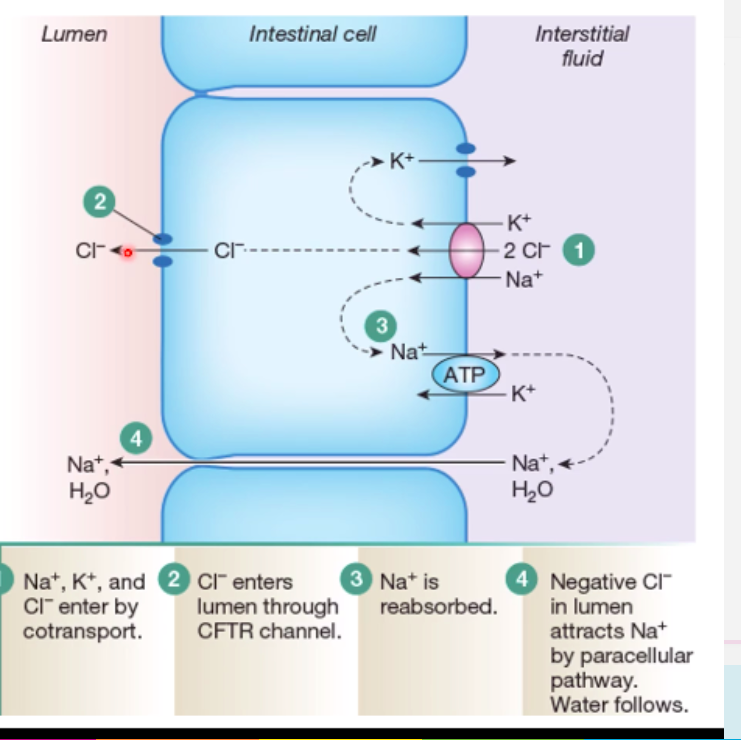
how does cholera effect the secretory cells of the crypts?
- Vibrio cholerae releases toxins: has a Part A & Part B
- Part A incorporated into cell. binds to adenylate cyclase, which in turn makes more cAMP
- too much cAMP triggers CFTR to be constantly open AND blocks Na/CL symporter (so lots of Cl- is leaving cell and is not being reimbursed)
- Cl leaves cell into gut = water follows
= secretory diarrhoea
gastric epithelial cells
- parietal cells produce HCl. But HCl is actually quite toxic. how does the body cell overcome this issue of not causing self harm via the HCl? (2)
1. HCl is only produced when food is in the stomach = get unstimualted and stimulated parietal cells:
a) unstimulated parietal cells have H+ ATPase Pumps in the cytosol
b) stimulated parietal cells have H+ ATPase Pumps on apical surface
- *2. surface mucus cells secrete mucus**
- without mucus = would directly interact with cells
- mucus works as:
a) physical barrier; gel layer
b) chemical barrier; bicarbonate
Q
what is MoA for when ORS treats cholera?
ORS MoA:
- ORS has Na, glucose and AA in it.
- Na & Gluocse transporters are still working with cholera
- Na prefers to be in ECF: leaves crpyt secretory cells
- *- pumped out via Na/K ATPase into ECF
- water follows = save wate**
explain how diabetes disrupts gluconeogensis pathway ox
insulin doesnt work:
SO
- pyruvate dehydrogenase remains phosphorylated & therefore inactive
- = less acetyl co-A to go into krebs cycle from pyruvate
- instead fats are broken down to produce fatty acids & acetyl co-A & goes into krebs cycle instead
- means that pyruvate is available for gluconeogenesis
which cells produce gastrin?
when do cells produce gastrin?
where are they?
why is gastrin produced?
produced by: G cells !! g 4 gastrin xox
located @ atrium of stomach -> bc at the bottom of the stomach. if they sense that there are big proteins - stimulate the formation of more acid.
BUT HOW COMMUNICATE to the other cells?
- gastrin produced and excreted into blood. = therefore a hormone ! (endocrine activity)
- goes to ECL and parietal cells
Acetyl Co-A is one of the starting molecules needed for TCA. But what is the equation for the formation of Acetyl Co-A from pyruvate?
what is the enzyme used to catalyse this reaction?
what nutrition is needed for this reaction?
- pyruvate + CoA + NAD+ –> acetyl Co-A + Co2 + NADH
- enzyme: pyruvate dehydrogenase (PDH)
- co-enzymes are members of the B-vitamin family. uses TPP (aka vitamin B1)
when is PDH blocked for TCA? [2]
- PDC / PDH is blocked when:
- *a) levels of Acetyl CoA levels are high
b) If reduced NAD levels are high**
what are 3 medical options for GORD?
why do u have to be careful if taking NSAIDS with GORD / GERD? (2)
- inhibited by PPI
- block the H2 receptor: (cant target others bc the receptors are so common)
- neutralised by antacids: form a protective raft over acid pockets
- NSAIDs: block the prostoglandins from binding to prostaglandin receptors on the parietal cells = means that body’s natural inhibitor is blocked :(.
- *- will cause less mucous and bicarbonate secretion :(**
when is PDH blocked for TCA? [2]
- PDC / PDH is blocked when:
a) levels of Acetyl CoA levels are high
b) If reduced NAD levels are high
what happens (overview) to acetyl co-A during the TCA?
Acetyl CoA combines with oxaloacetate to form Citrate.
(Citrate is a tricarboxylic acid, hence the name TCA)
This enters the cycle and is progressively oxidised, each time producing NADH/FADH2, until finally forms oxaloacetate again and the cycle can begin again.
how many acetly Co-A enter the TCA (from one glucose molecule)
what are the end products of TCA cycle? (3)
- TCA end products:
a) 1 GTP / ATP
b) 3 NADH
c) 1 FADH
1
BUT BECAUSE HAVE 2 ACETLY CO-As GOING INTO TCA:
a) 2 GTP / ATP
b) 6 NADH
c) 2 FADH
explain what happens to the stomach when food enters the intestines?
a) hormonal control
b) nervous control
Primarily inhibits gastric acid secretion when FOOD AND ACID ENTERS THE INTESTINES
NERVOUS CONTROL:
- *It signals the sympathetic system to stop gastric secretions**
- Inhibition of parietal and chief cells
HORMONAL CONTROL:
- *- Cholecystokinin, secretin and GIP (gastric inhibitory protein) produced by duodenum –> inhibit gastric secretions**
- Cholecystokinin and GIP released by presence of lipids and carbohydrates
- Secretin released when pH decreases (due to entrance of acidic chyme into the duodenum)
what is produced if hypoxia occurs at TCA? [2]
- during hypoxia: formation of reactive oxygen species (ROS) -> highly damagin to lipids / proteins / DNA
- oxygen is not there to mop up the electrons at complex 4. electrons are abcked into the ETC
Q
PDH is regulated in two ways:
- PDH is de/-phosphorylated by which enzymes? what do they add / remove? what is their effect?
which substances control 1.?
:)
- PDH Kinases inhibit PDH by adding PO4
- PDH Phosphatases activate PDH by removing PO4
//
- *control of PDH kinases**
- PDH kinases are activated: by ATP, acetyl Co-A and NADH (last two are products of PDH) = switch off PDH.
- Pyruvate & insulin inhibits PDH Kinasese (as pyruvate wants PDH to be active to break pyruvate down) = switch on PDH.
control of PDH phosphatases
- Ca2+ ions activate PDH phosphatises - increases PDH. occurs in muscle -> eventually get more ATP production = switch on PDH
- insulin activates PDH phosphatases - actives PDH
what does Akt do in muscle?
Akt: phosphorylates and inactivates glycogen synthase kianse = activates glyocgen synthase
how does Helicobacter pylori cause a peptic ulcer? (4)
- H. pylori produces urea in stomach.
- urea turns into NH3: as a result: 1. raises acid. 2. degels the mucin (lose mucous layer)
- builds up
- eventually mucin layer removed and mucosal damage is caused by the pepsin and H+ of HCl :(
Q
what is the common pathway used to break down alcohol?
* what is an important product of alchohol break down? *
most common pathway:
i) ethanol ⇌ acetaldehyde (via enzyme alcohol dehydrogenase (ADH))
ii) acetaldehyde –> acetate (ketone body - so can be used to make energy !) via enzyme ALDH2
iii) acetate can then be converted into (acetyl co-a
important product: NADHs produced !! remember
effect of insulin at:
muscles [2]
adipose tissues: [2]
liver: [2]
protein synthesis? [2]
effect of insulin at:
muscles:
- *i) activates glycogenesis
ii) inhibits glycogenolysis**
adipose tissues:
i) activates lipogenesis
ii) inhibits lipolysis
liver:
- *i) glycogensis Activated
ii) lipogenesis activated
iii) GNG inhbiited**
protein synthesis:
- *i) activates protein synthesis
ii) inhibits protein catabolism**
how is the TCA cycle controlled in response to exercise?
(3)
1.
- Ca2+ is an allosteric keeps the pyruvate deyhyrogenase complex activated.
- therefore causes **quicker conversion of pyruvate -> acetly co-A
- increases TCA to occur more**
(PDH controls the entry to the TCA, it’s activity is regulated. The enzyme is phosphorylated and dephosphorylated depending on whether it is active or inactive. The calcium is promoting essentially the active state of PDH, by influencing PDH phosphatase (this PDH phosphatase will remove phosphates from the PDC and activate it)
2:
calcium and ADP drive activity of two dehydrogenase enzymes in the TCA to maintain high ATP production
3.
Low levels of ATP/NAD pushes PDH into its active state.
explain how two pathologies occur from xs alchohol consumption !
- excess alchohol consumption leads to excess acetyl co-A
- excess acetyl co-A:
i) produces lots of ketone bodies: acidic –> metabolic acidosis
ii) gets converted to fats -> fat & obese
- fatty liver:
- XS acetly co-A converted to fat & stays in liver.
- often have low food intake - poor protein intake = low albumin. = fat not transported
- get scar tissue forming
- results in cirrhosis



-
FunMed EOYS251
-
FunMedEOYS347
-
FunMedEOYS459
-
FunMedEOYS153
-
FunMedEOYS427
-
FunMed EOYS Long 16
-
big boy things51
-
CR EOYS142
-
CR EOYS248
-
CR EOYS351
-
Calculations6
-
CR EOYS421
-
MET EOYS154
-
big boys29
-
MET EOYS253
-
MET EOYS343
-
MET EOYS445
-
MET EOYS538
-
BB EOYS150
-
BBB2
-
BB EOYS255
-
Short king spring65
-
BB EOYS350
-
BB EOYS446
-
:O29
-
BB EOYS447
-
Loco EOYS43
-
LOCO SSS59
-
LOCO EOYS 441
-
Loco EOYS344
-
LOCO EOYS 553
-
LOCO SSS246
-
LOCO EOYS542
-
LOCO EOYS629
-
SSS FunMed52
-
Spotter Qs130
-
SSS FunMed252
-
METSSS44
-
METSS249



