What is the first thing you should do if a trauma patient comes in?
- Assess the whole patient for life-threatening injuries –deal with these first! These are important to check before checkingforlimb usage
- Airway
- Breathing
- Circulation
- Provide adequate analgesia, antibiotic cover and fluid support – adequate analgesia should be provided, can also allow you to assess the animal more readily if they are more comfortable. Antibiotics, esp if open fracture. Fluid support to maintain circulation
- Decontaminate and prevent any further contamination of open wounds
- Support grossly unstable fractures –a bit later in assessment andmanagement
- Assess for any neurological signs –the most important thing beyond initial assessment is whether there are any neuro signs Assessment of the trauma patient
Why is analgesia essential for a trauma case?
They will likely be in huge amounts of pain
If they are more comfortable, you can assess them better also
What should all animals involved in an RTA have done as part of the further investigation after airways, breathing and circulation has been checked?
They should always have their chest radiographed - its very easy to miss miaphragmatic hernia and pneumothroax on a normal clinical exam
US of chest may be useful to identify fluid
Check integrity of urinary tract
Check for internal haemorrhage
Monitor patient constantly
What is happening on this radiograph of a dog thats been involved in an RTA?
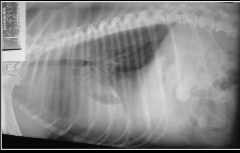
Haemothorax
What is happening on this contrast study radiograph of an animal that has been in an RTA?
What are treatment options?
Assessment of bladder function
At first it looks intact but can then see some leakage into the abdomen as can see free contrast agent
You might leave this and see if it will self heal, may need further treatment
What are the classifications of open fractures?
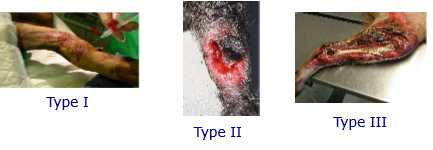
- Type I -small wound. Little contamination. Treat as closed fracture. May even miss that there has been an open fracture! Treat as if it is. Ab given and wound opened and cleaned as a consequence
- Type II –extensive wound communicating with the fracture. Larger wound, may be able to see fracture within the soft tissues
- Type III –very extensive soft tissue damage and fractured bones are seen protruding through the skin. See relatively frequently, esp distal tibia in cat –comes through small amount of soft tissue in that area. Will be clearly visible and very heavily contaminated
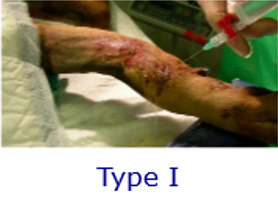
What is a type I classification of an open fracture?
- Type I -small wound. Little contamination. Treat as closed fracture. May even miss that there has been an open fracture! Treat as if it is. Ab given and wound opened and cleaned as a consequence
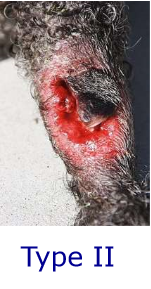
What is a type II open fracture classification?
- Type II –extensive wound communicating with the fracture. Larger wound, may be able to see fracture within the soft tissues
What is a type III open fracture classification?
- Type III –very extensive soft tissue damage and fractured bones are seen protruding through the skin. See relatively frequently, esp distal tibia in cat –comes through small amount of soft tissue in that area. Will be clearly visible and very heavily contaminated
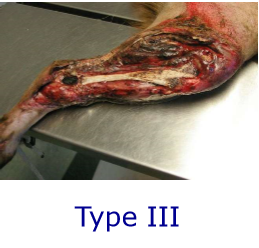
What can a shearing injury also be looked at like?
Shearing injuries could be looked at as a type 3 open fracture
What kind of things do you need to assess with a shearing injury?
Assess:
- blood supply
- damage to deeper tissues:
- nerves and ligaments –more difficult to assess. Ligaments –can check collaterals are intact, if lost malleolus, then the collateral ligaments will have gone with it
- bones
- superficial soft tissues
- These most commonly occur on the medial aspect of the hock or the radiocarpal joint –primarily as they are distal part of limb and little amount of soft tissue to protect them
What should you do to treat an open fracture before any surgical intervention etc?
- sterile water-soluble gel in wound
- wide clip
- Do this before you try to clean!! Clip itupand get all hair out of the way and once you have done this: 3.copious lavage
- Warm haartmans and 19g needle, squeeze into it and remove as much debris as you can.
- In early stages, it is contaminated, but not infected. Might become infected later due to hospital contamination –nosocomial infections! So always be aware of this, so always be sterile when touching and dealing!
- Can remove bits of skin etc. that are clearly dead. But if you are unsure –leave it! Want to maintain as much soft tissue structures as you can
- swab for bacteriology culture
- Rare
- IV broad-spectrum antibiotics
- sterile dressing
- Cover thewound! Prevent any further contamination
What are Pavlectics 6 basic principles with regards to an open fracture?
- Prevent further wound contamination
- Remove foreign debris and contamination
- Debride dead and dying tissue
- Provide adequate wound drainage
- Provide a viable vascular bed
- Select an appropriate method of closure
What is primary closure of a wound/open fracture?
This refers to wound closure immediately following the injury and prior to the formation of granulation tissue. In general, closure by primary intent will lead to faster healing and the best cosmetic result. Most patients presenting within 8 hours of injury can have the wound closed by primary intent. Simple and clean facial wounds, by virtue of the rich vascular supply to the face and the need for a good cosmetic result, can be closed by primary intent as late as 24 hours after the injury.
If primary closure is not an option for a wound/open fracture, how else can it heal?
If primary closure is not an option,
- delayed primary closure
- (pre-granulation)-3-5 days later
- secondary closure
- (granulation tissue present–5-10 d)
- Granulation tissue–pink,sometimes slightly fibrous but fairly vascular tissue. When you have this, you know the woundisnotcontaminated as the wound would not heal like this when contaminated
- second intention healing –leave wound to heal by natural process
- But don’t underestimate the time and cost that this can take! Can take several weeks and sometimes, you might be better to do something like attempt primary closure or refer on to do a skin graft –these can be quicker and less expensive than allowing secondary intention to take place
- granulation, contraction and epithelialisation
- Epithelialisation –around edge of wound, see pink line –cells migrate across surface of wound to cover it.
What is epithelialisation?
Epithelialisation –around edge of wound, see pink line –cells migrate across surface of wound to cover it.
healing by the growth of epithelium over a denudedsurface.
Which one of these wounds is ‘hyper-mature’ and what is this?
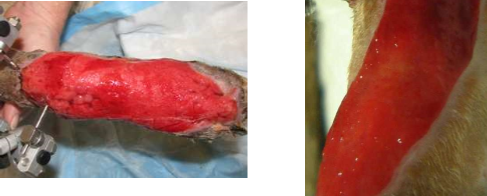
Chronic vs ‘healthy’ granulation tissue
Granulation tissue –can becomehyper mature. If it becomes a little paler and a bit fibrous (like left), this is too mature –needs to be more like right, redder and ‘angrier’
What dressing and bandages should you use for an open fracture/wound?
Which ones change and which stay the same?
- Primary (contact) layer changes
- adherent to wound
Other two layers stay the same:
- Secondary layer –absorbent (avoid maceration) e.g. cotton wool, softban
- Tertiary layer –supportive and allows evaporation –on the surface. Protects dressing from further contamination from environment e.g. Vetwrap, Elastoplast Dressings and
- Also support dressing –rob jones for example –especially if fracture is unstable
- Also helps with animals discomfort
Give an example of a secondary layer to a bandage for an open wound/fracture?
It is absorbent
e.g. cotton wool, softban
What is the tertiary layer of a dressing? give an example
Supportive and allows evaporation, on the surfacec
Protects underlying dressing from further contamination from environemnt
E.g. vetwrap, elastoplast
The primary (contact) layer changes depending upon the stage the wound is at, depending on the degree of damage to the tissues.
What primary layers could you use suring the DEBRIDEMENT STAGE?
Debridement stage: adherent
- wet-to-dry–straight forward,just a swab that you moisten with Hartman’s, place on wound and put light dressing over that, to allow it to dry out. Remove next day. Debride takes away dead tissue as it adheres to tissue as it dries. MOST EFFECTIVE
- dry-to-dry
- Hydrogel
The primary (contact) layer changes depending upon the stage the wound is at, depending on the degree of damage to the tissues.
What primary layers could you use suring the GRANULATION STAGE?
Granulation stage: dry, non-adherent
- Semi occlusive: absorptive e.g. Allevyn–place on and just absorbs some exudate and stores away from wound
- Occlusive: active rehydration e.g. Granuflex
What are the 2 ways you can manage pelvic fractures?
Conservative management
- less invasive, less expense, outcome less predictable (poorer?) and recovery more prolonged. Cage rest, takes 6-8 weeks. Few complications
Surgical management:
- invasive and expensive, but likely to provide more rapid and fuller return to function, rapid pain relief, and potentially better outcomes. Offers much more rapid recovery for the animals –good at giving immediate pain relief and get possibly better return to function, don’t get pelvic narrowing and don’t get distortion of pelvis you don’t get if you manage conservatively
What are some things you should consider when deciding whether a patient with a pelvic fracture needs surgery or not?
- is the patient ambulatory? If its up and walking, little advantage of using surgical stabilisation – the fracture might not be unstable, and as a consequence, they are only marginally displaced and can walk easily
- how long has fracture been present? If cat has been away for a week or so and comes back injured with broken pelvis, difficult to move the fragments if been this long! Better to leave it alone
- is the weight-bearing axis involved? Thw hip,Ileal shaft and then sacroiliac joint –weight baring axis, how weight goes from limbtospine–ifnoneofthisisaffected, animalshouldbeable to walkanddoesn’t really need surgery
- is the acetabulum involved? Articular fracture –if its broken, probably needs surgery! Can lead to OA
- is the pelvic canal diameter reduced ? (<50%) If greater than 50% -consider surgery, don’t want chronic constipation problems • is the patient intractably painful? Pelvis and lumbosacral outflow –if you an stabilise fractures, will reduce pain immediately
- are there multiple problems e.g. limb fracture? It wont be able to manage if its got pelvic fracture and other limb fracture
- But presence of neurological deficits (e.g. bladder function) can affect the decisions made regarding fracture repair Usually operate on ilial, acetabular, and bilateral fractures



-
CRS 1 Revision13
-
Infectious Respiratory Disease in Small Animals74
-
Bonzo has a cough..17
-
Freddie has Nasal Discharge26
-
A difficult pet show9
-
ECG revision26
-
Tracheostomy10
-
Coughing in SAs39
-
Foxy Eosinophilic bronchpneumopathy16
-
Help my dog can't breath32
-
Radiology quiz16
-
Thoracic Imaging 263
-
Thoracic imaging 338
-
Respiratory Tract Neoplasia in SA50
-
SA Airway Disease45
-
Approach to LRT Disease in SA48
-
Diseases and Conditions of the Avian Respiratory System47
-
Thoracic Radiography Quiz8
-
Lung Disease Gross Pathology25
-
SA surgery and nasal disease Wrap Up30
-
Respiratory Tract Disease in Small Animals28
-
Pleural Disease54
-
Respiratory Endoscopy35
-
Lower Airway Disease in Cats42
-
Feline Asthma (SDL)15
-
Chest Drains20
-
Sam The Dog Can't Breath6
-
Lung histopathology18
-
Small Animal respiratory parasites39
-
Blood Pressure SDL8
-
Dysrhythmias SDL41
-
SA Endocardial Disease58
-
The Ascitic Dog Cases11
-
Dysrhythmias Management25
-
Feline Cardiomyopathies52
-
Hypertension57
-
Canine Myocardial Disease53
-
Collapse, Weakness, Exercise Intolerance31
-
Cardiac Radiography50
-
Congenital Cardiac Disease48
-
Cyanosis35
-
Radiography of CRS8
-
Management of Heart Failure78
-
Heart Failure Problems10
-
Management Of Heart Failure 223
-
Echocardiograpy Images10
-
Pericardial disease in SA37
-
How to echo33
-
Pericardiocentesis5
-
Thoracic Surgery14
-
Cardiac Cases6
-
Felix11
-
AB selection for respiratory disease37
-
ECG generation14
-
ECG interpretation27
-
CPCR32
-
Triage58
-
Emergency and Critical Cases12
-
Important factors to consider in the emergency and critical care patient27
-
Traumatic Brain Injury38
-
Important factors to consider in the emergency and critical care patient COPY27
-
Nutrition for critically ill patients54
-
Anaesthesia For The Critical Patient: Is It Different?31
-
Critical patients monitoring37
-
CRS ECC Cases20
-
Formative questions46
-
Adrenal glands6
-
Pancreas4
-
Pituitary gland11
-
Thyroid and parathyroid7
-
Hyperglycaemia7
-
Canine hypoadrenocorticism30
-
Canine hyperadrenocorticism37
-
Hepatic lipidosis/ketosis/farm16
-
Feline DM34
-
Canine diabetes mellitus45
-
Diabetic Ketoacidosis27
-
Hypoglycaemia23
-
Feline hyperthyroidism37
-
Canine hypothyroidism34
-
Calcium disorders in SA25
-
Dermatology64
-
Endocrine cases29
-
PU/PD21
-
Uncommon endocrine disorders15
-
Bacterial skin disease43
-
Fungal skin disease22
-
Viral and protozoal skin disease23
-
Parasitic skin disease49
-
Autoimmune and immune mediated diseases of the skin32
-
Practical information14
-
Pattern analysis21
-
Allergic skin disease: pathophysiology and presentation18
-
Management of allergic skin disease29
-
Clinical signs of and approach to pruritus22
-
Appraoch to cutaneous masses35
-
Feline eosinophillic granuloma complexes11
-
Cytology of cutaneous masses28
-
FNA cytology practice7
-
Non-neoplastic masses21
-
Approach to alopecia27
-
Approach to pustular, papular, scaling and crusting skin disease36
-
Otitis48
-
Otitis available treatments and choice15
-
Otic surgery33
-
Dermatological therapeutic case discussion7
-
Feline specific aspects of dermatology18
-
Dermatology cases18
-
SA Anatomy Refresher17
-
Year 2 Formative (Revision)46
-
Introduction5
-
Clinical Approach To GI Disease in SA34
-
Sickly Dog35
-
Vomiting In Dogs and Cats54
-
Gastric Disease in Dogs and Cats57
-
Diagnostic Imaging of GI15
-
Practical: Dog anatomy32
-
SA GI radiography and Ultrasonography71
-
Management of SA oesophageal and gastric SA disease39
-
Pancreatitis43
-
Intro To Intestinal Disease72
-
SI Disorders in Dogs and Cats61
-
Chronic Diarrhoea in SA50
-
Management Plans for Vomiting SA16
-
Devising a Plan12
-
SA Large Intestinal Disease49
-
Why Is This Patient Vomiting Cases27
-
Approach to abdominal radiography21
-
Abdo surgery: intro and biopsy techniques38
-
Abdominal Palpation9
-
Sedation and GI plans for GI patient15
-
Abdominal radiology cases10
-
Weight loss and ascites58
-
Feline Liver Disease72
-
Liver Disease Introduction71
-
Chronic Liver disease in dogs51
-
SA Acute Liver Disease49
-
What Is Wrong With These Patients?19
-
GDV and Gastropexies54
-
Small Animal Acute Abdomen60
-
Abdominal surgery13
-
Feline infectious peritonitis40
-
Gastrotomy, Enterotomy and Enterectomy38
-
Liver, biliary tract and portosystemic shunts48
-
Surgical Diseases of The Oesophagus25
-
Anal and Rectal Conditions66
-
Hernias & Ruptures47
-
Oral tumours, oral surgery & stick injuries50
-
Rabbit Dental Disease15
-
Common Intoxications58
-
Peridontal Disease10
-
Toxiocology cases32
-
Extraction Technique28
-
Oral surgery: surgical extraction technique34
-
GI Disease in Herbivorous Rodents53
-
Formative27
-
Developmental and Genetic Dental Abnormalities9
-
Supporting the Poison Case34
-
Clinical Case10
-
Feline Oral Disease23
-
Pancreatic disease16
-
Bella and her liver16
-
Oral cavity exam33
-
Oral cavity trauma and infection32
-
Introduction COPY4
-
Erythroid110
-
Leukogram62
-
Leukaemia and Lymphadenopathy28
-
Anaemia54
-
Pathology of Lymphoid System58
-
Haemostatic Disease67
-
Diagnosis and Management of Lymphoid Diseases96
-
Immune Mediated Disease64
-
Viruses and Lymphoid System44
-
Blood Transfusions41
-
Formative assessment87
-
Revision practical16
-
Bone pathology51
-
Bone: Diagnostic Imaging70
-
SA MSK Radiography and Radiology20
-
Spine Head and Neck Imaging37
-
Autoimmunity37
-
Principles of Fracture Management 1125
-
Principles of fracture management 2100
-
Case: Bony swelling in dog16
-
NSAIDs58
-
Examination of the Lame Dog and Cat49
-
SA Joint Dx and OA51
-
Sprains and luxations46
-
Joint Treatment6
-
Decision making in Diagnostic Tests CR11
-
Antibiotics51
-
Bones and Joint Histology (and a few pics)28
-
Synoviocentesis7
-
Joint - Inflammatory Conditions60
-
SA bandaging30
-
Triage COPY19
-
Soft Tissue Trauma65
-
Radiology wrap up25
-
Orthopaedic infections46
-
CSGTR Flat Cat10
-
SA developmental disease66
-
SA Developmental Disease Part 260
-
Small Animal Distal Limb78
-
Surgical Planning2
-
Restricting Exercise8
-
SA Muscle Disease27
-
Muscle Pathology10
-
Post Op Managment60
-
SA Hindlimb51
-
SA Forelimb63
-
SA Trauma55
-
Salvage Procedures48
-
Neurodegenerative Disease33
-
Vascular Disease35
-
Neurology Infectious Diseases84
-
Ophthalmic Exam85
-
Conjunctiva and KCS60
-
Corneal Ulcers58
-
Pain Assessment17
-
Non-Notifiable Viral Disease44
-
Notifiable Neuro Viruses26
-
Neuropharmacology47
-
Eye and Disease30
-
Feline Ophthalmology32
-
Behaviour21
-
Ocular Emergencies40
-
Ocular Pharmacology81
-
Toxicities72
-
Inflammatory Disease59
-
Pain Treatment16
-
Neuropathology36
-
Neurosurgery37
-
Exotics Neurology17
-
Pharmacological Control Of Pregnancy and Parturition25
-
Formative COPY43
-
Principles of Pregnancy Failure14
-
Intro to repro pathology137
-
Principles of Cycle Manipulation32
-
Bitch and queen when to spay and why?25
-
Principles of managing dystocia45
-
Monkey (not even a monkey) at the clinic16
-
Approach to Examining the Female Tract42
-
Male Castration63
-
Principles of Contraception42
-
Principles of Neonate Care and Disorders of the Neonate37
-
Principles of therapeutics and anaesthesia in of the neonate and pregnant animal40
-
Reproductive Anaesthesia44
-
Reproductive anaesthesiaCase based seminar13
-
Approach to Examining the Male Reproductive Tract47
-
Reproductive Exam19
-
Facillitator Cases17
-
Spay practical notes28
-
The optimal mating time in the bitch22
-
Urinary Incontinence30
-
Clinical Research - Cystic Endometria Hyperplasia15
-
Diagnostic Methods in the Bitch and Queen82
-
When Will Sasha Have Her Pups?31
-
Abnormalities of pregnancy, parturition and puppies65
-
Abnormalities and Infertility in Female Small Animals45
-
Dystocia Cases31
-
Manipulation of Reproduction and Contraception45
-
Pregnancy Case studies - bitch13
-
First Opinion Reproduction Cases4
-
Unwanted Mating in the Bitch10
-
Pre-pubertal neutering14
-
Bitch Spay Complications21
-
Ovariectomy/Ovariohysterectomy34
-
Surgery of the Female Reproductive Tract34
-
Abnormalities of the Mammary Gland19
-
Peri-operative management and anaesthesia for pyometra in a dog28
-
Common Diseases and Surgery in the Male Dog and Cat37
-
Reproductive Tract Diagnostic Methods and Prostatic Disease in Males76
-
Imaging SA Repro43
-
Exotic reproduction44
-
Repro formative case 16
-
Repro formative case 24
-
Repro formative MCQ23
-
Evaluation of urinary tract disease54
-
Renal Physiology21
-
CKD & AKI26
-
Fluid Therapy9
-
Infectious Diseases7
-
Drug Choices and Therapeutics21
-
Blood Results28
-
Chronic kidney disease79
-
Acute Kidney Injury65
-
Urinary pathology98
-
Urinary Imaging112
-
Fluid therapy in urinary tract disease56
-
Diagnostic approach to polyuria and polydipsia (PUPD)48
-
Neoplasia of Urinary Tract62
-
Congenital And Neonatal Abnormalities82
-
Urinary tract infections39
-
Urinary Tract Disease in Reptiles and Birds85
-
Q and A with steve and jane3
-
Small Animal Urinary Tract Imaging Cases13
-
Interpreting Urinalysis Results48
-
Haematocrit stuff5
-
Crystal quiz9
-
Pu/Pd toolkit20
-
Lower Urinary Tract Disease60
-
Feline Lower Urinary Tract Disease, Calculi and Blocked Cats48
-
Urinary Tract Surgery11
-
Is It Incontinent?8
-
FLUTD7
-
Calculi in Dogs (and Other Pets)18
-
Hypertension/renal failure CR14
-
Practical urinary pathology14
-
FLUTD CR10
-
Contrast Radiographs16
-
Fluid Therapy In Practice36
-
Urinary Incontinence COPY32
-
Principles of urinary surgery53
-
CR Billy the dalmation18
-
Formative MCQ20
-
Formative clinical reasoning6



