What is triage briefly?
Triage is prioritising of need – trying to work out which of the patients is likely to die/decompensate first
Sometimes easy, sometimes harder!
The following emergencies come in:
–Dog that has been hit by a car – can walk
–Cat that is mouth-breathing
–Animal found largely unresponsive in lateral recumbency with distended abdomen
- What do you think regarding triage?
Dog that has been hit by a car: Could decompensate quite fast is does have a head injury, but at the moment it is probably our last priority here?
- Cat onto oxygen, deal with the dog then? Cats do mouth breathing later in the disease than others. GDV – can stabilise it, can decompress and then do the surgery – but then cat left for a while!
- Gayle might try and work out why its mouth breathing – CHF, pleural fluid? Might be quicker to quickly stabilise the cat and then go onto the dog
What are some important aspects to success with assessment of the poly-traumatised patient?
–Appropriate equipment and trained staff – in the right place!
–Enough staff
–Good initial assessment and rapid response to findings
–Care with identification and action on all abnormal findings
–In the order of ABC
- Airway
- Breathing
- Circulation
What are the 3 first steps to start to success with the emergency patient?
•1) Need dedicated area with equipment that may be required for these challenging patients
–Reduces time of successful resuscitation
–Shown to increase survival in paediatric/adult human patients
–Also in dogs and cats
•2) Appropriately trained staff and someone to take charge
–If multiple people available to manage the animal – likely increased success
–Approach patient in a horizontal approach – multiple tasks at once
•Faster and more successful than vertical approach (one task at a time)
–Need to practice and train team with specific jobs - cadavers
•3) Appropriate equipment and pharmacological agents
What should you do and look for when doing an initial assessment of an ECC patient?
•Appropriate advice given on the telephone to finder/owner at site of trauma so animal can be appropriately cared for at the scene – massive effect on success
–Need to train reception staff
•Wear gloves and gowns
–Animals at increased risk of infection esp in trauma cases – all at risk of sepsis
•Check your watch!
–Always have an idea of how long things are taking
–Platinum 5 minutes – if something very sick, should be doing ABC within 5 minutes of arrival
•‘Priority of need’
–Rapidly assess level of urgency required to ameliorate global, tissue and cellular consequences of each injury
•Rapid primary survey to assess and discover injuries or results of injuries that are the most life-threatening
–Always includes the airway, breathing, and cardiovascular systems in that order
- Treat in that order as long as not arrested
- Severe problems must be addressed in the initial ‘platinum 5 minutes’
What is the purpose of a goal directed primary survey?
•Focus of all severely poly-traumatised or critically ill patient protocols is to
–recognise and treat life-threatening problems
–reduce global and local hypoxia and hypercarbia
When would you do a goal directed primary survey?
What should you do/what are you looking for?
•The ability to recognise and treat oxygen debt and lactic acidosis correlates with the trauma patient’s recovery
–If we can fix this quickly, will improve likelihood of recovery
•Only after resuscitation is initiated and deemed appropriate is a detailed head to tail to toe (physical exam section and secondary survey) performed
–Only do a head to toe once patient stable!
- Primary survey should be done the same each time – focus on airway, breathing, circulation and neurological disability
- If life-threatening problems are noted during the primary survey, the problem is addressed before further assessment is continued
What should all animals with multiple injuries require according to a crash plan?
•All animals with multiple injuries require at least a 2 view radiographic study (lateral and VD or DV) of the entire body – DOGOGRAM AND CATOGRAM
–‘Trauma films’ controversial, but have proven beneficial in many severely polytraumatised patients
–Rule out spinal injury and give panoramic view of patient with minimal manipulation compared with specific views
–Specific and special studies are done if indicated and deemed safe
–If not safe, do not underestimate the value of ultrasound
–Can rule out spinal injury but can only do it if its stable
What things can you do as part of ‘A CRASH PLAN’ - secondary survery diagnostics?
•All animals with multiple injuries require at least a 2 view radiographic study (lateral and VD or DV) of the entire body – DOGOGRAM AND CATOGRAM
–‘Trauma films’ controversial, but have proven beneficial in many severely polytraumatised patients
–Rule out spinal injury and give panoramic view of patient with minimal manipulation compared with specific views
–Specific and special studies are done if indicated and deemed safe
–If not safe, do not underestimate the value of ultrasound
–Can rule out spinal injury but can only do it if its stable
•Baseline and serial blood samples
–CBC, platelets, total plasma protein, glucose, venous PO2, PCO2, HCO3-,pH, lactate, and all major chemistry analytes including ionised calcium, sodium, potassium and chloride
–Some biochemistry might be important, but blood gas machines will give us a lot of crucial information
•Special noninvasive diagnostic techniques - clipping the thoracic, flank and abdominal hair to detect bruises, and invasive tests including diagnostic peritoneal lavage which is 95% accurate in detecting abdominal haemorrhage or hollow visceral leakage
–Clipping – find holes, bruises etc.
What is the goal of a secondary survey?
•Goal of secondary survey - detect all injuries that will lead to life-threatening consequences early enough to prevent serious complications and death
What is the difference between MBSA and full physical exam?
Is the patient showing signs consistent with shock?
- MBSA focussed on cardiorespiratory largely!
- Pattern of abnormalities in the clinical setting that should be recognised as indicative of decreased tissue perfusion. The following parameters should therefore be assessed and cross-referenced:
When looking for shock - what should you look for with regards to mentation?
What is consistent with shock?
- . Mentation – the brain is an obligate user of oxygen and glucose and has few energy stores. Inadequate delivery of oxygen and glucose to the brain results in loss of the normal mental state in seconds. The following scale may be useful:
- alert and normally responsive
- depressed or obtunded
- stuporous or semicomatose (suggests functional brain disease)
- comatose (suggests functional brain disease)
When looking for shock - what should you look for with regards to MM colour?
What is consistent with shock?
- Mucous membrane colour - normal colour is salmon pink (cats and horses normally paler than dogs).
- A pale to white colour is caused by depletion of volume or of haemoglobin. Much darker pink if dealing with sepsis or SIRS
- A red colour suggests poor perfusion and vasodilatation (blood trapped within the capillary beds) as in sepsis.
- Cyanosis, which is represented by a blue-purple discolouration, is caused by the presence of >5g/dl deoxygenated haemoglobin. Severe hypoxaemia can occur without cyanosis.
- Methaemoglobinaemia, associated with paracetamol toxicity in cats, can cause mucous membranes to be pale, cyanotic, and muddy or brown in colour. Sulphaemoglobinaemia can also cause cyanosis. Carbon monoxide toxicity can cause the mucous membranes to be cherry red, although this is a late and unreliable sign.
- Icterus is indicative of bilirubin, suggesting haemolysis, hepatocellular disease or extrahepatic/intrahepatic biliary tract disease
When looking for shock - what should you look for with regards to CRT?
What is consistent with shock?
- Capillary refill time (CRT) - normally <2 seconds (buccal mucosa refills slightly slower than gingival mucosa). CRT determined by pre-capillary sphincter tone, increases in tone lengthening CRT and decreases in tone shortening CRT
- Vasoconstriction caused by an increase in sympathetic tone, such as in response to a decrease in circulating blood volume in shock, can cause CRT to be > 2 seconds as can hypovolaemia.
- Vasodilatation is characteristic of SIRS & sepsis and can result in a shortened CRT.
When looking for shock - what should you look for with regards to pulse evaluation?
What is consistent with shock?
–Femoral pulses, is it symmetrical? Move to peripheral pulses
–NO information about blood pressure as pulses are the difference between systolic and diastolic pressure and as such can be an estimate of stroke volume
–Careful palpation of the pulse in patients with compensated hypovolaemia reveals a pulse profile that is taller and narrower than normal reflecting a slightly decreased pulse volume - hyperdynamic or bounding
–More severe hypovolaemia progresses - decompensated hypovolaemic shock
- global tissue perfusion is severely compromised
- Increased heart rates (170–220 bpm in dogs)
- Femoral pulse profile is short and narrow - weak or thready (C) and metatarsal pulses are absent
–Heart rates faster than 220-240 bpm are unlikely sinus tachycardia in response to hypovolaemia - more likely to be a primary tachydysrhythmia.
Describe these pulses and roughly what does each mean?
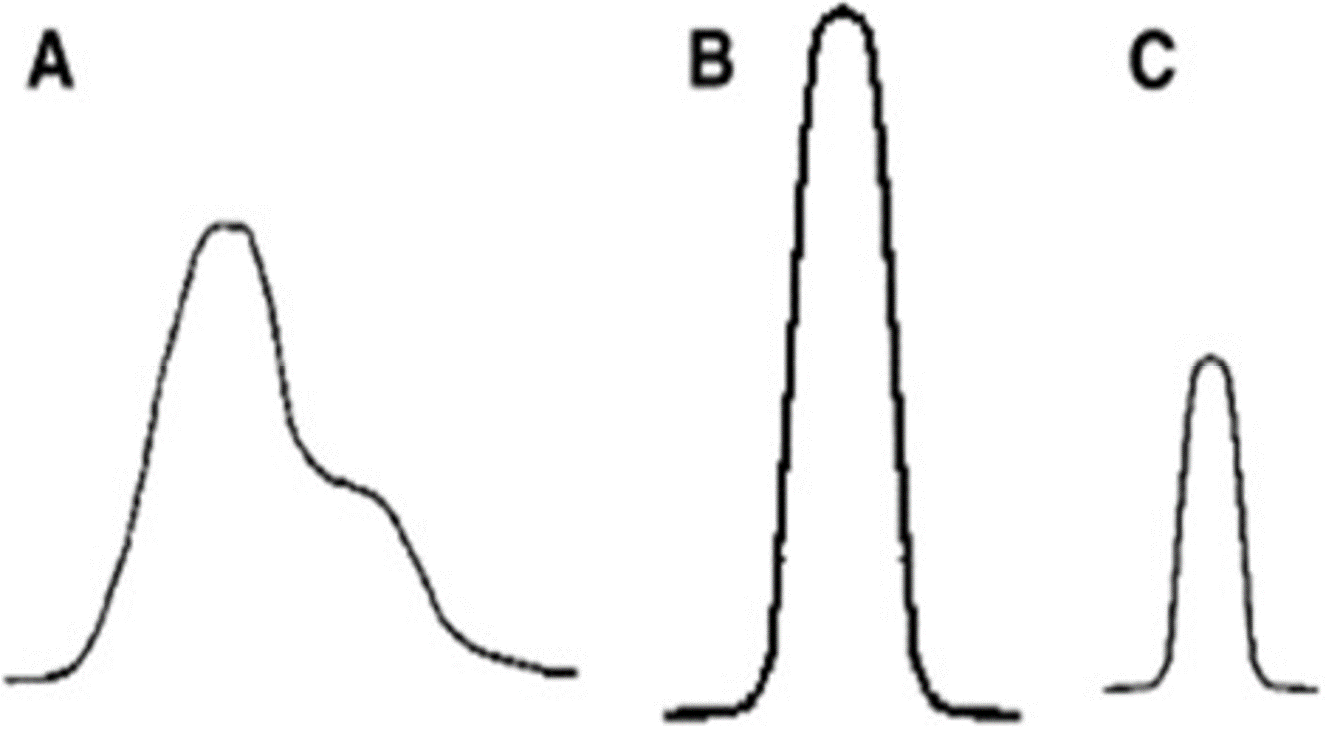
- A – normal pulse
- B – compensated shock, a reduction in SV but the body is trying to get it out of the body. Narrow but tall pulse
- C – decompensated shock, weak, thread pulses
When looking for shock - what should you look for with regards to core extremity temperature difference?
What is consistent with shock?
•Normally a temperature difference between central temperature and that of the extremities of less than 8°F or 4°C. Peripheral vasoconstriction causes the temperature in the extremities to approach an ambient level.
–Feel the toes, and note if they are cold. One can measure the extremity temperature in the toe web by placing a thermometer or temperature probe there and compressing the tissue over it. Compare this with the temperature obtained from a central location (usually rectal).
–Be alert for the presence of cold pelvic limbs in cats associated with peripheral cyanosis of the footpads, suggesting a saddle thrombus.
What are some scenarios that will cause hypovolaemia, dehydration and both?
- Terms regarding hydration status are often misused and this is not helpful to us when considering appropriate fluid type and speed of administration
- Majority of our emergency and critically ill patients are HYPOVOLAEMIC
–They have lost circulation volume and lost fluid from intravascular space
•In longstanding disease animals may be both HYPOVOLAEMIC AND DEHYDRATED
–Dehydration – fluid sucked from cells and interstitial space
- Dogs left in hot cars and those animals’ with severe burns, DEHYDRATION is likely to be the primary fluid loss (cats with renal failure)
- We are extremely good at assessing hypovolaemia, but very poor at identifying dehydration
What is dehydration?
How can you assess it?
- Describe a loss of electrolytes and water from the interstitial and intracellular spaces
- Skin turgor (elasticity) BUT depends on the amount of fluid as well as fat in the skin and subcutaneous tissues – lots of variabilities!
–Does reduce with age as collagen and elastin concentrations change.
–Normally hydrated thin patients, older patients and certain breeds with ‘lots of skin (e.g. Bassett hounds and Sharpei) have decreased skin turgor
–Obese patients have increased skin turgor
–Puppies and kittens have increased total body water, and their skin turgor is normally greater than that of an adult.
•Gently lift the skin over the back just behind the scapula
–let it return to its resting position (normal <2 seconds)
–Slowness of return is correlated to various degrees of dehydration
–Mild – 2-3 seconds (5%)
–Moderate – 3-5 seconds (7%)
–Severe - >5 seconds (12%)
Why should you take care with certain methods of assess dehydration?
How can you overcome these issues?
- Take care in interpreting the skin turgor over the dorsal neck, because the skin in this area normally returns to its resting position more slowly than skin over the back
- Assess the moistness of the mucous membranes
–That’s okay unless they have increased salivation or they are nauseous – they have moist MM when they shouldn’t – look at cornea and conjunctiva
- Interpret changes in light of the effects of other conditions, such as nausea, which causes increased salivation, and azotaemia, which causes dry oral mucous membranes
- Observe the cornea and conjunctivae for moistness suggesting adequate tear production
Distinction between hypovolaemia/ hypovolaemic shock and dehydration – why do we care?
- Will influence order of likely differential diagnoses
- May change fluid choices
–Certain fluids are contra-indicated in dehydration
–Hypertonic saline not for use in dehydration!
–If hypovolaemic – need to rapidly expand intravascular space. If dehydrated, need to be a slower increase so it has time to diffuse into extracellular spaces and expand this slowly etc.
- Will change required fluid resuscitation rates
- Will change DD and treatment choices!
What should we do with regards to pain relief in ECC?
- There is a high likelihood that an emergency or critically ill patient is in pain.
- Observe the patient’s behaviour and response to stimulation, bearing in mind species and breed differences.
- Observe for painful responses to manipulation or palpation.
- Assume that the patient is in pain until proven otherwise especially if you identify a disease or injury that would be painful to you
- Adequate analgesia also increases the likelihood that a thorough physical examination can be performed – so you can do a better job
What are some things we should consider with active bleeding? e.g. where can it be coming from?
•Exsanguinating external bleeding is usually obvious
–examine the entire patient
–palpate with the fingertips in heavily coated patients to identify all wounds and thus likely points of bleeding
- Substantial bleeding may occur into traumatised soft tissues (e.g. around fracture sites) especially in the smaller patient
- Nasal haemorrhage usually obvious, but substantial amounts of blood can be swallowed - haematemesis if severe
- Abdominal organs as highly vascular common source of internal bleeding
- Bleeding in the thorax may involve multiple sites - lung parenchyma, large or small airways, pericardial sac, pleural cavity
How can you look for active bleeding in a patient?
- If on the outside – simple! If internally and you given fluid bolus, they look brighter and HR comes down etc., then another fluid bolus – they don’t improve too much, then you give another fluid bolus and then they look worse – you have managed to increase BP and they feel better, then you give more and pop the clot and they start bleeding again
- Signs - Hypoperfusion and the space occupying effects of blood accumulation or excretion of blood in urine or faeces or from the nose.
- Internal bleeding suspected in patients that respond to initial fluid resuscitation and then deteriorate



-
CRS 1 Revision13
-
Infectious Respiratory Disease in Small Animals74
-
Bonzo has a cough..17
-
Freddie has Nasal Discharge26
-
A difficult pet show9
-
ECG revision26
-
Tracheostomy10
-
Coughing in SAs39
-
Foxy Eosinophilic bronchpneumopathy16
-
Help my dog can't breath32
-
Radiology quiz16
-
Thoracic Imaging 263
-
Thoracic imaging 338
-
Respiratory Tract Neoplasia in SA50
-
SA Airway Disease45
-
Approach to LRT Disease in SA48
-
Diseases and Conditions of the Avian Respiratory System47
-
Thoracic Radiography Quiz8
-
Lung Disease Gross Pathology25
-
SA surgery and nasal disease Wrap Up30
-
Respiratory Tract Disease in Small Animals28
-
Pleural Disease54
-
Respiratory Endoscopy35
-
Lower Airway Disease in Cats42
-
Feline Asthma (SDL)15
-
Chest Drains20
-
Sam The Dog Can't Breath6
-
Lung histopathology18
-
Small Animal respiratory parasites39
-
Blood Pressure SDL8
-
Dysrhythmias SDL41
-
SA Endocardial Disease58
-
The Ascitic Dog Cases11
-
Dysrhythmias Management25
-
Feline Cardiomyopathies52
-
Hypertension57
-
Canine Myocardial Disease53
-
Collapse, Weakness, Exercise Intolerance31
-
Cardiac Radiography50
-
Congenital Cardiac Disease48
-
Cyanosis35
-
Radiography of CRS8
-
Management of Heart Failure78
-
Heart Failure Problems10
-
Management Of Heart Failure 223
-
Echocardiograpy Images10
-
Pericardial disease in SA37
-
How to echo33
-
Pericardiocentesis5
-
Thoracic Surgery14
-
Cardiac Cases6
-
Felix11
-
AB selection for respiratory disease37
-
ECG generation14
-
ECG interpretation27
-
CPCR32
-
Triage58
-
Emergency and Critical Cases12
-
Important factors to consider in the emergency and critical care patient27
-
Traumatic Brain Injury38
-
Important factors to consider in the emergency and critical care patient COPY27
-
Nutrition for critically ill patients54
-
Anaesthesia For The Critical Patient: Is It Different?31
-
Critical patients monitoring37
-
CRS ECC Cases20
-
Formative questions46
-
Adrenal glands6
-
Pancreas4
-
Pituitary gland11
-
Thyroid and parathyroid7
-
Hyperglycaemia7
-
Canine hypoadrenocorticism30
-
Canine hyperadrenocorticism37
-
Hepatic lipidosis/ketosis/farm16
-
Feline DM34
-
Canine diabetes mellitus45
-
Diabetic Ketoacidosis27
-
Hypoglycaemia23
-
Feline hyperthyroidism37
-
Canine hypothyroidism34
-
Calcium disorders in SA25
-
Dermatology64
-
Endocrine cases29
-
PU/PD21
-
Uncommon endocrine disorders15
-
Bacterial skin disease43
-
Fungal skin disease22
-
Viral and protozoal skin disease23
-
Parasitic skin disease49
-
Autoimmune and immune mediated diseases of the skin32
-
Practical information14
-
Pattern analysis21
-
Allergic skin disease: pathophysiology and presentation18
-
Management of allergic skin disease29
-
Clinical signs of and approach to pruritus22
-
Appraoch to cutaneous masses35
-
Feline eosinophillic granuloma complexes11
-
Cytology of cutaneous masses28
-
FNA cytology practice7
-
Non-neoplastic masses21
-
Approach to alopecia27
-
Approach to pustular, papular, scaling and crusting skin disease36
-
Otitis48
-
Otitis available treatments and choice15
-
Otic surgery33
-
Dermatological therapeutic case discussion7
-
Feline specific aspects of dermatology18
-
Dermatology cases18
-
SA Anatomy Refresher17
-
Year 2 Formative (Revision)46
-
Introduction5
-
Clinical Approach To GI Disease in SA34
-
Sickly Dog35
-
Vomiting In Dogs and Cats54
-
Gastric Disease in Dogs and Cats57
-
Diagnostic Imaging of GI15
-
Practical: Dog anatomy32
-
SA GI radiography and Ultrasonography71
-
Management of SA oesophageal and gastric SA disease39
-
Pancreatitis43
-
Intro To Intestinal Disease72
-
SI Disorders in Dogs and Cats61
-
Chronic Diarrhoea in SA50
-
Management Plans for Vomiting SA16
-
Devising a Plan12
-
SA Large Intestinal Disease49
-
Why Is This Patient Vomiting Cases27
-
Approach to abdominal radiography21
-
Abdo surgery: intro and biopsy techniques38
-
Abdominal Palpation9
-
Sedation and GI plans for GI patient15
-
Abdominal radiology cases10
-
Weight loss and ascites58
-
Feline Liver Disease72
-
Liver Disease Introduction71
-
Chronic Liver disease in dogs51
-
SA Acute Liver Disease49
-
What Is Wrong With These Patients?19
-
GDV and Gastropexies54
-
Small Animal Acute Abdomen60
-
Abdominal surgery13
-
Feline infectious peritonitis40
-
Gastrotomy, Enterotomy and Enterectomy38
-
Liver, biliary tract and portosystemic shunts48
-
Surgical Diseases of The Oesophagus25
-
Anal and Rectal Conditions66
-
Hernias & Ruptures47
-
Oral tumours, oral surgery & stick injuries50
-
Rabbit Dental Disease15
-
Common Intoxications58
-
Peridontal Disease10
-
Toxiocology cases32
-
Extraction Technique28
-
Oral surgery: surgical extraction technique34
-
GI Disease in Herbivorous Rodents53
-
Formative27
-
Developmental and Genetic Dental Abnormalities9
-
Supporting the Poison Case34
-
Clinical Case10
-
Feline Oral Disease23
-
Pancreatic disease16
-
Bella and her liver16
-
Oral cavity exam33
-
Oral cavity trauma and infection32
-
Introduction COPY4
-
Erythroid110
-
Leukogram62
-
Leukaemia and Lymphadenopathy28
-
Anaemia54
-
Pathology of Lymphoid System58
-
Haemostatic Disease67
-
Diagnosis and Management of Lymphoid Diseases96
-
Immune Mediated Disease64
-
Viruses and Lymphoid System44
-
Blood Transfusions41
-
Formative assessment87
-
Revision practical16
-
Bone pathology51
-
Bone: Diagnostic Imaging70
-
SA MSK Radiography and Radiology20
-
Spine Head and Neck Imaging37
-
Autoimmunity37
-
Principles of Fracture Management 1125
-
Principles of fracture management 2100
-
Case: Bony swelling in dog16
-
NSAIDs58
-
Examination of the Lame Dog and Cat49
-
SA Joint Dx and OA51
-
Sprains and luxations46
-
Joint Treatment6
-
Decision making in Diagnostic Tests CR11
-
Antibiotics51
-
Bones and Joint Histology (and a few pics)28
-
Synoviocentesis7
-
Joint - Inflammatory Conditions60
-
SA bandaging30
-
Triage COPY19
-
Soft Tissue Trauma65
-
Radiology wrap up25
-
Orthopaedic infections46
-
CSGTR Flat Cat10
-
SA developmental disease66
-
SA Developmental Disease Part 260
-
Small Animal Distal Limb78
-
Surgical Planning2
-
Restricting Exercise8
-
SA Muscle Disease27
-
Muscle Pathology10
-
Post Op Managment60
-
SA Hindlimb51
-
SA Forelimb63
-
SA Trauma55
-
Salvage Procedures48
-
Neurodegenerative Disease33
-
Vascular Disease35
-
Neurology Infectious Diseases84
-
Ophthalmic Exam85
-
Conjunctiva and KCS60
-
Corneal Ulcers58
-
Pain Assessment17
-
Non-Notifiable Viral Disease44
-
Notifiable Neuro Viruses26
-
Neuropharmacology47
-
Eye and Disease30
-
Feline Ophthalmology32
-
Behaviour21
-
Ocular Emergencies40
-
Ocular Pharmacology81
-
Toxicities72
-
Inflammatory Disease59
-
Pain Treatment16
-
Neuropathology36
-
Neurosurgery37
-
Exotics Neurology17
-
Pharmacological Control Of Pregnancy and Parturition25
-
Formative COPY43
-
Principles of Pregnancy Failure14
-
Intro to repro pathology137
-
Principles of Cycle Manipulation32
-
Bitch and queen when to spay and why?25
-
Principles of managing dystocia45
-
Monkey (not even a monkey) at the clinic16
-
Approach to Examining the Female Tract42
-
Male Castration63
-
Principles of Contraception42
-
Principles of Neonate Care and Disorders of the Neonate37
-
Principles of therapeutics and anaesthesia in of the neonate and pregnant animal40
-
Reproductive Anaesthesia44
-
Reproductive anaesthesiaCase based seminar13
-
Approach to Examining the Male Reproductive Tract47
-
Reproductive Exam19
-
Facillitator Cases17
-
Spay practical notes28
-
The optimal mating time in the bitch22
-
Urinary Incontinence30
-
Clinical Research - Cystic Endometria Hyperplasia15
-
Diagnostic Methods in the Bitch and Queen82
-
When Will Sasha Have Her Pups?31
-
Abnormalities of pregnancy, parturition and puppies65
-
Abnormalities and Infertility in Female Small Animals45
-
Dystocia Cases31
-
Manipulation of Reproduction and Contraception45
-
Pregnancy Case studies - bitch13
-
First Opinion Reproduction Cases4
-
Unwanted Mating in the Bitch10
-
Pre-pubertal neutering14
-
Bitch Spay Complications21
-
Ovariectomy/Ovariohysterectomy34
-
Surgery of the Female Reproductive Tract34
-
Abnormalities of the Mammary Gland19
-
Peri-operative management and anaesthesia for pyometra in a dog28
-
Common Diseases and Surgery in the Male Dog and Cat37
-
Reproductive Tract Diagnostic Methods and Prostatic Disease in Males76
-
Imaging SA Repro43
-
Exotic reproduction44
-
Repro formative case 16
-
Repro formative case 24
-
Repro formative MCQ23
-
Evaluation of urinary tract disease54
-
Renal Physiology21
-
CKD & AKI26
-
Fluid Therapy9
-
Infectious Diseases7
-
Drug Choices and Therapeutics21
-
Blood Results28
-
Chronic kidney disease79
-
Acute Kidney Injury65
-
Urinary pathology98
-
Urinary Imaging112
-
Fluid therapy in urinary tract disease56
-
Diagnostic approach to polyuria and polydipsia (PUPD)48
-
Neoplasia of Urinary Tract62
-
Congenital And Neonatal Abnormalities82
-
Urinary tract infections39
-
Urinary Tract Disease in Reptiles and Birds85
-
Q and A with steve and jane3
-
Small Animal Urinary Tract Imaging Cases13
-
Interpreting Urinalysis Results48
-
Haematocrit stuff5
-
Crystal quiz9
-
Pu/Pd toolkit20
-
Lower Urinary Tract Disease60
-
Feline Lower Urinary Tract Disease, Calculi and Blocked Cats48
-
Urinary Tract Surgery11
-
Is It Incontinent?8
-
FLUTD7
-
Calculi in Dogs (and Other Pets)18
-
Hypertension/renal failure CR14
-
Practical urinary pathology14
-
FLUTD CR10
-
Contrast Radiographs16
-
Fluid Therapy In Practice36
-
Urinary Incontinence COPY32
-
Principles of urinary surgery53
-
CR Billy the dalmation18
-
Formative MCQ20
-
Formative clinical reasoning6



